Heritage & identity mapping
Cultural genogram: map your family heritage
Quick answer
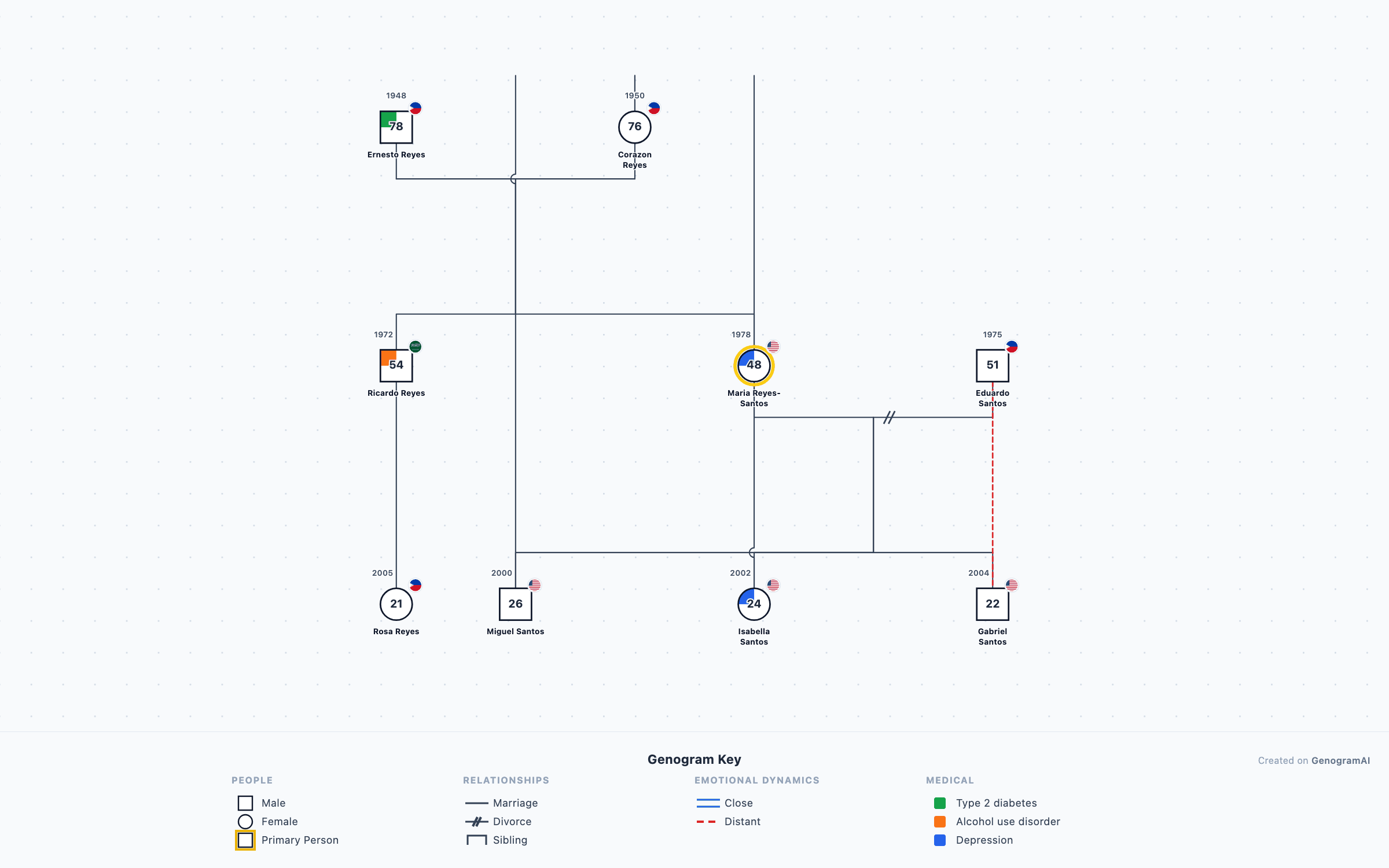
What is a cultural genogram?
A cultural genogram is a visual map of family heritage that goes beyond basic family structure to explore the cultural influences that shape identity. It documents ethnic backgrounds, religious traditions, languages, immigration history, and cultural practices across multiple generations.
Unlike standard genograms that focus primarily on relationships and medical history, cultural genograms emphasize the transmission of cultural identity. They help answer questions like: Where did my family come from? How has our cultural identity changed over generations? What traditions have been maintained or lost? How do different cultural backgrounds blend in multicultural families?
GenogramAI's Cultural View mode provides specialized tools for creating cultural genograms, including 9 heritage patterns you can layer and label, 13 religion options, 5 social class levels and 10 education levels: everything you need to map your family's cultural journey.
The Hardy and Laszloffy cultural genogram
The cultural genogram was introduced by Kenneth V. Hardy and Tracey A. Laszloffy in 1995 as a way to train culturally competent family therapists. Their method starts with the trainee's own family: defining the culture of origin, naming its organizing principles (the core beliefs that shape how the group thinks and behaves) and its pride and shame issues (aspects of the culture that are sanctioned as sources of pride or of shame), and then marking each cultural group on the genogram with its own colour or symbol, including where groups meet through intercultural marriage.
The point is not only the finished chart. Building it, and presenting it to a small group, surfaces the assumptions a clinician brings into the room, which is why the cultural genogram is still a standard assignment in counseling, MFT and social work programs.
What to include in a cultural genogram
Ethnic heritage
Religious traditions
Languages
Immigration history
Education & class
Cultural traditions
Benefits of cultural genograms
- Understand how cultural heritage shapes family dynamics
- Explore multicultural and bicultural identity development
- Identify patterns of acculturation and assimilation
- Discover cultural strengths and resources in family history
- Process immigration experiences and intergenerational trauma
- Celebrate cultural traditions and family heritage
- Bridge cultural gaps between generations
- Support culturally-informed therapy and counseling
Cultural genogram symbols
| Pattern | Name | Suggested use |
|---|---|---|
| Horizontal stripes | A first heritage group (often the paternal line). | |
| Vertical stripes | A second heritage group (often the maternal line). Layer with horizontal for dual heritage. | |
| Diagonal (right) | A third group, or a regional identity within a national one. | |
| Diagonal (left) | A fourth group; pairs visually with diagonal right. | |
| Crosshatch | A group the family identifies with strongly, or a host culture after migration. | |
| Dots | An Indigenous, tribal or clan affiliation alongside a national heritage. | |
| Waves | A diaspora or migration-defined identity. | |
| Braid | A blended or bicultural identity a person names as one. | |
| Checkerboard | Any additional group; strong contrast for print. | |
| Zigzag | Any additional group. | |
| Diamonds | Any additional group. |
| Layer | Options in GenogramAI | How it is shown |
|---|---|---|
| Religion | Christian, Catholic, Orthodox, Mormon, Jehovah's Witness, Jewish, Muslim, Buddhist, Hindu, Sikh, Spiritual, None, Other (13), plus a non-practicing marker | A small badge with the faith's symbol on the person |
| Social class | Upper, upper-middle, middle, working, poverty (5) | A class marker, shown when Social View is on |
| Education | No formal schooling through doctorate and professional degrees (10 levels) | A short badge, plus free text for schools |
| Migration | Country of origin and dates | Labels on the person; a note on the line between generations |
| Language | Free text | Label on the person (heritage language, language lost) |
Tip for dual heritage
Cultural genogram questions
Origins and migration
- What ethnic or cultural groups make up your family?
- Where did each side of the family come from, and when and why did they migrate?
- Which languages were spoken in each generation? Which were lost?
- Were there refugee, forced migration or displacement experiences?
Organizing principles
- What beliefs most shape how your culture thinks and behaves?
- How are gender roles, elders and children defined?
- What does your family believe about family loyalty and obligation?
- What role does religion or spirituality play?
Pride and shame
- What aspects of your culture are sources of pride?
- What is considered shameful, and how is shame handled?
- What experiences of racism, prejudice or discrimination has your group faced?
- How does your family view other groups?
Blending and change
- If your family includes more than one culture, how were differences negotiated?
- Which traditions have been kept, adapted or dropped?
- How has social class or education changed across generations?
- How do you identify today, and how does that differ from your parents?
More prompts for the rest of the genogram interview are in genogram questions for therapy.
Cultural genogram examples
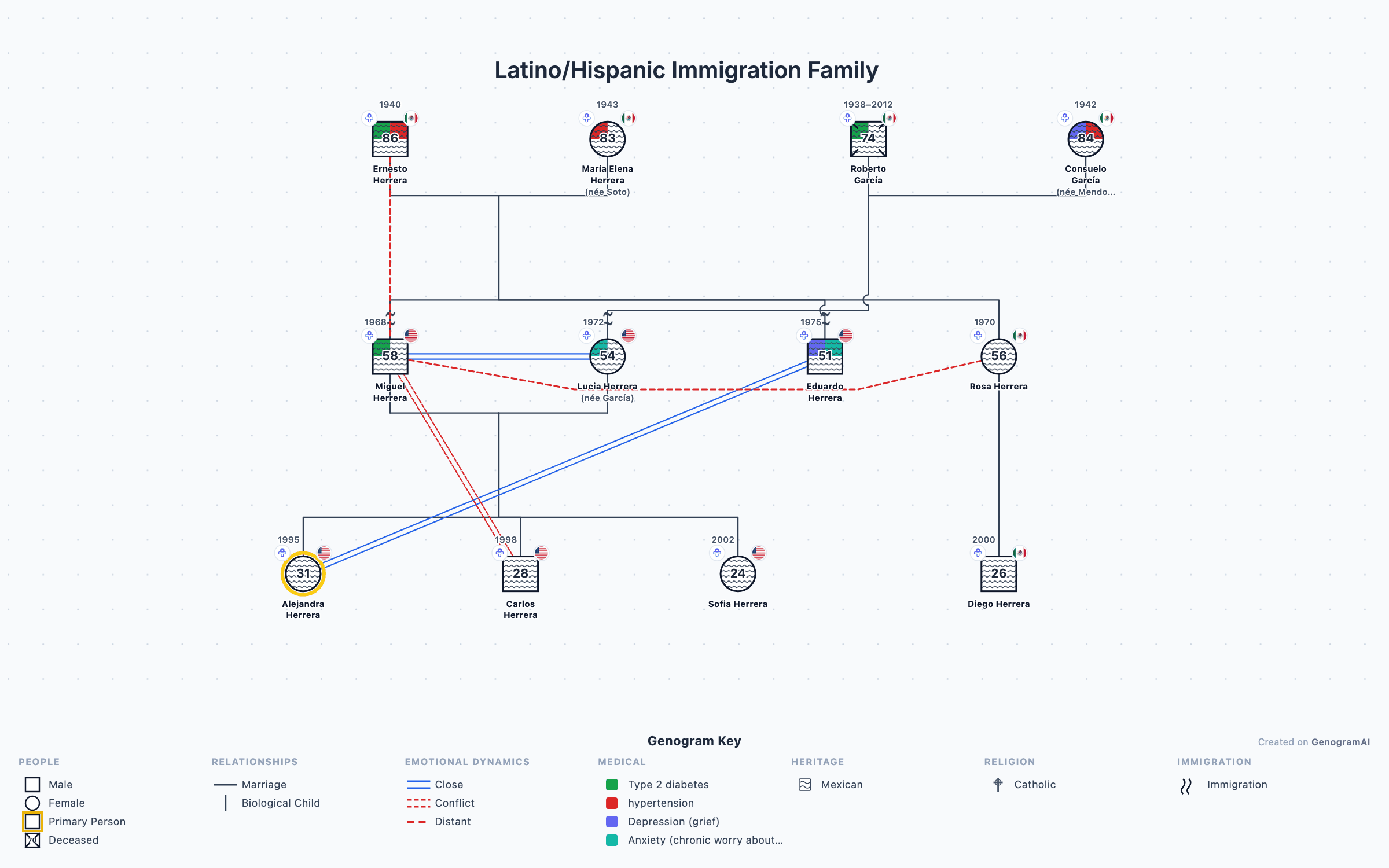
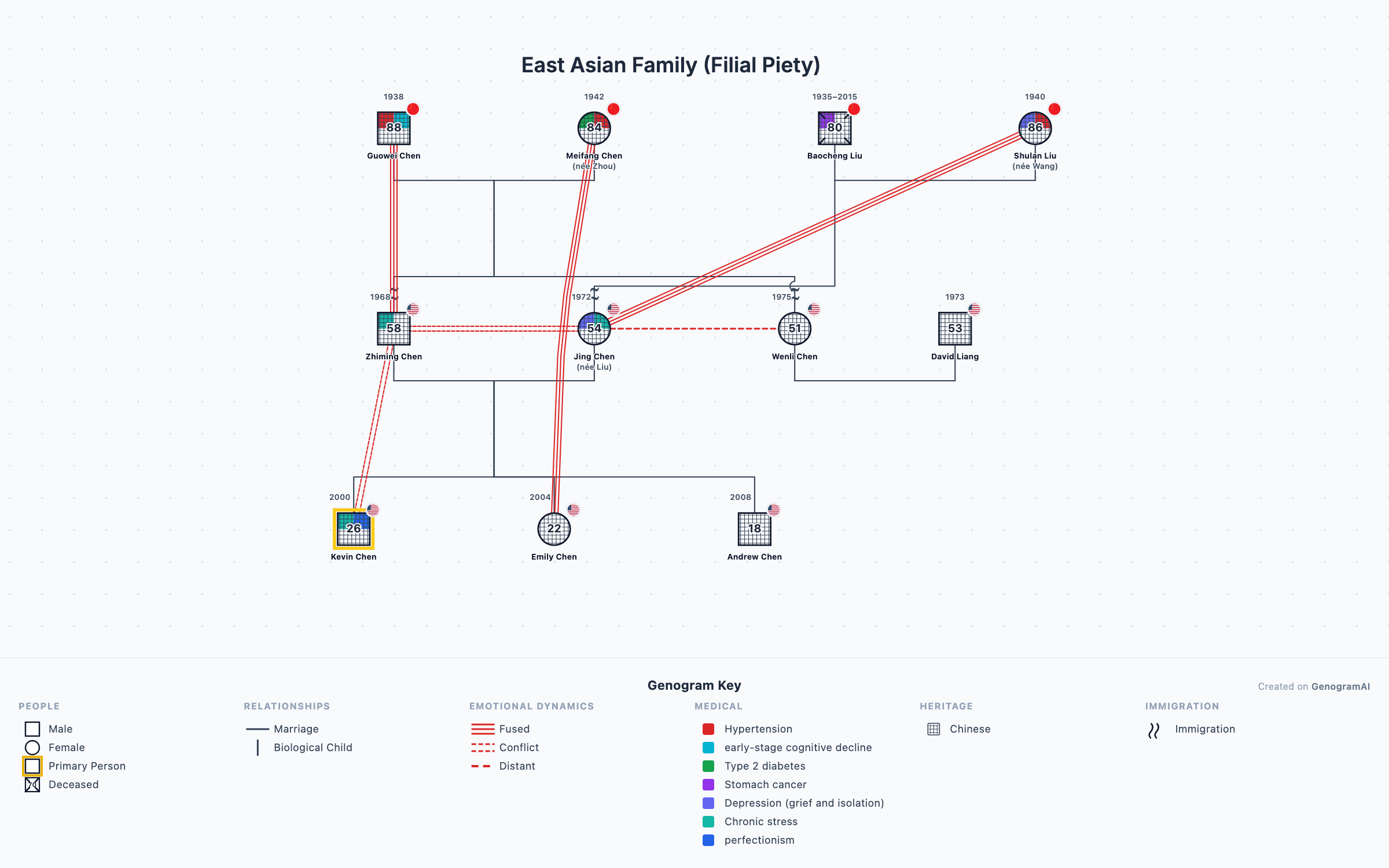
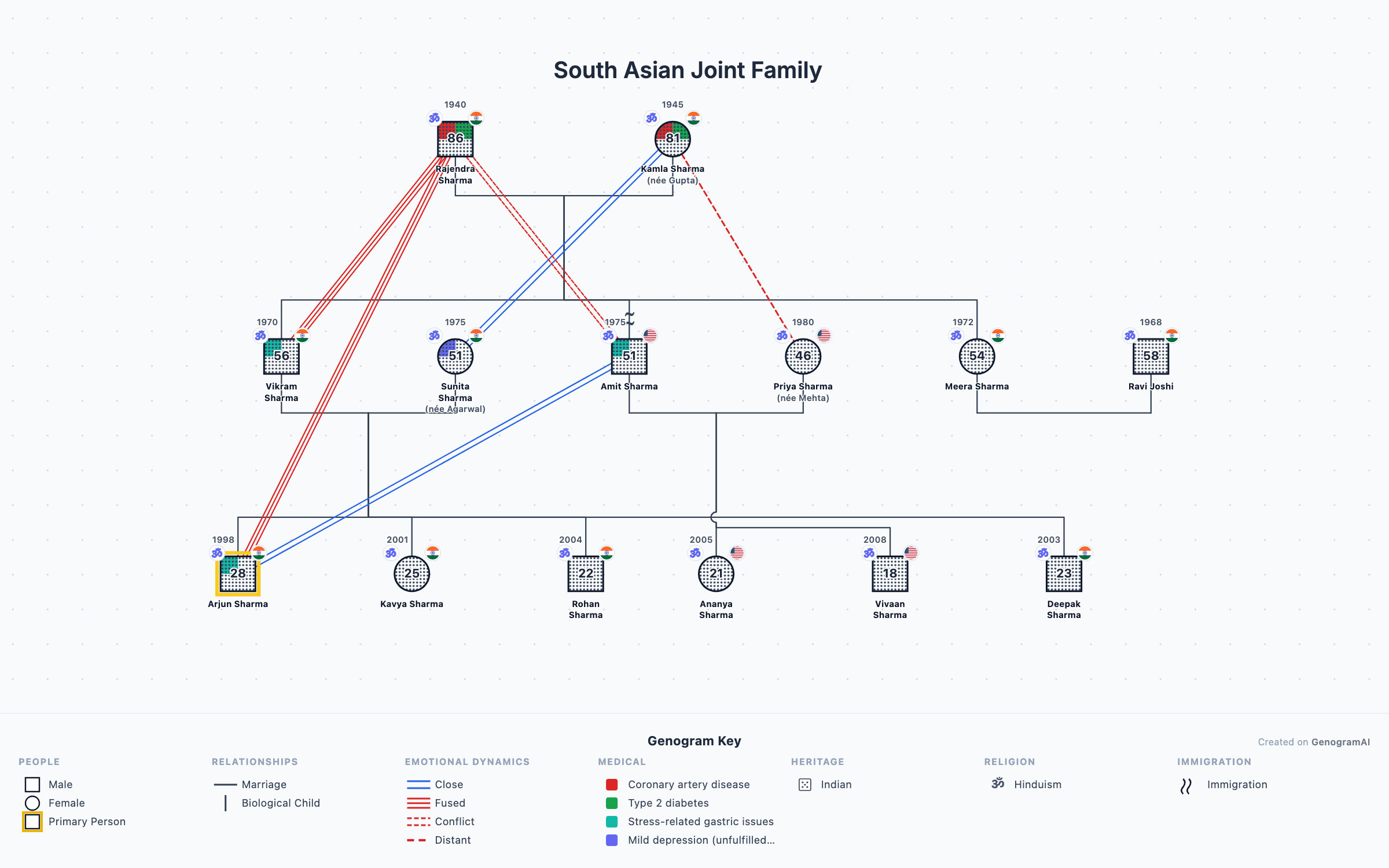
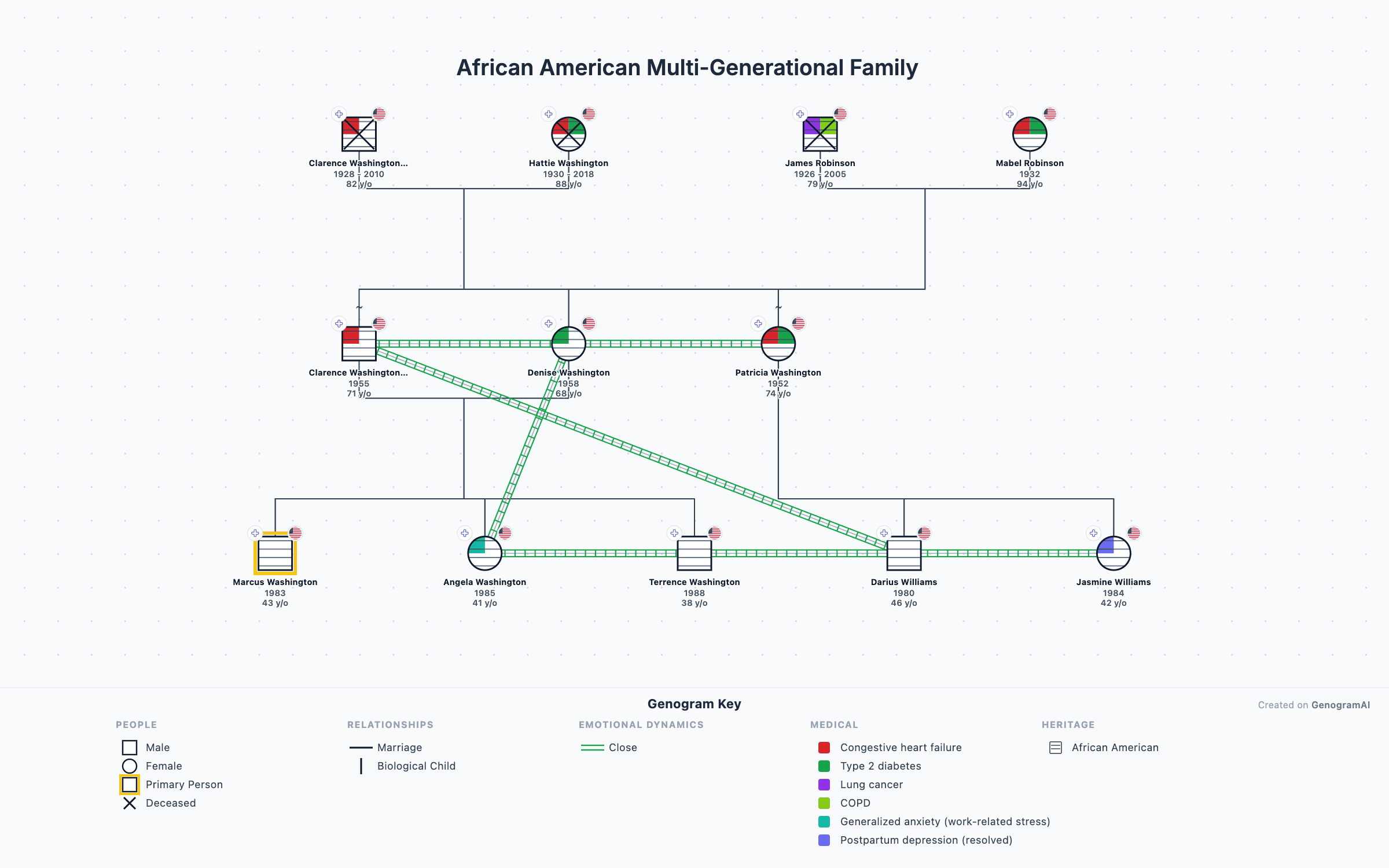
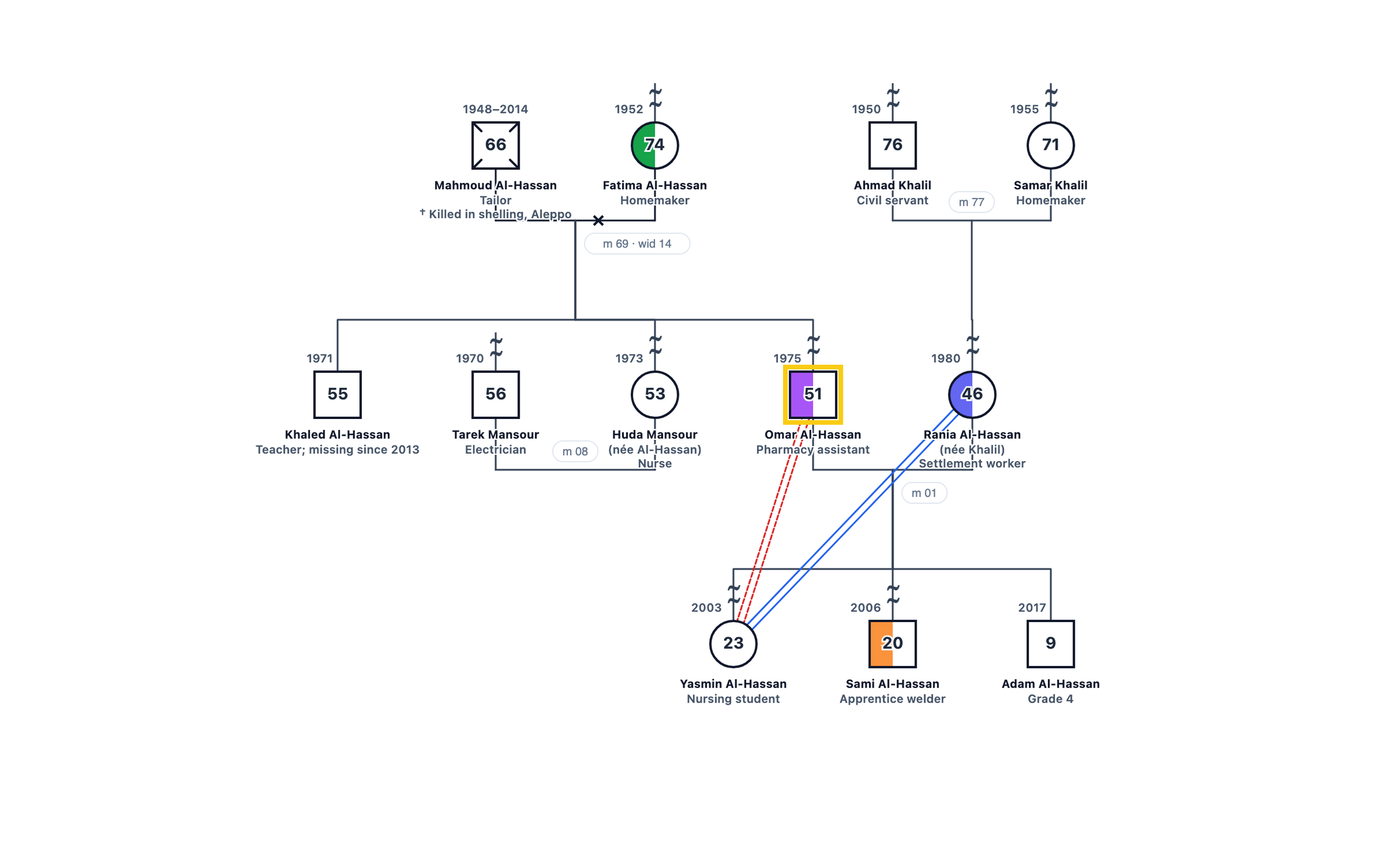
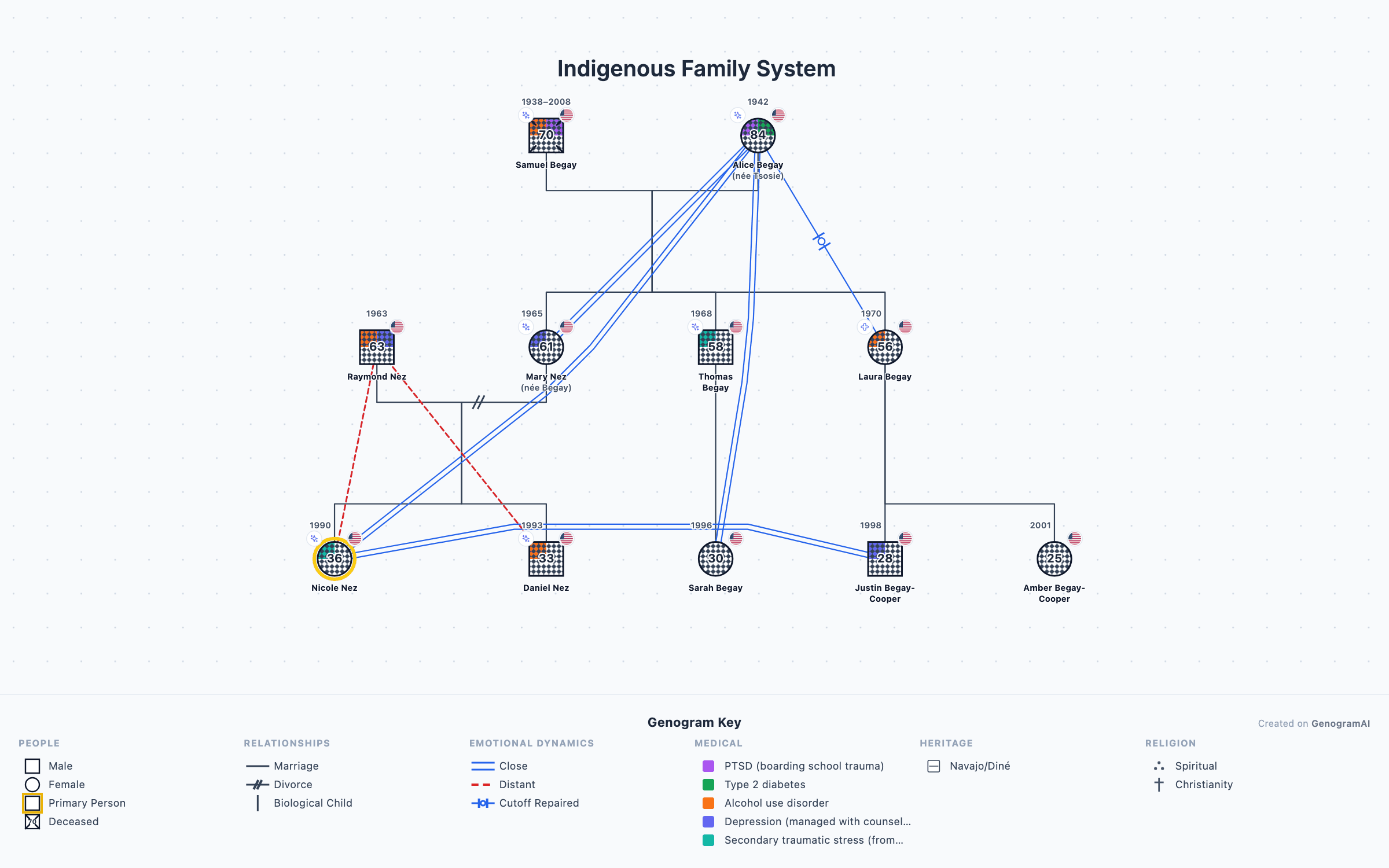
Cultural genogram vs culturagram
| Cultural genogram | Culturagram | |
|---|---|---|
| Introduced by | Hardy & Laszloffy (1995) | Elaine Congress (1994) |
| Shape | A genogram with heritage, religion and class layers | A one-page diagram with the family at the center and ten areas around it |
| Time span | Three or more generations | The family now |
| Typical use | Clinician self-awareness training; family therapy | Social work assessment of immigrant families |
| Covers | Culture of origin, organizing principles, pride and shame, intercultural marriage | Reasons for migration, legal status, time in community, language, health beliefs, holidays, crisis events, values, contact with institutions |
Many practitioners use both. See genogram vs culturagram for a full comparison.
Who uses cultural genograms?
Therapists & counselors
Individuals & families
Multicultural families
Immigration counselors
Cultural genogram FAQs
What is a cultural genogram?
A cultural genogram is a specialized type of genogram that focuses on cultural, ethnic, and heritage information across generations. It maps cultural backgrounds, religious traditions, languages spoken, immigration patterns, and how cultural identity has been transmitted through the family. Cultural genograms help individuals understand how their heritage shapes their identity and worldview.
Who created the cultural genogram?
Kenneth Hardy and Tracey Laszloffy introduced the cultural genogram in 1995, in the Journal of Marital and Family Therapy, as a training tool for culturally competent family therapists. Their method asks trainees to define their culture of origin, its organizing principles and its pride and shame issues, and to mark each cultural group on the genogram with its own colour or symbol.
How is a cultural genogram different from a regular genogram?
While a standard genogram focuses on family structure and relationships, a cultural genogram emphasizes cultural heritage, ethnicity, religion, socioeconomic status, and cultural traditions. It uses additional symbols and patterns to represent different cultural backgrounds and shows how cultural identity changes or blends across generations.
What symbols are used in a cultural genogram?
Cultural genograms add a fill pattern or colour to each person's symbol for each heritage group, so a person of dual heritage carries two patterns. Religion is shown with a small badge, and social class or education with a marker or label. Always include a legend, because there is no single fixed code for heritage patterns.
Who uses cultural genograms?
Cultural genograms are used by family therapists, multicultural counselors, social workers, genealogists, and individuals exploring their heritage. They're particularly valuable in cross-cultural therapy, immigration counseling, identity work, and understanding how cultural factors influence family dynamics. They are also a common assignment in counseling, MFT and social work programs.
What information goes in a cultural genogram?
A cultural genogram typically includes: ethnic/cultural background, country of origin, immigration history, languages spoken, religious affiliations, cultural traditions, socioeconomic status, education levels, and acculturation patterns. GenogramAI supports 9 heritage patterns, 13 religion options (with a non-practicing marker), 5 social class levels and 10 education levels.
Can I create a cultural genogram with GenogramAI?
Yes. GenogramAI includes a dedicated Cultural View mode that lets you map heritage patterns, religious backgrounds, languages, and socioeconomic factors. You can layer more than one heritage pattern on a person and label each one, so mixed-heritage family members read correctly, and the legend updates automatically.
Further Reading
- Hardy, K. V., & Laszloffy, T. A. — The cultural genogram: Key to training culturally competent family therapists. Journal of Marital and Family Therapy, 21(3), 227-237, 1995
- Congress, E. P. — The use of culturagrams to assess and empower culturally diverse families. Families in Society, 75(9), 531-540, 1994
- McGoldrick, M., Gerson, R., & Petry, S. — Genograms: Assessment and Treatment (4th ed.). W.W. Norton & Company, 2020