Free genogram maker
The free online genogram maker and creator that builds itself
Quick answer
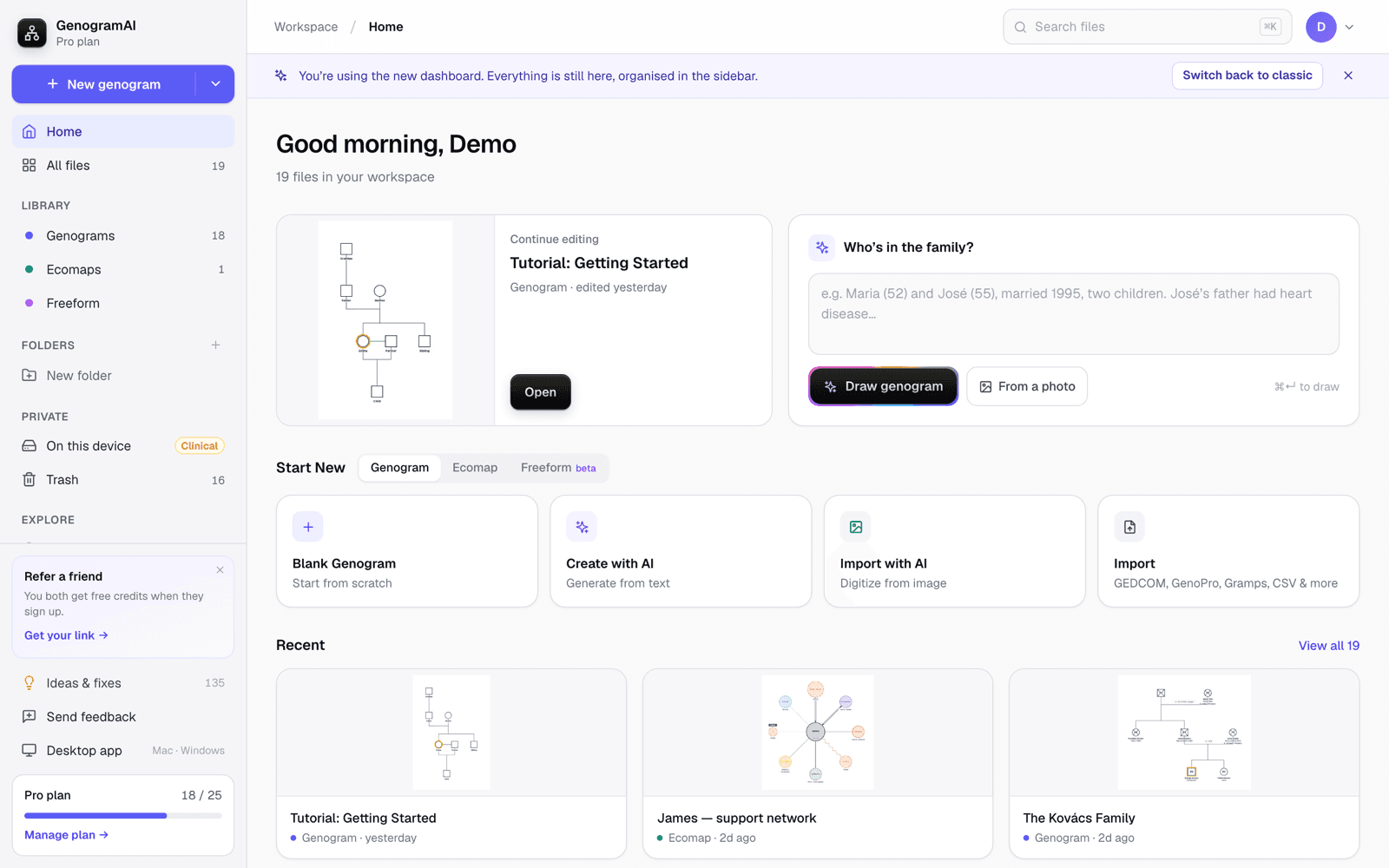
Try it yourself
Click any member to explore. Drag to rearrange. No learning curve.
Rodriguez-Chen family · 4 generations · Interactive preview
What is a genogram creator?
A genogram creator is specialized software that helps mental health professionals, medical practitioners and families visualize family relationships, medical history and emotional patterns across multiple generations. Unlike simple family tree makers, a genogram creator includes the standardized clinical symbols described by Monica McGoldrick, Randy Gerson and Sueli Petry for mapping relationship types, life events and health conditions.
GenogramAI is an online genogram creator that combines standard genogram notation with AI. You can describe your family in plain English and get a genogram with the correct symbols and relationships in seconds; on the Professional and Clinical plans you can also upload a photo of a hand-drawn diagram and have AI recreate it. Whether you're a family therapist or a social work student learning genogram construction, GenogramAI makes accurate genograms faster to build.
How to make a genogram online: 6 steps
- 1
Sign up for free
Create a free account at app.genogramai.com with your email. No credit card is required. The free plan includes 2 genograms, 5 AI credits a month, all 64 relationship types and PNG export. - 2
Choose how to start
On the dashboard, open Start New and keep the Genogram tab selected. Pick Blank Genogram to draw from scratch, Create with AI to generate from text (Professional and Clinical; on Free, use Ask AI inside a blank genogram), Import with AI to digitize a photo of a hand-drawn chart (Professional and Clinical plans), or Import to open a GEDCOM, GenoPro, Gramps or CSV file (also Professional and Clinical). - 3
Describe the family or add the first person
With Create with AI, type the family in plain words: names, ages or birth years, marriages, divorces, deaths and health conditions. AI draws the genogram with standard symbols. On a blank canvas, add the index person (the client or focal person) first, then their details. - 4
Build family connections
Select a person and use the quick-add buttons to add parents, partners, siblings and children. Structural relationships (marriage, divorce, separation, cohabitation, parent-child, adoption and more) are drawn with standard genogram notation and the layout arranges itself. - 5
Add emotional relationships, medical and cultural data
Draw emotional relationship lines between any two people (close, distant, hostile, fused, cutoff and more). Open a person to add medical conditions in the 4 quadrants, cultural heritage, religion, occupation and location. You can also ask the AI for one change at a time, such as 'mark Robert as deceased in 2010'. - 6
Export and share
Export a high-resolution PNG on any plan, with an automatic genogram key. Professional and Clinical plans add PDF, SVG and GEDCOM export. Print directly for session notes or coursework.
What does the AI genogram generator do?
Text to genogram (Create with AI)
Image to genogram (Import with AI)
AI editing
AI eco-maps
What you type
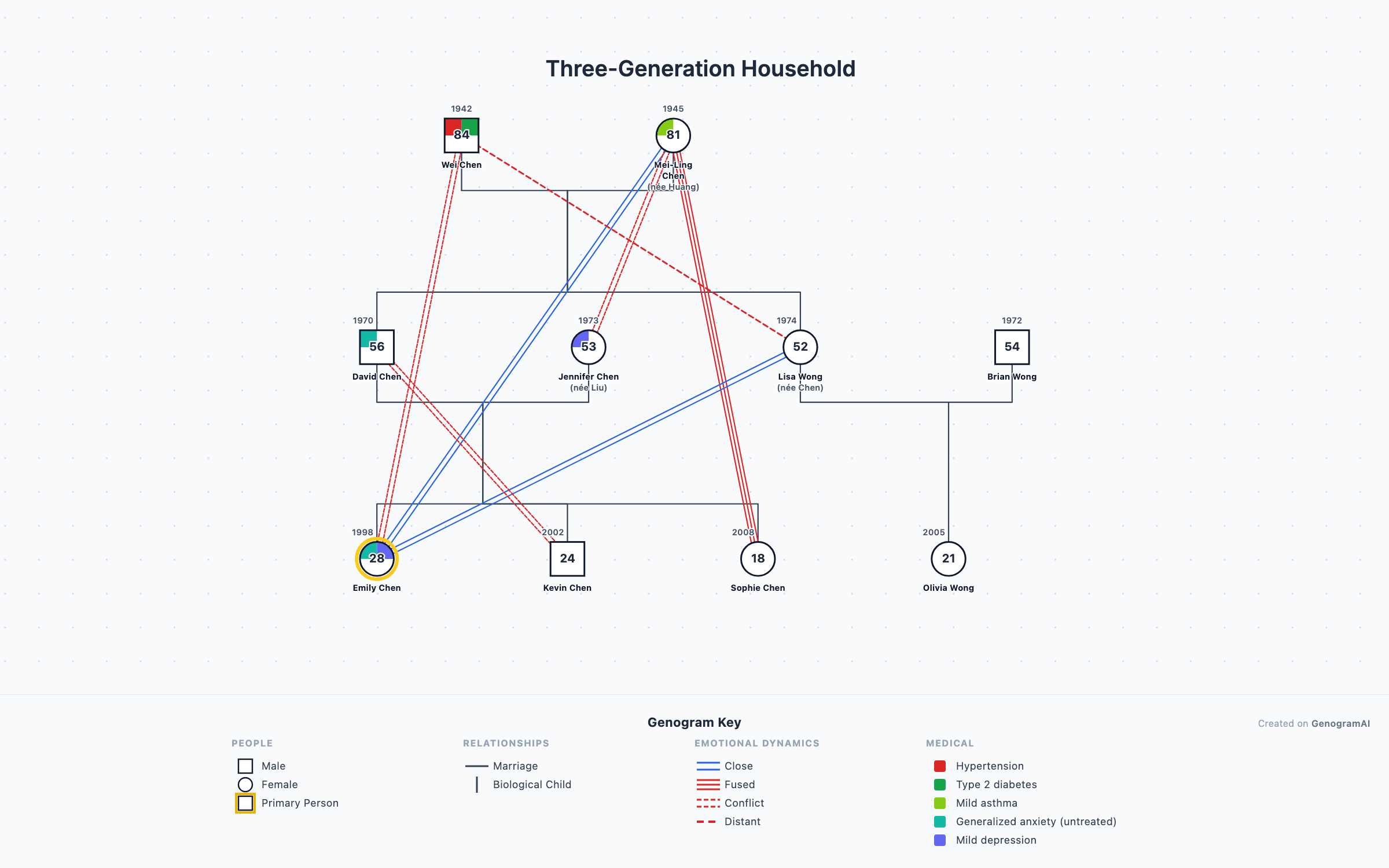
Is the genogram maker free? What each plan includes
| Free | Professional | Clinical | |
|---|---|---|---|
| Price | $0 | $12 / month, or $99 / year ($8.25 / month) | $29 / month, or $228 / year ($19 / month) |
| Genograms | 2 (up to 50 people each) | Up to 25 projects | Unlimited |
| AI generation and edits | 5 AI credits a month (shared with eco-maps) | Unlimited AI, plus AI Architect and Insights | Unlimited AI, plus AI Architect and Insights |
| Import a photo of a hand-drawn chart (Import with AI) | Not included | Included | Included |
| Import a GEDCOM, GenoPro, Gramps or CSV file | Not included | Included | Included |
| Relationship types | All 64 | All 64 | All 64 |
| Medical quadrants and cultural patterns | Included | Included | Included |
| Export | PNG | PNG, PDF, SVG, GEDCOM | PNG, PDF, SVG, GEDCOM |
| Encryption | AES-256 at rest (cloud) | AES-256 at rest (cloud) | Clinical Mode: AES-256-GCM zero-knowledge, offline storage |
| Desktop app | Browser only | Browser only | Native macOS app (Windows coming soon) |
| Freeform documents (beta) | Not included | Included | Included |
| Support | Standard | Priority | Priority |
Free
Professional, most popular
Clinical
Create any type of genogram
Family genogram
Emotional genogram
Medical genogram
Therapy genogram
Why choose our genogram creator?
AI-powered generation
64 relationship types
4 medical quadrants
Cultural heritage patterns
Secure and private
Professional export
Watch: build a genogram in minutes
Prefer chapters, or short lessons on a single task? See the genogram tutorial video page.
Who uses our genogram creator?
Family therapists
Medical professionals
Clinical social workers
Counselors and psychologists
Marriage and family counselors
Students and educators
Rooted in decades of clinical practice
| Year | Milestone |
|---|---|
| 1970s | Murray Bowen and colleagues draw family diagrams to map emotional process across generations, the forerunner of the genogram. |
| 1985 | Monica McGoldrick and Randy Gerson publish Genograms in Family Assessment (W.W. Norton), standardizing genogram symbols. |
| 1999 | 2nd edition, Genograms: Assessment and Intervention, with Sylvia Shellenberger. |
| 2008 | 3rd edition, with Sueli Petry. |
| 2020 | 4th edition, Genograms: Assessment and Treatment (McGoldrick, Gerson and Petry), the current reference. |
| Today | Digital genogram makers add automatic layout, medical quadrants, export and AI generation from a text description. |
Where genograms are used
- Marriage and family therapy: a core assessment tool in systemic family therapy training and practice
- Social work: used in MSW programs to teach family-centered assessment and case documentation
- Medical genetics: pedigree charts, a close relative of the clinical genogram, document hereditary conditions
In education
- Nursing education: family health history genograms are common in BSN and MSN coursework
- School counseling: three-generation genograms support student family assessments
- Clinical psychology: intergenerational genograms are used in doctoral training for systemic assessment
How GenogramAI compares
| GenogramAI | GenoPro | SmartDraw | EdrawMax | Canva | |
|---|---|---|---|---|---|
| AI builds the genogram from a description | Yes, from text; photo import on paid plans | No | No | No | No |
| Standard genogram (McGoldrick-style) notation | Built in: 64 relationship types | Partial | Basic shapes | Basic shapes | None, generic shapes |
| Works in the browser, no download | Yes | No, Windows desktop only | Yes | Yes | Yes |
| Free tier | Yes, 2 genograms free | Trial only | Trial only | Limited free | Yes, but manual drawing |
| Emotional relationship lines | Built in, standard line styles | Yes | Manual lines | Manual lines | Manual lines |
Full head-to-head reviews: GenogramAI vs GenoPro, vs SmartDraw, vs EdrawMax, vs Canva, and the top 10 genogram tools compared. Switching from GenoPro? Read the GenoPro alternative guide.
GenogramAI vs other genogram software at a glance
| Feature | GenogramAI | Others |
|---|---|---|
| AI generation from text | Yes | No |
| Image to genogram | Yes (Professional and Clinical) | No |
| Online (no download) | Yes | Some |
| 64 relationship types | Yes | Limited |
| Medical quadrants | Yes | Some |
| Cultural patterns | Yes | No |
| Cloud storage | Yes | Some |
| Free tier | Yes | Limited |
Learn genogram symbols
Create genograms anywhere
Web app
Tablet and phone
Cloud sync
Zero-knowledge option
Genogram examples created with the AI genogram maker
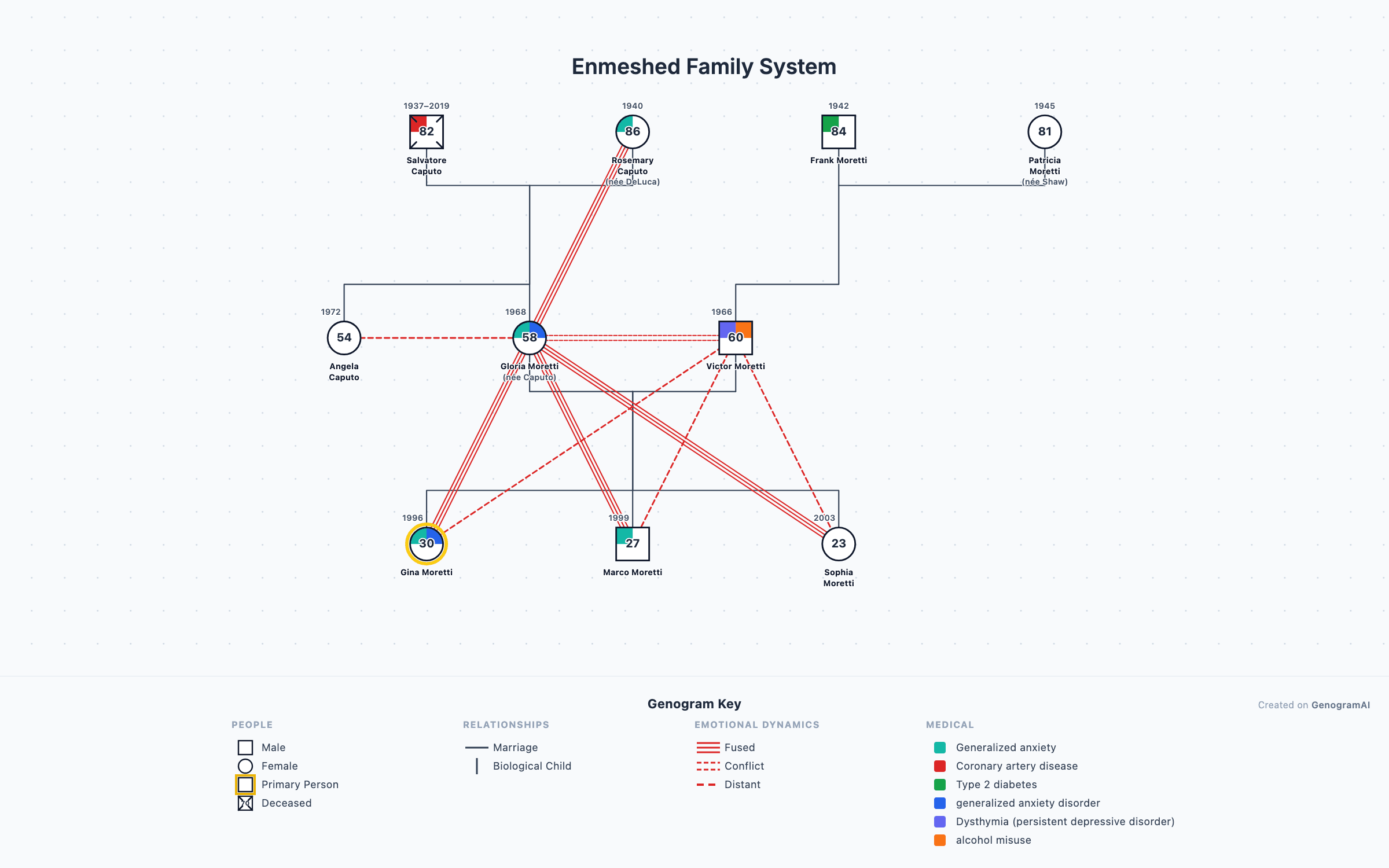
Enmeshed Family System
Clinical genogram showing fused emotional boundaries and over-involved relationships between generations.
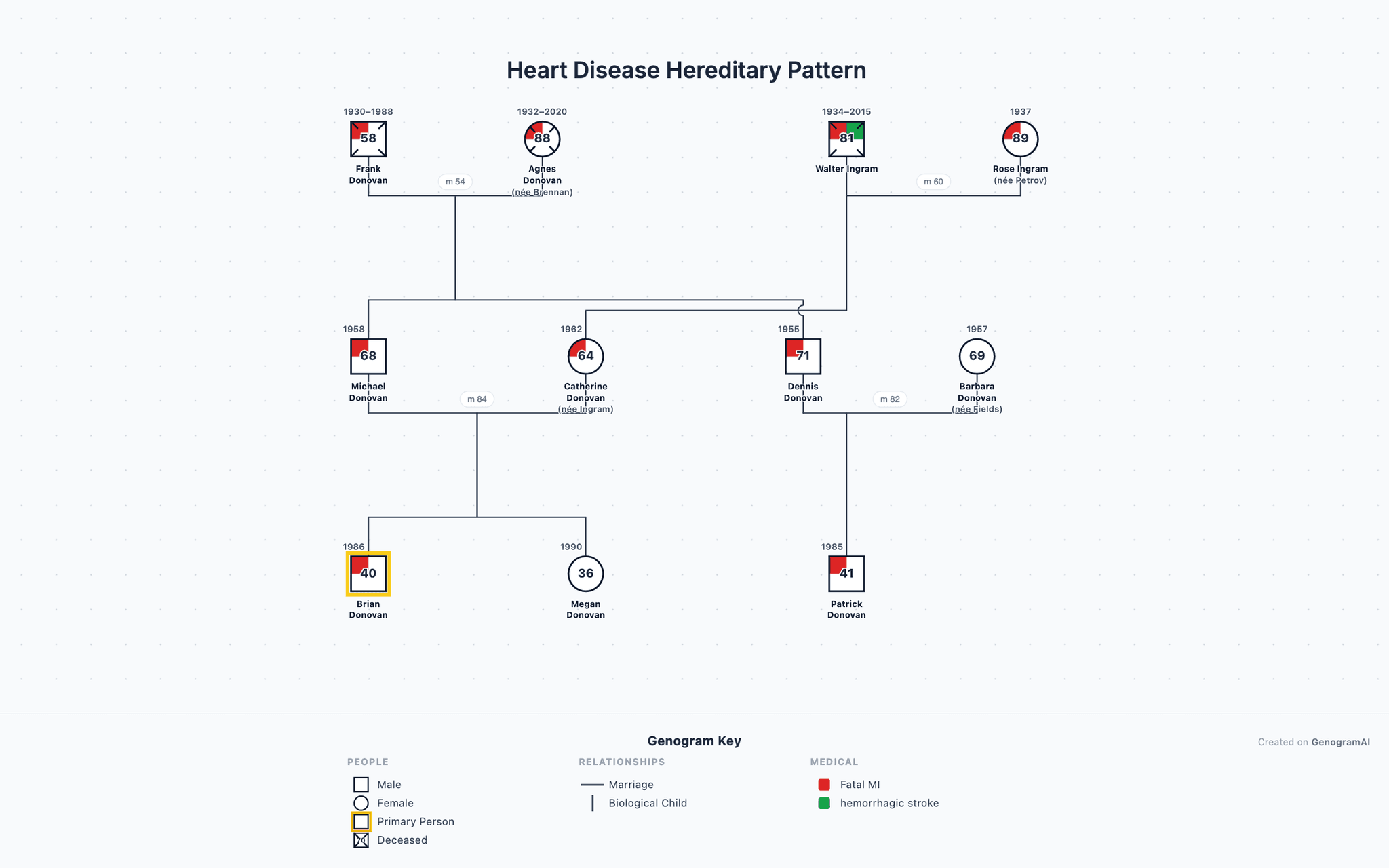
Heart Disease Pattern
Three-generation medical genogram tracking heart disease using the four-quadrant medical notation system.
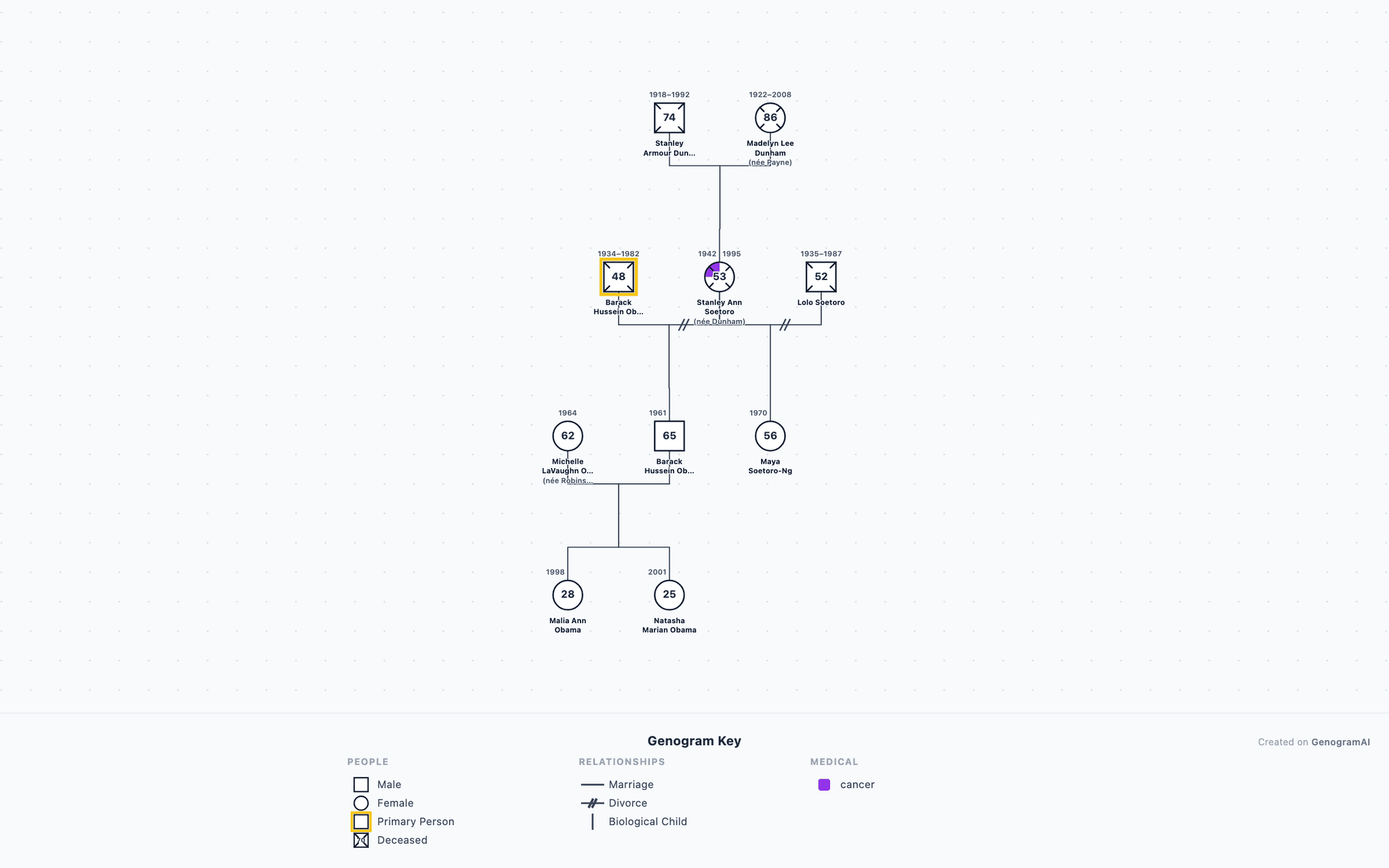
Barack Obama Genogram
Multicultural three-generation genogram of the Obama family, useful for teaching cross-cultural family structure.
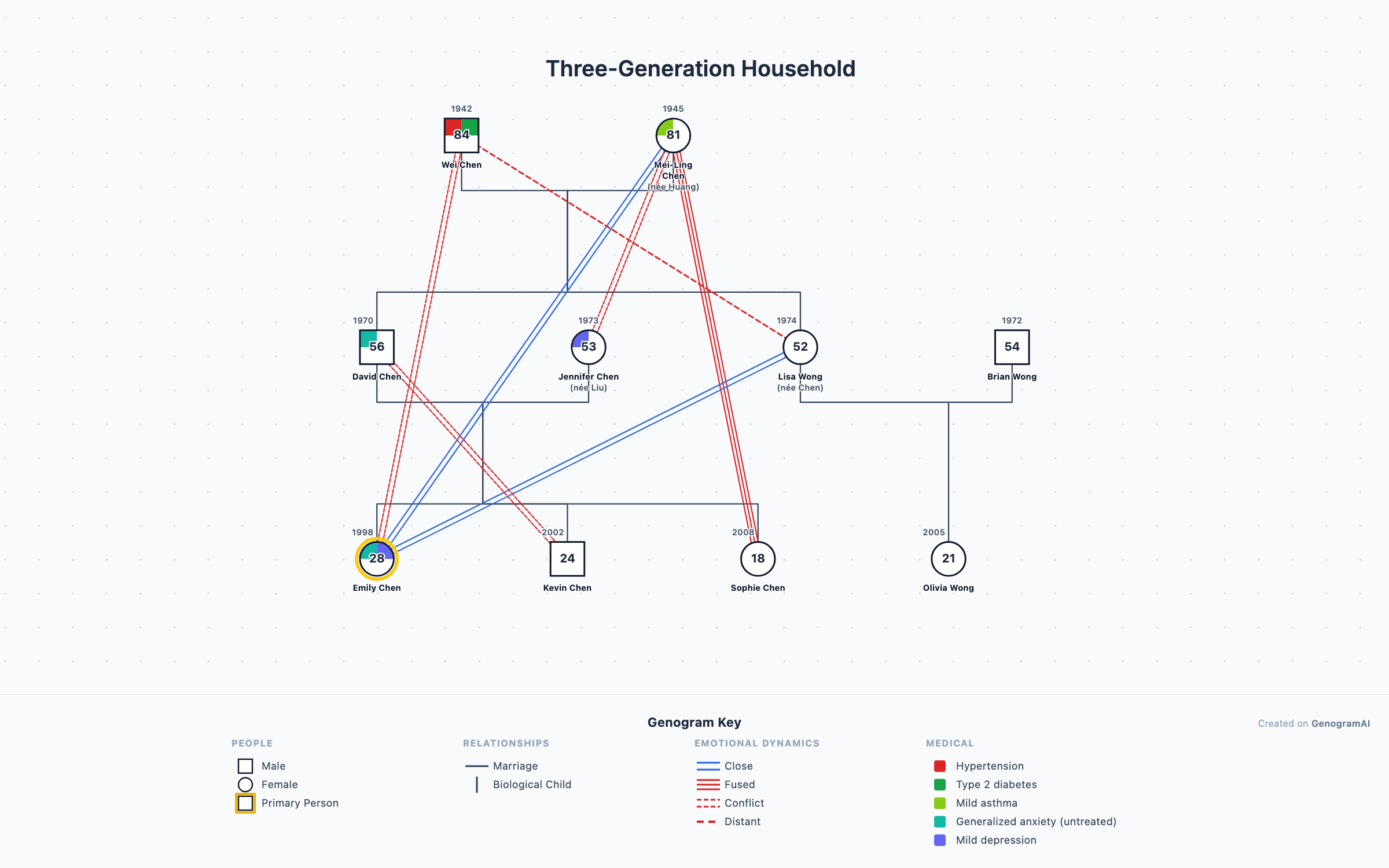
3-Generation Template
The standard three-generation genogram layout used in nursing and family therapy assignments.
Frequently asked questions
What is the best free genogram creator?
For clinical genograms, a dedicated tool beats a general diagram app because the symbols are built in. GenogramAI is a free online genogram creator with AI generation from a text description, 64 relationship types (18 partnership, 39 emotional and 7 child connection types), 4 customizable medical quadrants, cultural heritage patterns and PNG export. The free plan includes 2 genograms and 5 AI credits a month; importing a photo of a hand-drawn chart and PDF/SVG export are on the paid plans. No download is required.
Is there a free genogram generator?
Yes. GenogramAI's free plan works as a genogram generator: type a description of the family (names, ages, marriages, divorces, deaths, health conditions) and AI draws the genogram with standard symbols. Each build or AI edit uses AI credits; the free plan includes 5 AI credits a month, shared with AI eco-maps. You can also draw by hand on the canvas without using credits.
Can I create a genogram online for free?
Yes. GenogramAI lets you create up to 2 genograms completely free with no software download required. Sign up with your email and start creating genograms directly in your web browser. The free plan includes 5 AI credits a month, all 64 relationship types, medical quadrants and PNG export, and your genograms are saved to the cloud automatically. No credit card is needed.
How do I make a genogram online?
Sign up free at app.genogramai.com. On the dashboard, under Start New > Genogram, choose Blank Genogram to draw it yourself, Create with AI to generate it from a text description (paid plans; on Free, open a blank genogram and use Ask AI in the editor), Import with AI to digitize a photo of a hand-drawn chart (paid plans), or Import to open a GEDCOM, GenoPro, Gramps or CSV file (also a paid feature). Then add relatives with quick-add, draw emotional relationship lines, add medical conditions, and export a PNG.
Can AI make a genogram?
Yes. In GenogramAI you describe the family in plain words, for example 'Maria (52) and José (55), married 1995, two children; José's father had heart disease', and AI builds the genogram with standard symbols, partner lines and medical markers. You can then ask the AI for one change at a time ('mark Robert as deceased in 2010') or edit the chart by hand. Always check AI output against what the client actually told you.
What makes GenogramAI different from other genogram creators?
GenogramAI builds the genogram for you with AI. You can describe your family in plain English and get a digital genogram in seconds, or, on the paid plans, upload a photo of a hand-drawn genogram and have AI recreate it. It also has a large relationship library with 64 relationship types, medical quadrants, cultural heritage patterns and an automatic genogram key.
Do I need to download software to create genograms?
No download is required. GenogramAI is a web-based genogram creator that runs in your browser on a computer, iPad, Chromebook or phone. Genograms are saved to the cloud with AES-256 encryption at rest. A native macOS desktop app is included with the Clinical plan; a Windows app is coming soon but not available yet.
How do I make a genogram for therapy?
Creating a therapy genogram with GenogramAI: 1) Sign up for a free account, 2) Start a Blank Genogram and describe the family to Ask AI in the editor (5 AI credits a month on Free), or use Create with AI on the dashboard on a paid plan, 3) Add family members with the quick-add buttons, 4) Connect them with structural relationships (marriages, divorces, parent-child), 5) Add emotional relationship lines (close, distant, hostile, cutoff and more), 6) Include medical conditions and cultural background, 7) Export as PNG for your clinical notes, or PDF/SVG on a paid plan.
What symbols are used in genograms?
Genograms use standardized symbols: squares for males, circles for females, horizontal lines for marriages and partnerships, vertical lines for parent-child relationships, and different line styles for emotional relationships (for example a double line for close, a zigzag for hostile, a dashed line for distant). GenogramAI follows the standard notation described by McGoldrick, Gerson and Petry and adds extra relationship types used in practice.
Can I create a genogram with medical history?
Yes. GenogramAI includes 4 customizable medical quadrants for tracking health conditions across generations. You can set your own labels for each quadrant (for example Heart Disease, Cancer, Diabetes, Mental Health) and color-code conditions so hereditary patterns are easy to see.
Is my data secure on GenogramAI?
Genograms saved to the cloud on every plan are encrypted with AES-256 at rest and sent over HTTPS. The Clinical plan adds Clinical Mode with AES-256-GCM zero-knowledge encryption: data is encrypted on your device and the keys never leave it, so GenogramAI's servers cannot read those files. Clinical eco-maps stay on the device.
What's the difference between a genogram and a family tree?
Both show family relationships, but genograms include much more information than family trees. Genograms display emotional relationships, medical history, behavioral patterns and family dynamics using standardized clinical symbols. Family trees mainly show lineage and birth and death dates. Genograms are used therapeutically to identify multigenerational patterns.
Can I create genograms on my phone or tablet?
Yes. GenogramAI is responsive and works in any modern web browser, so you can create and edit genograms on a phone, iPad, Chromebook or computer. Your work syncs across devices through cloud storage. A larger screen is easier for big multi-generation families.
What is the McGoldrick-Gerson notation system used in genograms?
The McGoldrick-Gerson notation is the most widely used convention for genogram symbols. Genograms grew out of Murray Bowen's family diagrams in the 1970s; Monica McGoldrick and Randy Gerson standardized the symbols in Genograms in Family Assessment (1985), and the book is now in its 4th edition (Genograms: Assessment and Treatment, 2020, with Sueli Petry). It defines symbols for gender (squares for males, circles for females), partner and parent-child relationships, life events, medical conditions and emotional relationships. GenogramAI follows these conventions descriptively and is not affiliated with the authors or publisher.
How do genograms differ from family trees for clinical use?
While family trees show biological lineage, clinical genograms go much further. They map emotional relationship quality (close, distant, conflicted, cutoff, enmeshed), medical history across generations, behavioral patterns such as substance use and mental health history, cultural and religious background, and significant life events. This depth makes genograms indispensable in family therapy, where understanding relational patterns is as important as understanding who is related to whom.
How are genograms used in nursing and healthcare?
In nursing and healthcare, genograms (related to pedigree charts and family health history forms) document hereditary conditions, chronic disease patterns and risk factors. Nursing students create genograms as assessments in family health nursing courses. Clinical nurses use them at intake to identify genetic risk factors. In primary care, three-generation genograms help clinicians screen for hereditary conditions like heart disease, cancer and diabetes.
What are intergenerational patterns in genograms?
Intergenerational patterns are recurring behaviors, conditions or relationship dynamics that appear across multiple generations in a family system. Common patterns identified in genograms include substance use histories, divorce and separation patterns, mental health conditions, communication styles, cultural and religious transmission, and occupational patterns. Murray Bowen's family systems theory holds that understanding these multigenerational patterns is foundational to family therapy.
Can I use GenogramAI for clinical documentation?
Yes. Licensed therapists, social workers and healthcare professionals use GenogramAI for clinical documentation. Cloud data is encrypted at rest, PNG export is free and PDF/SVG export is on paid plans, and the notation follows the conventions described by McGoldrick, Gerson and Petry. For identifiable client records, the Clinical plan's Clinical Mode keeps files zero-knowledge encrypted on your device. Always make sure your documentation practices meet your licensing board's requirements and privacy rules such as HIPAA in the US.
Trusted by professionals worldwide
"This app is incredible, it was extremely easy to use and navigate. I have told all of my classmates about it and they all used it. Thank you so much."
Rylea Victoria
Verified Google Review
"Makes it so easy! It leaves other AI platforms in the dust."
Jennifer Doty
Verified Google Review
"This app is absolutely amazing!"
Verified User
10/10 in-app rating
Used in 50+ countries · Thousands of genograms created · 4.6/5 · 1014 in-app ratings
Further Reading
- McGoldrick, M., Gerson, R., & Petry, S. — Genograms: Assessment and Treatment (4th ed.). W.W. Norton & Company, 2020.
- DeMaria, R., Weeks, G., & Twist, M. — Focused Genograms: Intergenerational Assessment of Individuals, Couples, and Families (2nd ed.). Routledge, 2017.
- Hardy, K.V. & Laszloffy, T.A. — The Cultural Genogram: Key to Training Culturally Competent Family Therapists. Journal of Marital and Family Therapy, 21(3), 227-237, 1995.
- Kerr, M.E. & Bowen, M. — Family Evaluation: An Approach Based on Bowen Theory. W.W. Norton & Company, 1988.