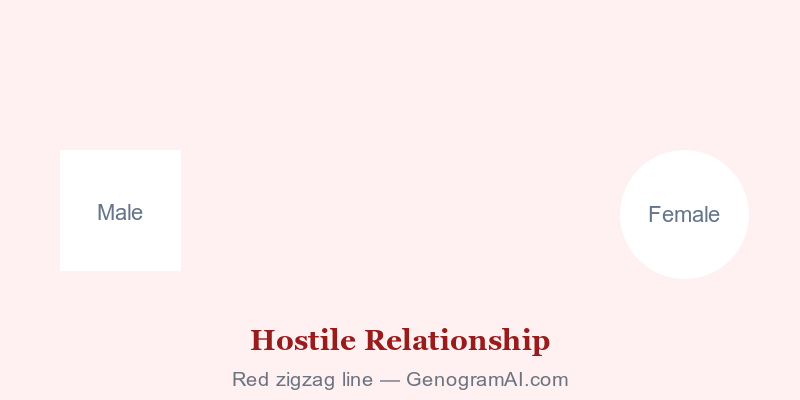
The hostile relationship symbol—depicted as a zigzag (jagged) line—represents active conflict, antagonism, and discord between family members. This symbol indicates relationships characterized by frequent arguments, tension, mutual animosity, or ongoing disputes.
Male
Female
Hostile/Conflict Relationship: Zigzag line (red)
What is a Hostile Relationship in Genogram Notation?
A hostile relationship in genogram terminology represents an emotional pattern characterized by ongoing conflict, antagonism, or discord. According to McGoldrick, Gerson, and Petry in "Genograms: Assessment and Treatment" (2020), "A zigzag line indicates conflict."
Conflict in family systems exists on a spectrum from occasional disagreements to chronic hostility. The hostile relationship symbol indicates relationships where negative interactions predominate—whether through open warfare, passive aggression, or chronic tension.
Standard Notation
The zigzag line is universally recognized in genogram notation as indicating conflict or hostility. The jagged nature of the line visually represents the "rough edges" and friction in the relationship. Red coloring is typically used to emphasize the negative nature of the pattern.
Types of Conflict in Family Relationships
Hostile relationships can manifest in various forms, each with different clinical implications and intervention approaches.
Open Conflict
Active arguments, shouting matches, and openly expressed anger. Family members directly confront each other.
Passive Aggression
Indirect hostility through silent treatment, subtle criticism, sarcasm, or undermining behaviors.
Chronic Tension
Persistent underlying hostility without open confrontation. "Walking on eggshells" atmosphere.
Recurring Disputes
Same issues resurface repeatedly without resolution. Arguments follow predictable patterns.
Clinical Significance
Conflict is a normal part of family life. However, chronic, unresolved, or destructive conflict significantly impacts family functioning and individual mental health. Understanding conflict patterns helps therapists:
Identify triggers and cycles that perpetuate hostility
Understand the function conflict serves in the family system
Recognize multigenerational patterns of conflict management
Develop targeted intervention strategies
Conflict and Family Systems
In family systems theory, conflict often serves to manage anxiety in the system. Conflict may stabilize a triangle, distract from other problems, or maintain homeostasis. Understanding this function is crucial before attempting to reduce conflict—removing conflict without addressing underlying anxiety may create problems elsewhere in the system.
Conflict Triangles
Murray Bowen's concept of triangulation is particularly relevant to understanding hostile relationships. When anxiety in a dyad becomes too intense, a third party is often drawn in to stabilize the system. Common conflict triangles include:
Parent-parent-child: Parents in conflict pull child to take sides
Spouse-spouse-in-law: Conflict with in-laws triangulating the spouse
Sibling-sibling-parent: Competition for parental attention/approval
Ex-spouse triangles: New partners drawn into ongoing conflict
Impact on Children
Research Findings
Extensive research documents the negative effects of parental conflict on children:
Increased anxiety and depression
Behavioral problems and academic difficulties
Impaired relationship skills in adulthood
Higher likelihood of conflict in their own relationships
Multigenerational Patterns
Conflict patterns frequently repeat across generations. When mapping genograms, look for:
Similar conflict patterns in parents' families of origin
Learned behaviors around expressing anger
Family scripts about how conflict "should" be handled
Transmission of specific conflict triggers (money, control, loyalty)
Conflict vs. Violence
It's important to distinguish between hostile relationships (conflict) and abusive relationships (violence). While both involve negative interactions:
Hostile/Conflict
Violence/Abuse
Mutual antagonism
Power imbalance, one-directional
Verbal disagreements
Physical harm or threat
Can be addressed in therapy
Requires safety planning first
Zigzag line symbol
Arrow symbol with zigzag
How to Use This Symbol in GenogramAI
Steps to Add a Hostile Relationship:
1Press E to activate the Emotional Relationship tool
2Click on the first family member
3Drag to the second family member
4Select "Hostile" or "Conflict" from the relationship type menu
5Document nature of conflict, triggers, and history in notes
Case Example
The Garcia Family: Rosa (45) and her sister Maria (42) have been in open conflict for 15 years since their mother's death. The dispute centers on inheritance, but genogram mapping reveals this conflict echoes their mother's relationship with her own sister. The sisters' children have been triangulated, splitting the extended family into two camps that don't speak.
Therapeutic intervention focuses on deconstructing the triangle, helping each sister own their part in the conflict, and exploring how their mother's unresolved sibling issues contributed to the current pattern.
Therapeutic Approaches to Conflict
Clinical Strategies
Identify the cycle: Map the sequence of triggering events, thoughts, feelings, and behaviors
Explore function: What does the conflict accomplish in the system?
Detrianglulate: Help individuals take direct positions without involving others
Build differentiation: Increase ability to tolerate differences without reactivity
Communication skills: Teach fair fighting and active listening
How do I distinguish normal conflict from problematic conflict?
Normal conflict involves occasional disagreements that get resolved without lasting damage to the relationship. Problematic conflict is chronic, involves the same unresolved issues, includes destructive behaviors, or significantly impairs relationship functioning.
Should both people in a hostile relationship be documented?
Yes. The zigzag line connects both individuals, indicating that conflict is typically a relational pattern involving both parties, even if one seems more "at fault." This systemic view is fundamental to family therapy.
Can hostile relationships change?
Yes. With therapeutic intervention, improved communication skills, and addressing underlying issues, hostile relationships can transform. This often requires both parties' willingness to change their patterns of interaction.