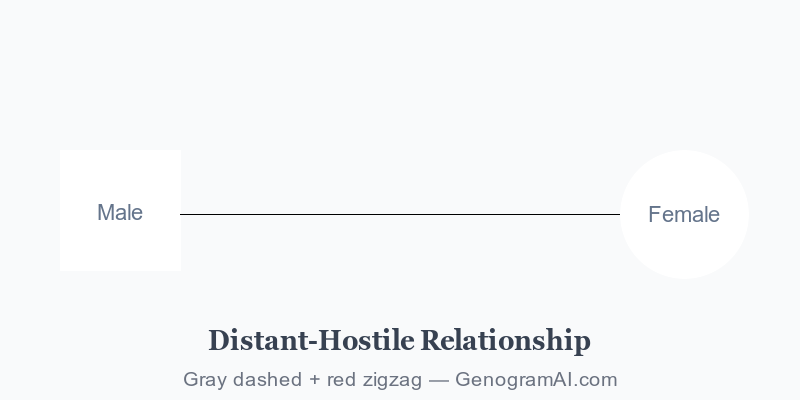
Understanding Distant-Hostile Dynamics
The distant-hostile pattern represents relationships where:
- Regular contact has been reduced or avoided
- When contact occurs, it quickly becomes hostile
- There's no warm middle ground—only absence or conflict
- May represent a step toward eventual cutoff
Common Presentations
- Estranged siblings who fight at family gatherings
- Divorced parents who can barely co-parent
- Adult children and parents with unresolved issues
- In-law relationships that have deteriorated
When to Use This Symbol
- High-conflict divorce co-parenting: When divorced parents have minimal contact but every interaction (custody handoffs, school decisions) devolves into argument, the distant-hostile symbol captures this volatile-yet-avoidant pattern better than either symbol alone.
- Family gathering dynamics: When two relatives avoid each other for months or years but reliably clash at family events — holidays, funerals, weddings — this compound symbol documents the alternation between avoidance and confrontation.
- Deteriorating relationships heading toward cutoff: Distant-hostile often represents a transitional stage. Documenting it helps clinicians track whether the relationship is stabilizing, improving, or progressing toward full disconnection.
How This Differs From the Hostile Symbol
The hostile and distant-hostile symbols both involve conflict, but they describe different relational patterns:
- Hostile relationships involve regular contact that is predominantly conflictual. The people are engaged with each other — they fight, argue, and clash because they are still in each other's lives.
- Distant-hostile relationships involve withdrawal punctuated by conflict. The baseline state is avoidance and distance; hostility erupts only when contact is forced or unavoidable.
- Treatment differs significantly: hostile relationships may benefit from conflict resolution and communication skills training. Distant-hostile relationships often require addressing the avoidance pattern first — understanding why distance feels necessary — before the hostility can be worked through.
How to Add in GenogramAI
- 1Press E to activate the Emotional Relationship tool, then click the first family member and drag to the second.
- 2In the relationship type menu, select Distant-Hostile. A combined dashed line (distance) with zigzag (hostility) will appear between the two individuals.
- 3Add a note describing the pattern — how often contact occurs, what typically triggers the hostile exchanges, and whether there have been attempts at reconciliation.
Frequently Asked Questions
Is distant-hostile the same as estranged?
No. Estrangement describes near-complete disconnection without necessarily implying hostility — the relationship has simply withered. Distant-hostile specifically captures the pattern where distance and active conflict coexist. An estranged pair may feel sad or indifferent; a distant-hostile pair feels antagonistic.
Can a distant-hostile relationship improve without becoming closer first?
Sometimes. Some families find that reducing the hostile component (through boundaries, mediated communication, or individual therapy) allows the distance to remain while removing the toxicity. The relationship may evolve into simply "distant" — which, depending on the context, may be a healthy and sustainable outcome.
How do children experience distant-hostile parental relationships?
Children in families with distant-hostile parental dynamics often experience loyalty conflicts, anxiety around family gatherings, and parentification (being pulled into mediating or choosing sides). Documenting this symbol on the genogram highlights the environment children are navigating even when the conflict is not directed at them.
When should I use distant-hostile vs. fused-hostile?
The key difference is proximity. Fused-hostile describes people who are intensely enmeshed yet constantly fighting — they cannot separate despite the conflict. Distant-hostile describes people who have separated but cannot interact without fighting. Fused-hostile pairs are too close; distant-hostile pairs are far apart but volatile when paths cross.
Related Symbols