GenogramAI
Back to Genogram Symbols
Mixed PatternComplex Dynamic

Fused-Hostile Relationship Symbol in Genograms

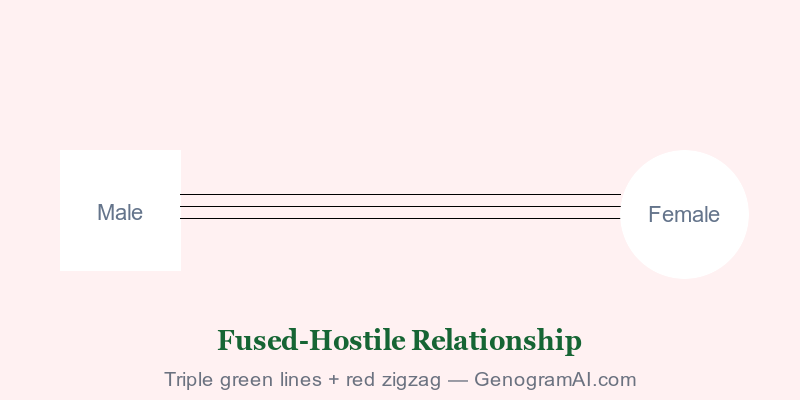
The fused-hostile symbol—three parallel lines combined with a zigzag—represents relationships that are simultaneously enmeshed and conflicted. These highly volatile dynamics involve extreme over-involvement coupled with frequent hostility, creating intense, exhausting relationship patterns.

Fused-Hostile: Three lines (enmeshed) + zigzag (conflict)

Genogram fused-hostile relationship symbol showing triple purple lines with red zigzag

Understanding Fused-Hostile Dynamics

The fused-hostile pattern represents one of the most challenging relationship dynamics in family therapy. It combines:

  • Fusion/Enmeshment: Blurred boundaries, over-involvement, difficulty separating
  • Hostility: Frequent conflict, anger, antagonism

These individuals cannot live with or without each other—desperately connected yet constantly fighting.

Clinical Presentation

  • Intense arguments followed by equally intense reconciliations
  • Inability to disengage despite mutual dissatisfaction
  • Third parties constantly triangulated into the conflict
  • Pattern often seen in co-dependent relationships
  • May involve substance use or mental health issues

Therapeutic Challenges

Fused-hostile relationships are particularly difficult to treat because:

  • The hostility feels more manageable than the terror of separation
  • Each party may sabotage the other's growth
  • The pattern often reflects multi-generational transmission
  • Individual therapy may be undermined by the enmeshed system

When to Use This Symbol

Reserve the fused-hostile symbol for relationships that show both enmeshment and active conflict simultaneously:

  • Mother-daughter enmeshment with constant fighting: A mother and adult daughter who speak multiple times daily, are deeply involved in each other's decisions, yet every conversation escalates into screaming matches. Neither can tolerate separation, but togetherness is equally unbearable.
  • Co-dependent couples with volatile cycles: A couple who break up and reunite repeatedly, each time with more intensity. They share finances, social circles, and identity to a degree that makes separation feel impossible, yet their interactions are dominated by blame and rage.
  • Sibling rivalry within enmeshed family systems: Two siblings whose parents fostered extreme closeness and competition simultaneously, resulting in adults who are deeply intertwined in each other's lives yet locked in bitter rivalry over parental approval.

How Fused-Hostile Differs From Close-Hostile

Fused-Hostile vs. Close-Hostile: Key Distinctions

  • Boundary dissolution: Close-hostile relationships maintain individual identities despite warmth and conflict. Fused-hostile relationships feature blurred or absent boundaries -- individuals struggle to know where one person ends and the other begins.
  • Separation tolerance: Close-hostile pairs can spend time apart without distress. Fused-hostile pairs experience intense anxiety when separated, even though being together triggers conflict.
  • Intensity level: Close-hostile is two lines plus a zigzag. Fused-hostile is three lines plus a zigzag, reflecting the greater degree of enmeshment and the more extreme volatility.
  • Therapeutic approach: Close-hostile relationships often respond to conflict resolution skills. Fused-hostile relationships require differentiation work first -- individuals must develop a separate sense of self before conflict can be addressed productively.

How to Add in GenogramAI

Steps to Document a Fused-Hostile Relationship:

  1. 1Press E to open the Emotional Relationship tool, then click the first person and drag to the second.
  2. 2Select "Fused-Hostile" from the relationship type menu -- this applies the combined three-line-plus-zigzag notation automatically.
  3. 3Optionally add a clinical note describing the cycle pattern (e.g., "daily phone calls escalate to arguments; reconcile within hours") to capture the push-pull dynamic.

Frequently Asked Questions

Is fused-hostile the same as a "trauma bond"?

There is significant overlap. Trauma bonding typically involves a power imbalance and cycles of abuse, while fused-hostile can be more symmetrical. However, many trauma-bonded relationships would be documented as fused-hostile on a genogram because they share the hallmark qualities of enmeshment and volatility.

Can fused-hostile relationships exist between parents and children?

Absolutely. Parent-child fused-hostile dynamics are common, especially between a parent and an adult child who never successfully differentiated. The parent may oscillate between intrusive over-involvement and explosive anger, while the child may alternate between resentful compliance and hostile rebellion.

What is the treatment goal for a fused-hostile relationship?

The primary goal is differentiation -- helping each person develop a clearer sense of self. This does not mean ending the relationship, but rather shifting it from fused-hostile toward close (or at least close-hostile as an intermediate step). Bowen family systems therapy is particularly well-suited for this work.

How do I distinguish fused-hostile from a relationship that is simply intense?

The key test is boundary dissolution. In an intense but healthy relationship, both people maintain separate identities, friendships, and decision-making. In a fused-hostile relationship, boundaries are severely blurred -- they may finish each other's sentences one moment and scream at each other the next, with no stable middle ground.

Related Symbols

Map Complex Dynamics

Document fused-hostile and other challenging patterns.

Start Free