Genogram Key & Legend
Complete Symbol Reference
The complete genogram key and legend for reading any genogram. Learn what every symbol means and decode family diagrams like a professional.
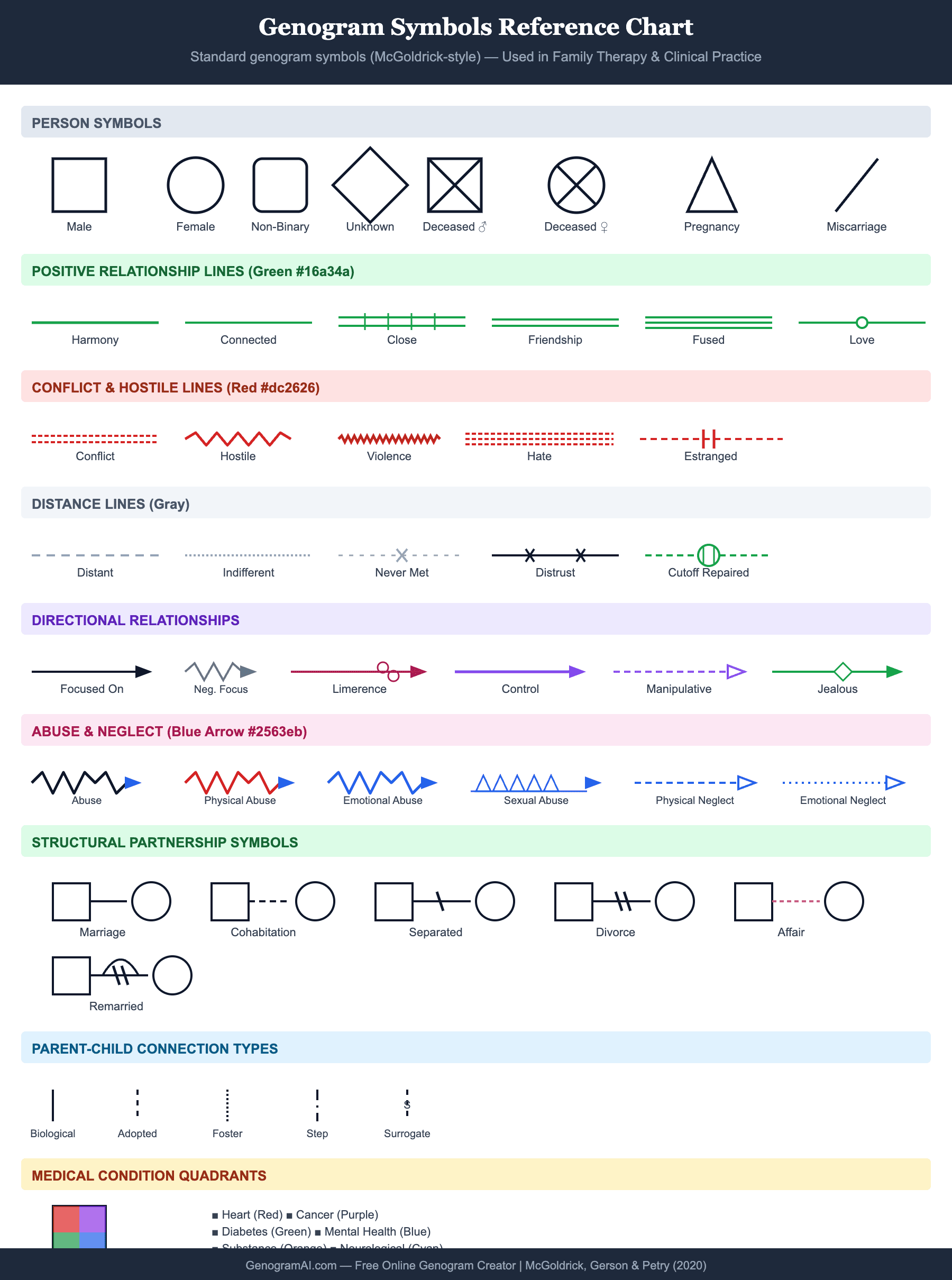
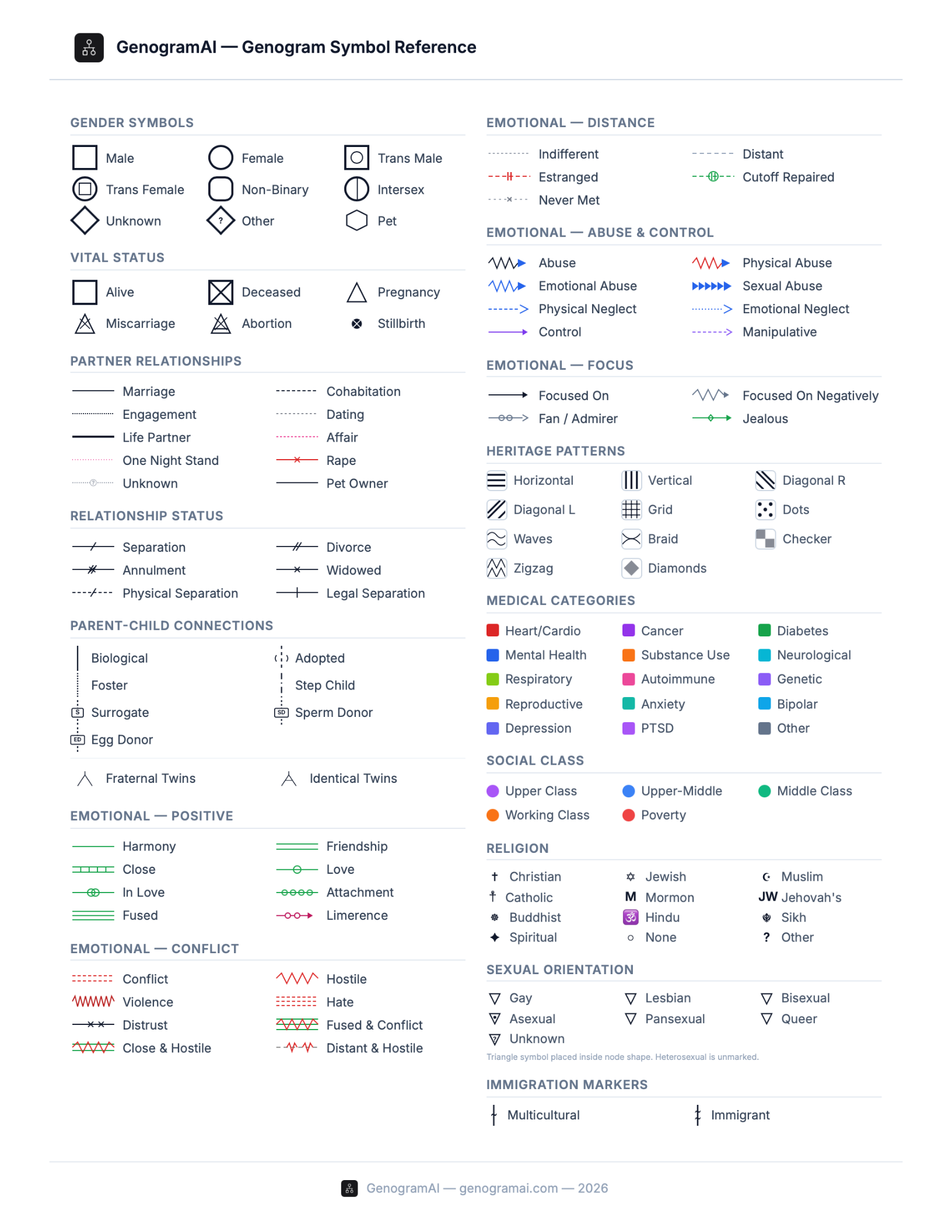
A genogram key (also called a genogram legend) is the reference chart that explains what each symbol in a genogram means: squares are males, circles are females, an X marks a deceased person, horizontal lines are partnerships (two slashes = divorce), vertical lines connect parents to children, and colored or patterned overlays encode emotional relationships, medical conditions, and heritage. Every professional genogram includes a key so anyone can read it without memorizing the notation.
For the full meaning of each symbol, see the genogram symbols guide; to print the whole set, get the genogram symbols PDF.
Printable Genogram Key & Legend Chart
All 150+ genogram symbols organized by category — download as PDF or PNG for free.
What is a Genogram Key & Legend?
A genogram key (or genogram legend) is the decoder ring for understanding genogram diagrams. It explains what each symbol, line style, and marking means, ensuring anyone can accurately interpret the family information displayed.
While genogram symbols are largely standardized across the mental health and medical professions, slight variations exist. Including a key with your genogram eliminates confusion and ensures your diagram communicates exactly what you intend. A good genogram key covers gender symbols, life status, relationship types, emotional bonds, and any custom notations you've added.
Gender Symbols
Basic shapes representing family members
Male
Square shape represents male family members
Female
Circle shape represents female family members
Trans Male
Square with inner circle for transgender male
Trans Female
Circle with inner square for transgender female
Nonbinary
Diamond (rotated square) for nonbinary identity
Intersex
Hexagon for intersex individuals
Unknown
Dashed diamond when gender is not specified
Other
Diamond for other gender identities
Pet
Rounded square for family pets
Life Status Symbols
Indicating living, deceased, and pregnancy status
Living
Empty shape indicates person is alive
Deceased
X through shape indicates death
Stillbirth
Small X for stillbirth
Miscarriage
Crossed triangle for miscarriage
Abortion
Triangle with horizontal line
Relationship Symbols
Lines connecting partners and indicating relationship status
Marriage
Solid horizontal line connecting partners
Engagement
Dotted line for engaged couples
Cohabitation
Dashed line for living together
Dating
Light dotted line for casual relationships
Life Partner
Solid line with LP marker for committed non-married
Separation (Legal)
Single slash through the line
Separation (Physical)
Single slash, living apart
Divorce
Double slash through the line
Annulment
Double slash with annulment marker
Remarriage
Double slash bridged by an arc — the couple divorced and married each other again
Widowed
X on deceased partner's side
Affair
Dashed line for extramarital relationship
One-Night Stand
Dotted line for brief encounter
Emotional Relationship Symbols
Lines showing the quality of emotional bonds
Harmony
Balanced, peaceful relationship
Close
Warm, supportive bond with healthy boundaries
Friendship
Non-familial supportive bond
Love
Deep affection and caring
In Love
Mutual romantic attachment
Attachment
Secure ongoing emotional tie
Limerence
One-sided infatuation
Fused / Enmeshed
Over-involved; boundaries blurred
Fused / Conflict
Enmeshed and actively conflictual
Fused / Hostile
Enmeshed with open antagonism
Fused / Violence
Enmeshed with physical violence
Distant
Emotional disconnection
Indifferent
No emotional investment
Estranged / Cutoff
Contact deliberately broken
Cutoff Repaired
A break since reconciled
Never Met
No relationship ever formed
Distant / Hostile
Disengaged and antagonistic
Distant / Violence
Disengaged with violence
Conflict
Active tension and arguments
Hostile
Open antagonism
Violence
Physical violence or threat
Hate
Deep-seated animosity
Distrust
Suspicion, withheld confidence
Jealous
Possessiveness and envy
Close / Hostile
Close yet openly antagonistic
Close / Violence
Close with physical violence
Abuse
Generic abuse pattern
Abuse — Physical
Bodily harm, harm-doer to harmed
Abuse — Emotional
Coercion, degradation, control
Abuse — Sexual
Sexual violation
Neglect — Physical
Care, food or shelter withheld
Neglect — Emotional
Emotional care withheld
Control
Coercive control
Manipulative
Covert influence
Focused On
Attention directed at one person
Focused On — Negative
Critical or blaming focus
Caretaker
Caregiving directed at another
Fan / Admirer
Admiration directed at another
Medical Genogram Key
Tracking health conditions across generations
Medical genograms use color-coded quadrants within each person symbol to indicate health conditions. GenogramAI supports 4 customizable quadrants that you can assign to any conditions relevant to your family.
Example Quadrant Setup:
- Top Left: Heart Disease
- Top Right: Diabetes
- Bottom Left: Cancer
- Bottom Right: Mental Health
How It Works:
Each person symbol is divided into 4 quadrants. Fill in a quadrant with the assigned color when that person has the corresponding condition. This creates a visual pattern showing which conditions run in the family.
Child Connection Types
How children are connected to their parents
Biological
Solid vertical line — genetic parent-child connection
Adopted
Dashed vertical line — legally adopted child
Foster
Dotted vertical line — foster care placement
Step
Dash-dot vertical line — stepchild relationship
Surrogate
Marked line — surrogate birth connection
Sperm Donor
Marked line — sperm donor connection
Egg Donor
Marked line — egg donor connection
Twin Symbols
Twins are connected to their parents with a branching line from a single point.
Fraternal Twins
Two diagonal lines forming a V — non-identical twins
Identical Twins
Two diagonal lines forming a V with a horizontal bar — identical twins
Immigration Markers
Tilde markers on parent-child lines indicate migration/immigration.
Single Tilde (~)
Person lived in two or more cultures
Double Tilde (~~)
Person immigrated from another country
Genogram Key & Legend FAQs
What is a genogram key?
A genogram key (also called a genogram legend) is a reference guide that explains all the symbols used in a genogram. It includes symbols for gender, life status, relationship types, emotional bonds, and medical conditions. Every genogram should include a key so readers can interpret the diagram correctly.
What are the basic genogram symbols?
The basic genogram symbols are: square for male, circle for female, triangle for pregnancy/miscarriage, X through shape for deceased, horizontal line for marriage, single slash for separation, double slash for divorce, and vertical lines connecting parents to children.
How do you show relationships in a genogram key?
Relationship symbols in a genogram key include: solid line for marriage, dotted line for engagement, single slash for separation, double slash for divorce, dashed line for cohabitation. Emotional relationships use different line styles: solid blue line for close bonds, dashed red for conflict, zigzag for hostility, dashed for distant.
What symbols are used for emotional relationships?
GenogramAI supports 30+ emotional relationship types organized in 6 categories: Positive (harmony, close, fused, friendship, love, limerence), Negative (conflict, hostile, violence, hate, distrust, fused-conflict, close-hostile, distant-hostile), Distance (indifferent, distant, estranged, never met, cutoff repaired), Abuse & Control (abuse with 4 subtypes, neglect, control, manipulative), and Focus (focused on, focused negatively, fan/admirer, jealous).
Should I include a key with my genogram?
Yes, always include a genogram key with your diagram. Even though many symbols are standardized, interpretations can vary. A key ensures anyone viewing your genogram understands exactly what each symbol represents. GenogramAI automatically includes standard symbols.
Free Downloadable Guides
Print-ready PDFs you can reference anytime — no sign-up required.
Deepen Your Genogram Knowledge
How to Read a Genogram
Go beyond the key — learn to interpret complete genogram diagrams.
Genogram Interpretation
Advanced techniques for analyzing multigenerational patterns.
Types of Genograms
Medical, emotional, cultural, and other specialized genogram formats.
Emotional Genograms
Focus on the emotional relationship symbols covered in this key.
Genogram Templates
Start with a pre-built template that already includes the standard key.
Ecomap and Genogram
Understand how ecomap symbols compare to genogram notation.
Further Reading
- McGoldrick, M., Gerson, R., & Petry, S. — Genograms: Assessment and Treatment (4th ed.). W.W. Norton & Company, 2020
- Bowen, M. — Family Therapy in Clinical Practice. Jason Aronson, 1978
- International Association for Marriage and Family Counselors — Genogram Symbols and Notation Standards. IAMFC Practitioner Guidelines, 2018
- DeMaria, R., Weeks, G., & Twist, M. — Focused Genograms: Intergenerational Assessment of Individuals, Couples, and Families (2nd ed.). Routledge, 2017
Create Your Own Genogram
GenogramAI includes all standard symbols and generates a professional key and legend automatically
Start Creating Free