Examples
Ecomap examples from clinical practice
Quick answer
| Ecomap example | Setting | What it shows |
|---|---|---|
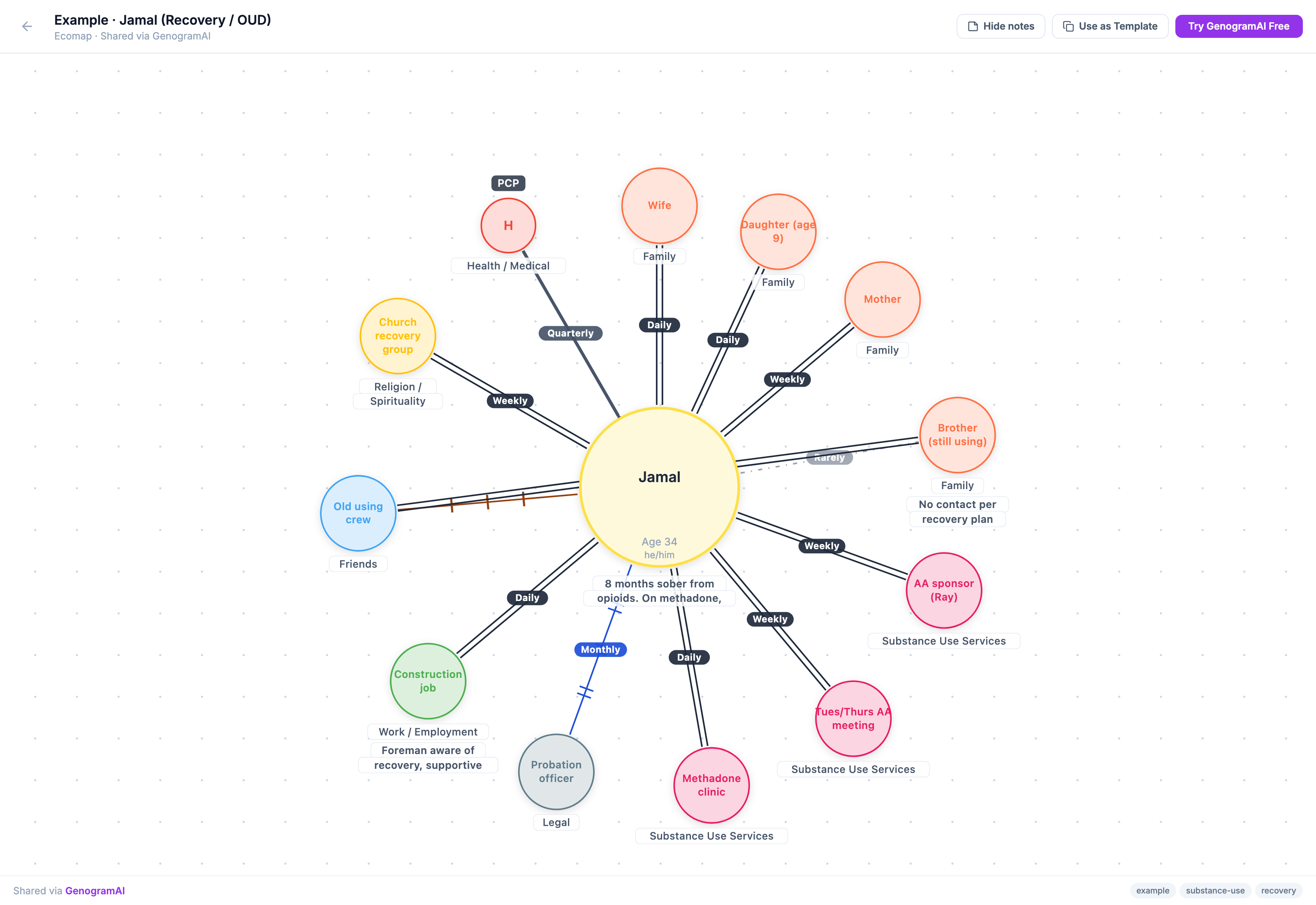
| Jamal, 34 | Addiction recovery | Strong supports to family, clinic and work; a conflict line to his old using crew |
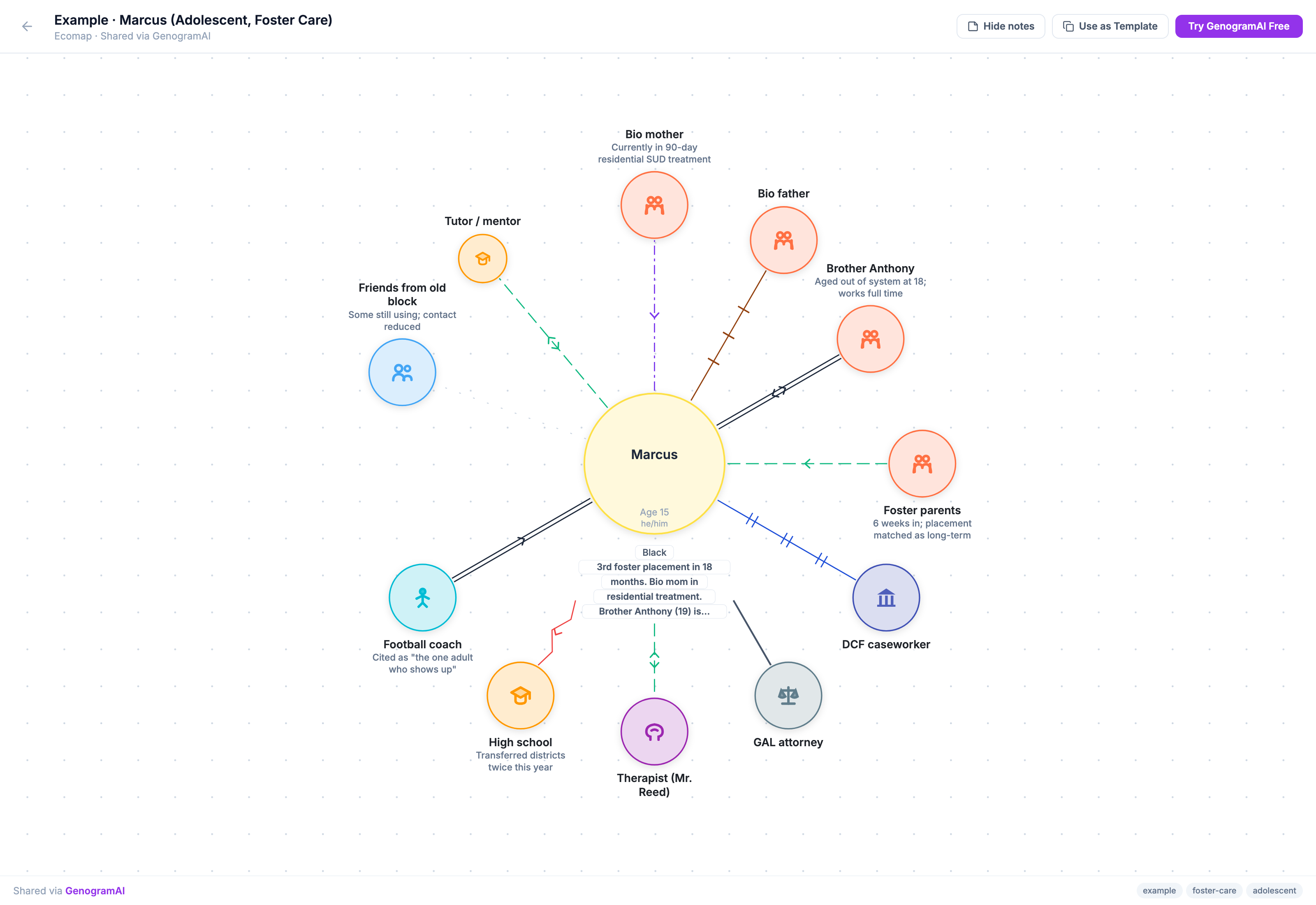
| Marcus, 15 | Foster care | A new, tenuous foster placement line; strong lines to his brother and coach |
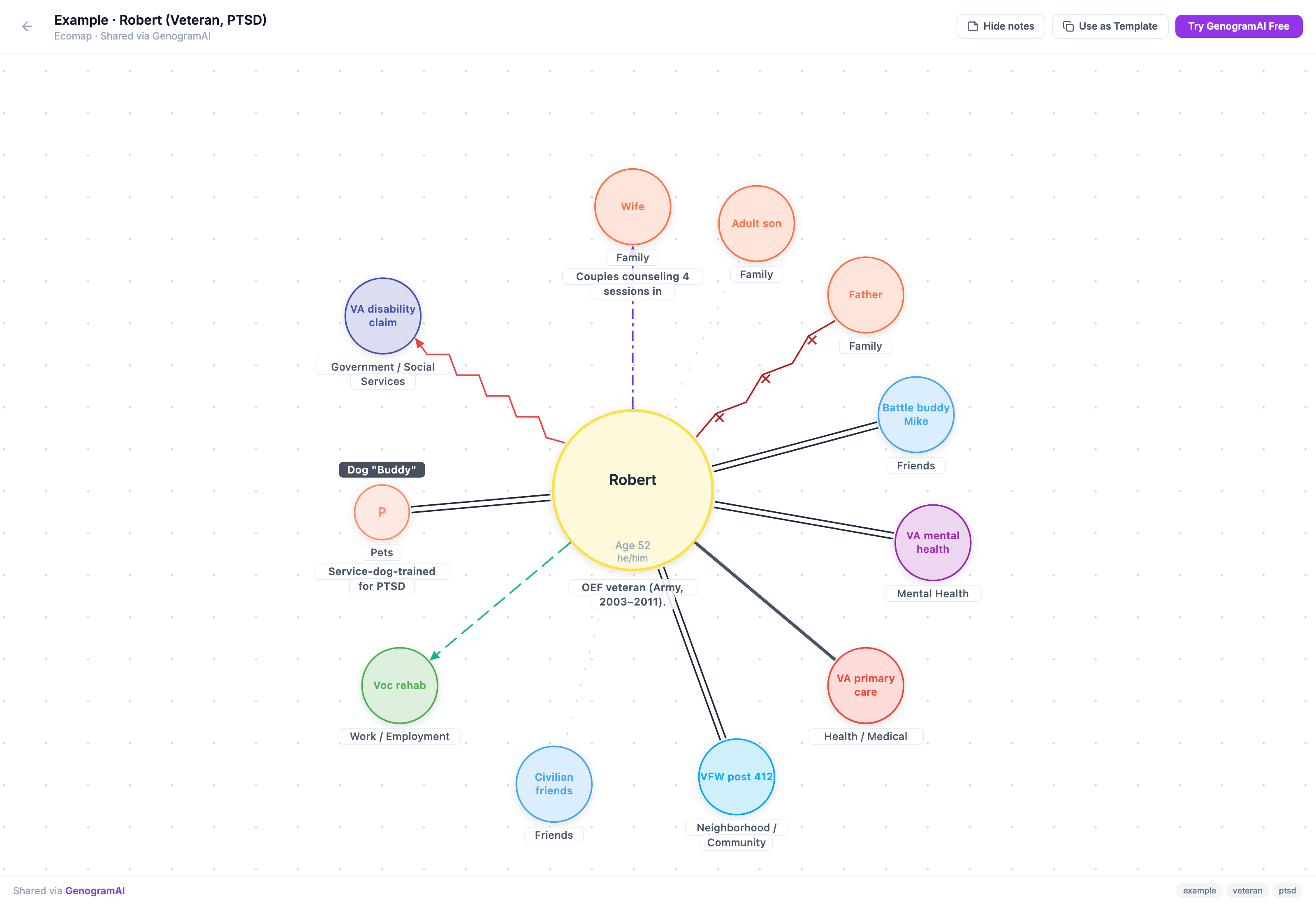
| Robert, 52 | Veteran mental health | VA, peer and service-dog supports; a stressful disability claim and a cut-off with his father |
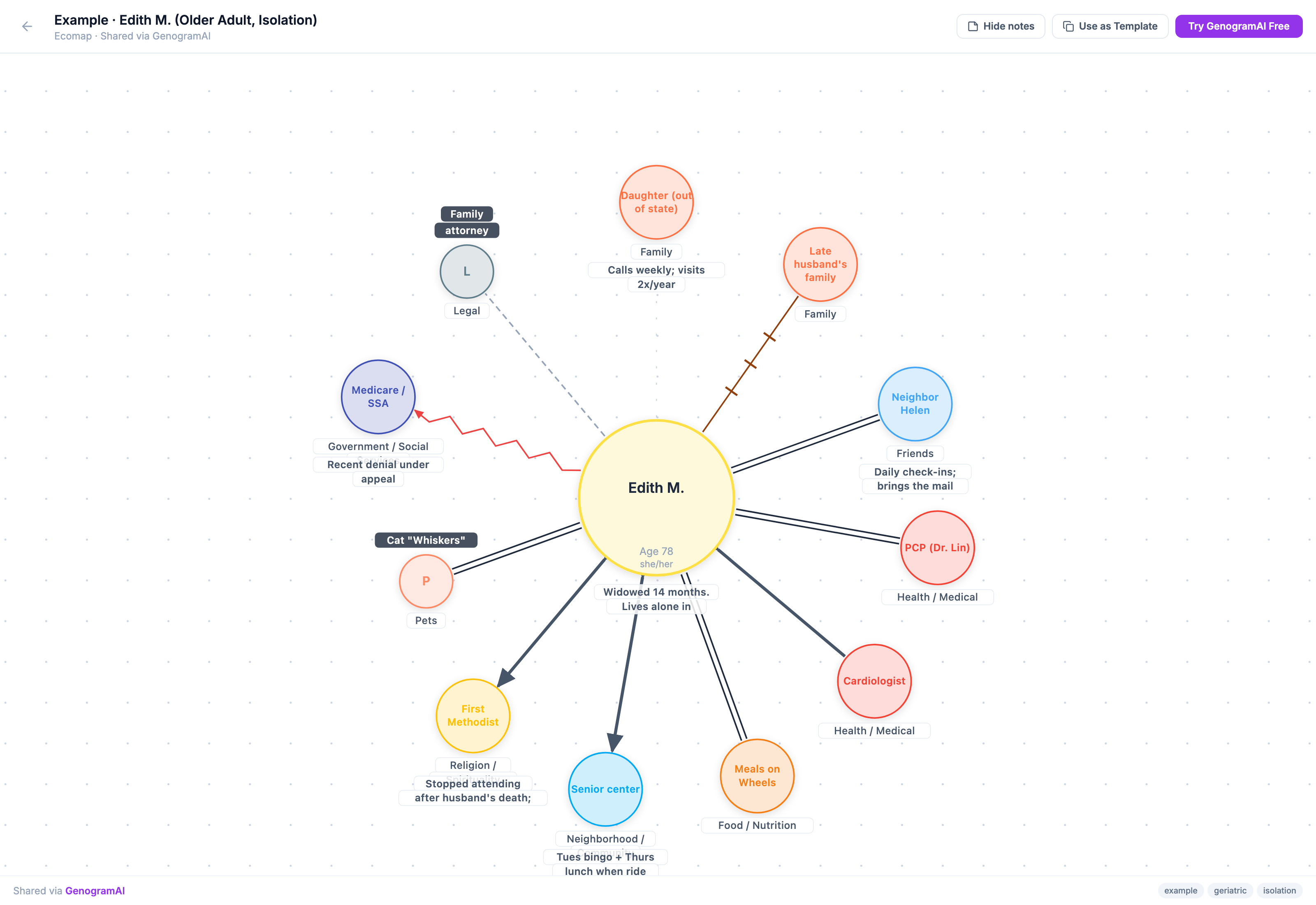
| Edith M., 78 | Geriatric care | A neighbor, her doctor and Meals on Wheels as main supports; withdrawal from church and senior center |
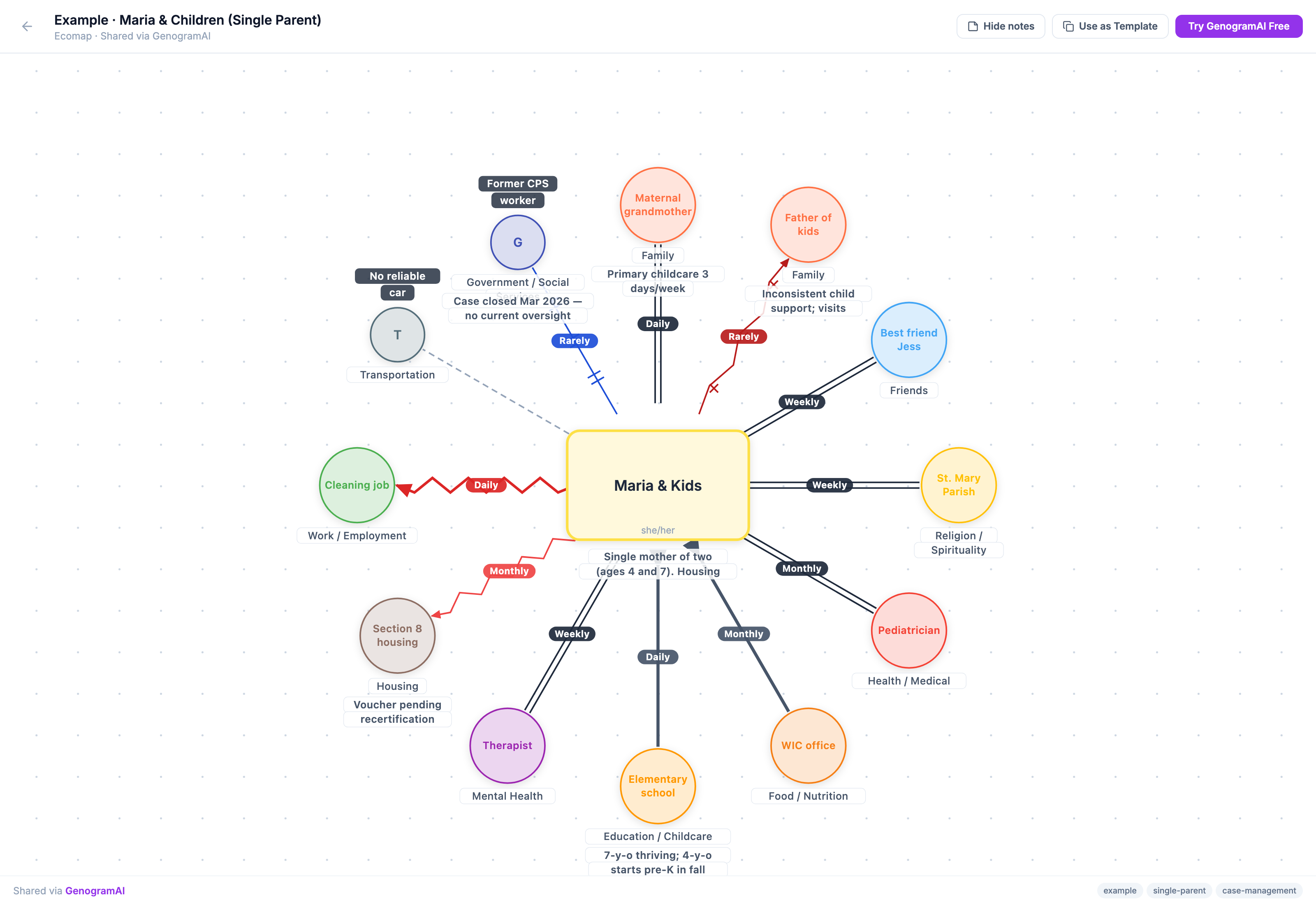
| Maria and children | Child welfare | A household at the centre; childcare from grandmother, stress from work, housing and transport |
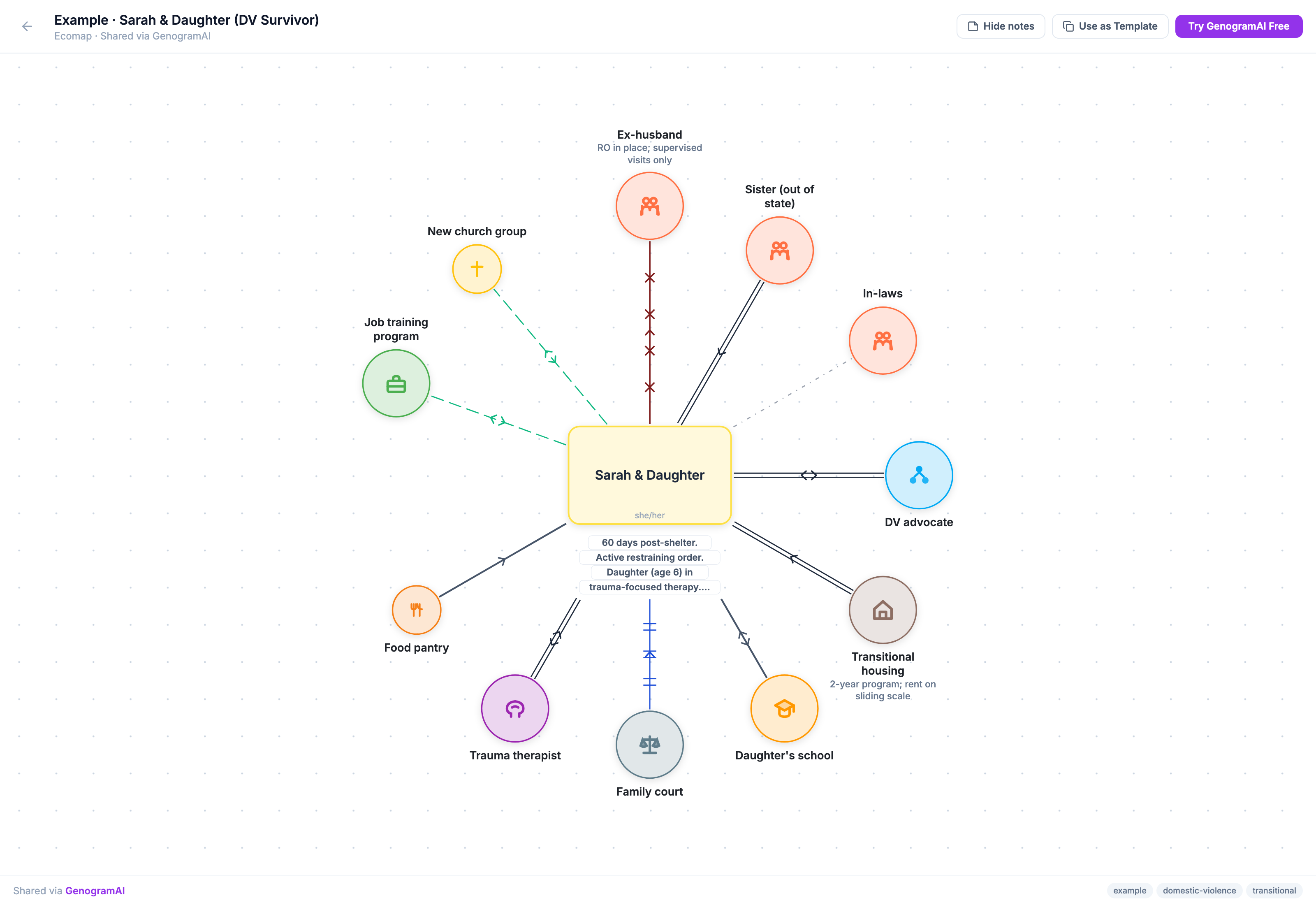
| Sarah and daughter | Domestic violence | A cut-off from her ex-husband, conflict with family court, strong advocate and housing lines |
How to read an ecomap example
Each example below follows the same structure: the identified client or family sits at the center, surrounded by external systems drawn as labeled circles. The lines connecting them carry clinical meaning: a thick solid line means a strong, supportive relationship; a dashed line means the connection is tenuous or still forming; a zig-zag line signals stress. Arrowheads show direction: pointing toward the center means the system is giving resources to the client; pointing outward means the client is giving energy to the system; arrows on both ends indicate a mutual exchange.
When reading an ecomap, pay attention to what is absent as much as what is present. A client with strong professional supports (therapist, sponsor) but a broken line to family and no recreation system is showing you a fragile scaffold: recovery or stability depends entirely on paid relationships. That pattern looks different from a client whose family line is stressful-strong: the intensity is high in both directions, which is protective but also exhausting. The examples below illustrate common versions of these patterns across different clinical domains.
| Line | Meaning |
|---|---|
| Thick or double solid line | Strong, supportive connection |
| Thin solid line | Normal connection |
| Dashed or dotted line | Weak, tenuous or new connection |
| Zig-zag line | Stressful relationship |
| Line with hash marks | Conflict |
| Line crossed with X marks | Cut-off or severed relationship |
| Arrowhead | Direction of energy or resources |
Sources: eco-map conventions as introduced in Hartman, A. (1978). Diagrammatic assessment of family relationships. Social Casework, 59(8), 465–476. All cases on this page are composites, not real clients.
Six ecomaps drawn in GenogramAI
Addiction recoveryJamal, 34: opioid recovery
Foster careMarcus, 15: adolescent in foster care
Veteran mental healthRobert, 52: veteran with PTSD
Geriatric careEdith M., 78: older adult living alone
Child welfare / case managementMaria and children: single parent
Domestic violenceSarah and daughter: after leaving a violent relationship
Ten composite ecomap cases
Addiction recovery
James, 28
6 months sober. Sponsor + therapist (strong), AA group (strong), employer (mutual), mother (stressful), father (broken). Strong recovery scaffold but parental conflict is a relapse risk.
Adolescent mental health
Maya, 15
School counselor + therapist (strong), parents (mutual), friend group (stressful), sports team (strong). Three protective systems balancing one peer-related stressor.
Foster care
Eli, 9
Foster parents (strong), biological mother (weak, supervised), bio sibling (strong), caseworker (mutual), school + therapist (mutual). Visualizes case-plan compliance and natural supports.
Geriatric in-home
Mrs. Lin, 81
Adult son (mutual), in-home aide (strong), primary-care MD (mutual), neighbor (strong), church congregation (mutual), Meals-on-Wheels (support flows in). Limited but well-utilized supports.
Child welfare
Family Chen
Mother + 3 children at center. Custodial parent (strong with all 3), non-custodial father (weak with 2, broken with 1), CPS caseworker (stressful), daycare + pediatrician (mutual).
Refugee resettlement
Hassan family
IRC caseworker (support flows in), English class (mutual), mosque (strong), legal-aid attorney (support flows in), employer (stressful), distant relatives abroad (weak).
Couples therapy
A & R
Both at center as a family unit. Friends (one stressful, one strong), in-laws (one mutual, one broken), couples therapist (mutual), workplaces (stressful for both).
School social work
Tyler, 12
Mom (mutual), absent dad (weak), older sibling (strong), school counselor (mutual), teacher (stressful), basketball coach (strong), peer group (strong).
Chronic illness
David, 54
Spouse (strong), kids (mutual), oncologist (support flows in), nurse navigator (mutual), employer (stressful), insurance (stressful-strong), support group (strong).
Community/business
Small business
A bakery at the center. Customers (mutual), suppliers (mutual), accountant (support flows in), legal (support flows in), competitors (stressful), landlord (stressful-strong). Non-clinical use of the same method.
Build one from your own description
Ecomap examples: questions
Are these real cases?
No. All examples are composites for illustrative purposes. They use realistic system patterns drawn from common practice areas but contain no identifying information from real clients.
What should an ecomap example include?
The client or household in the centre, a circle for each system they deal with (family, friends, work or school, health care, mental health, faith, legal, community services), a line from each system to the centre whose style shows the quality of the relationship, and arrows for the direction of support. Short notes on lines, such as contact frequency, help.
How do I use these in my own work?
Each composite case links to a guide for that clinical domain, with the questions to ask and the systems to include. The ecomap templates page has starter canvases by domain that you can open and adapt to your case.
Can I build my own from one of these?
Yes. Use the AI ecomap generator and paste any of the example summaries as the prompt. The AI rebuilds it as an editable canvas; then you adjust names and categories for your case. AI ecomaps use AI credits (5 a month on the free plan, shared with genograms).
How do I read an ecomap?
Start at the centre, then read each line: its style tells you the quality of the relationship and any arrow tells you which way support flows. Then look at the whole map for balance, such as many stressful lines and few strong ones, and for systems that are missing entirely.