Genogram Relationship Lines
Every line on a genogram tells a story. This visual guide covers every structural, emotional, and child connection line type used in standard genogram notation.
What Do Genogram Lines Mean?
Each line style in a genogram represents a different type of relationship between family members:
- Solid line
- = Marriage
- Dashed line
- = Cohabitation
- Dotted line
- = Engagement / Dating
- Single slash /
- = Separation
- Double slash //
- = Divorce
- X on line
- = Widowed
- Two blue lines
- = Close relationship
- Three red lines
- = Fused / Enmeshed
- Red zigzag
- = Hostile (Conflict = two dashed red lines)
- Red dashed line
- = Distant
- Solid red + two bars
- = Estranged / Cutoff
- Zigzag + arrow
- = Abuse (directional)
Genogram lines fall into three categories: structural lines that define legal and biological connections (marriage, divorce, parent-child), emotional lines that describe the quality of the bond between any two people, and child connection lines that specify how a child joined the family (biological, adopted, foster). Understanding these lines is essential for reading any genogram accurately — and for building one using a genogram maker.
Quick Reference: Common Genogram Lines
The most frequently used relationship lines in genogram notation
| Line Type | Visual Description | Meaning |
|---|---|---|
| Marriage | Single solid horizontal line | Legal marriage between two partners |
| Divorce | Solid line with two slashes (//) | Finalized legal divorce |
| Separation | Solid line with one slash (/) | Separated but not legally divorced |
| Close Relationship | Two parallel lines | Healthy, strong emotional bond |
| Enmeshed / Fused | Three parallel lines | Overly dependent, blurred boundaries |
| Conflict | Two dashed red lines | Ongoing tension and disagreement |
| Hostile | Zigzag (jagged) line | Open, expressed antagonism |
| Close-Hostile | Parallel line + zigzag together | Intimate yet conflictual relationship |
| Distant | Single dashed line | Emotional distance, lack of closeness |
| Cutoff / Estranged | Solid red line crossed by two vertical bars | No contact, severed relationship |
| Abuse | Zigzag line with arrow | Abuse directed toward one person |
Structural Relationship Lines
Define the legal and formal connections between partners
Marriage
A single solid horizontal line connecting two partner symbols. The most fundamental structural line in genogram notation. Partners are placed on the same horizontal level.
Engagement
A dotted horizontal line indicates an engaged but not yet married couple. This is less commonly seen but useful for showing relationship progression.
Cohabitation
A dashed horizontal line represents a couple living together without a legal marriage. Increasingly common in modern genograms as family structures evolve.
Separation
A single forward slash (/) through the marriage line means the couple is separated but not legally divorced. They remain legally married.
Divorce
Two forward slashes (//) through the marriage line indicate a finalized divorce. If a person remarries, a second marriage line is drawn from their symbol.
Committed Partnership
Some practitioners use a solid line paired with a dashed line to indicate a committed domestic partnership that is not a legal marriage.
Emotional Relationship Lines
Describe the quality and nature of bonds between any two family members
Close
Two parallel blue lines indicate a close, healthy emotional bond between two people. This is a positive relationship marker showing trust and connection.
Fused / Enmeshed
Three parallel lines signify an enmeshed or fused relationship where boundaries are blurred. Clinically significant because it indicates an unhealthy level of dependence or over-involvement.
Distant
A dashed or dotted line represents emotional distance. The people are still in contact but the relationship lacks closeness or warmth.
Hostile / Conflict
A zigzag line represents ongoing conflict or hostility between two people. One of the most recognizable emotional relationship lines in genogram practice.
In GenogramAI: McGoldrick treats this as one conflictual line; the editor splits it into two types so you can grade severity. Choose Hostile for the classic red zigzag above, or Conflict for a lower-intensity two-dashed-red-line variant.
Close-Hostile
A combination of a close line and a hostile zigzag indicates a relationship that is both intimate and conflictual — common in many family dynamics.
Cutoff / Estranged
A line with a visible break or gap represents a severed relationship. The people have no contact. This is one of the most clinically significant markers in family therapy.
Focused On
A line with an arrow indicates one person is overly focused on or preoccupied with the other. The arrow points toward the person being focused on.
Abuse
A zigzag line with a directional arrow indicates abuse flowing from one person toward another. The arrow points to the person being abused. Some notations distinguish physical, emotional, and sexual abuse.
Fused-Hostile
A combination of enmeshed lines and a hostile zigzag. Represents a deeply intertwined relationship that is simultaneously codependent and antagonistic.
Violence
A thicker, bolder zigzag line or a zigzag with a filled arrow distinguishes physical violence from general conflict. Notation varies by practitioner; always check the genogram's legend.
Child Connection Lines
Specify how children are connected to their parents
Biological Child
A solid vertical line from the parent couple's horizontal line down to the child symbol. This is the default child connection and indicates a biological relationship.
Adopted Child
A dashed vertical line indicates the child was adopted. Some notations include a bracket or "A" near the line. The dashed style visually distinguishes the connection from biological.
Foster Child
A dotted vertical line connects foster children to their foster parents. This denotes a temporary or non-permanent caregiving relationship.
Twins
Twin children are shown with lines that converge from a single point on the parent line before splitting to each child. Identical twins have a horizontal bar connecting their converging lines; fraternal twins do not.
Reading Tips for Relationship Lines
- Structural lines (marriage, divorce) are always horizontal between partners on the same generational row.
- Emotional lines can connect any two people in the family, regardless of generation.
- Color coding is optional but common: green for positive bonds, red for conflict, blue for distance. Always check the genogram's legend.
- Multiple line types can overlap between the same two people. A married couple can also have a "hostile" emotional overlay.
- Child connection lines are always vertical from the parent's horizontal couple line downward to the child symbol.
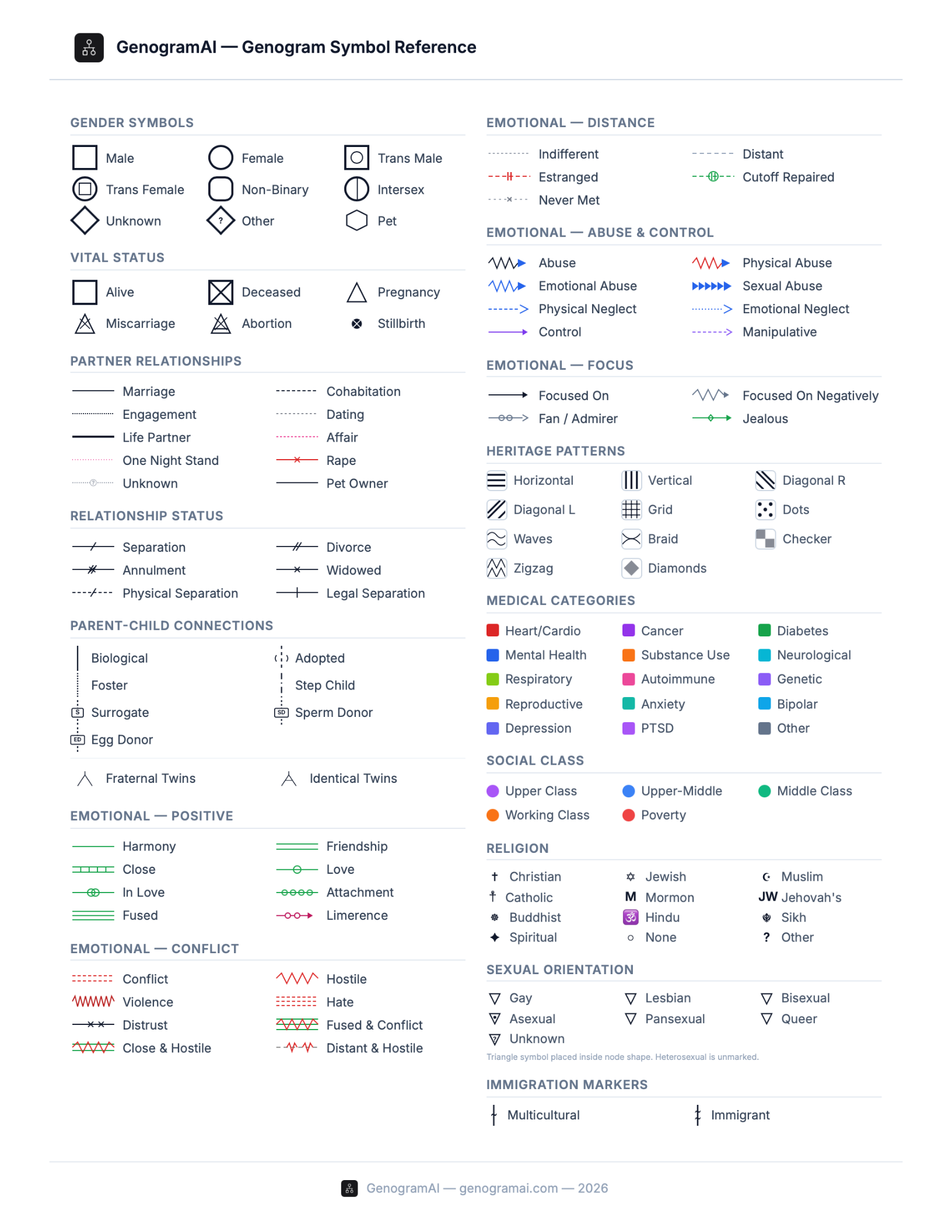
Complete Genogram Relationship Lines & Symbols Chart
All relationship lines, emotional overlays, and 150+ symbols in one downloadable reference.
Frequently Asked Questions
What do the different lines on a genogram mean?
Lines on a genogram convey two types of information: structural relationships (marriage, divorce, separation, cohabitation) and emotional relationships (close, distant, hostile, cutoff, enmeshed). Structural lines are horizontal connections between partners, while emotional lines are typically drawn between any two family members to show the quality of their bond.
What does a zigzag line mean on a genogram?
A zigzag or jagged line between two people on a genogram represents conflict or hostility. If the zigzag has a directional element (like an arrow), it may indicate abuse. This is one of the most commonly used emotional relationship lines in clinical practice. In the GenogramAI editor this continuum is split into two selectable types: choose Hostile to draw the classic zigzag, or Conflict for a lower-intensity variant drawn as two dashed red parallel lines.
How do you show divorce on a genogram?
Divorce is shown by drawing two parallel slashes (//) through the horizontal marriage line connecting the two partners. A single slash (/) indicates separation rather than a finalized divorce.
What is the difference between close and enmeshed lines?
A close relationship is shown with two parallel blue lines, indicating a healthy strong bond. An enmeshed or fused relationship is shown with three parallel red lines, indicating an unhealthy, overly dependent bond where boundaries are unclear. The distinction is clinically important in family therapy.
How do you show adopted children on a genogram?
Adopted children are connected to their adoptive parents using a dashed vertical line instead of a solid one. Foster children use a dotted vertical line. Biological children always have a solid vertical line connecting them to their parents.
Can a genogram show multiple types of relationships between two people?
Yes. It is common to show both a structural relationship (like marriage) and an emotional overlay (like conflict) between the same pair. The emotional line is typically drawn alongside or near the structural line. GenogramAI supports layering multiple relationship types.
Related Symbol Guides
All Genogram Symbols
Complete symbol reference guide
Genogram Key & Legend
Symbol meanings at a glance
How to Read a Genogram
Beginner's interpretation guide
Printable Cheat Sheet
Free PDF symbol reference
Simple Genogram Examples
See lines in context with examples
Genogram Examples
Famous families and case studies
What is a Genogram?
Complete definition and beginner guide
History of Genograms
From Bowen to McGoldrick's standard
Genogram Templates
Ready-made templates for therapy, social work, and nursing
GenogramAI
Free AI-powered genogram maker
Free Downloadable Guides
Print-ready PDFs you can reference anytime — no sign-up required.
Further Reading
- McGoldrick, M., Gerson, R., & Petry, S. — Genograms: Assessment and Intervention (4th ed.). W.W. Norton & Company, 2020
- Bowen, M. — Family Therapy in Clinical Practice. Jason Aronson, 1978
- McGoldrick, M., Gerson, R., & Shellenberger, S. — Reading Genograms: A Clinical Guide. W.W. Norton & Company, 1999
- DeMaria, R., Weeks, G., & Twist, M. — Focused Genograms: Intergenerational Assessment of Individuals, Couples, and Families (2nd ed.). Routledge, 2017
Create Genograms with All Line Types
GenogramAI supports 58 relationship types — 17 structural, 24 emotional, and 7 child connections
Start Creating Free