Historical overview
Who invented the genogram? A history
Quick answer
Where did the genogram come from?
The genogram has a rich history rooted in the ideas of psychiatrist Murray Bowen and the systematic work of Monica McGoldrick and Randy Gerson. What began as simple family diagrams in the 1950s has evolved into a clinical tool used by therapists, social workers, and medical professionals worldwide.
Understanding this history helps clinicians appreciate why genograms are structured the way they are and how the underlying theory informs their clinical use. For the basics, see what a genogram is and the standard genogram symbols.
Key insight
What did Murray Bowen contribute?
Dr. Murray Bowen (1913-1990) was an American psychiatrist who developed one of the most comprehensive theories of human behavior and family functioning. His work fundamentally changed how we understand families.
In the 1950s, at the National Institute of Mental Health (NIMH), Bowen conducted research in which entire families of patients with schizophrenia were hospitalized together. This allowed him to observe family emotional processes directly, leading to insights that became the foundation of family systems theory.
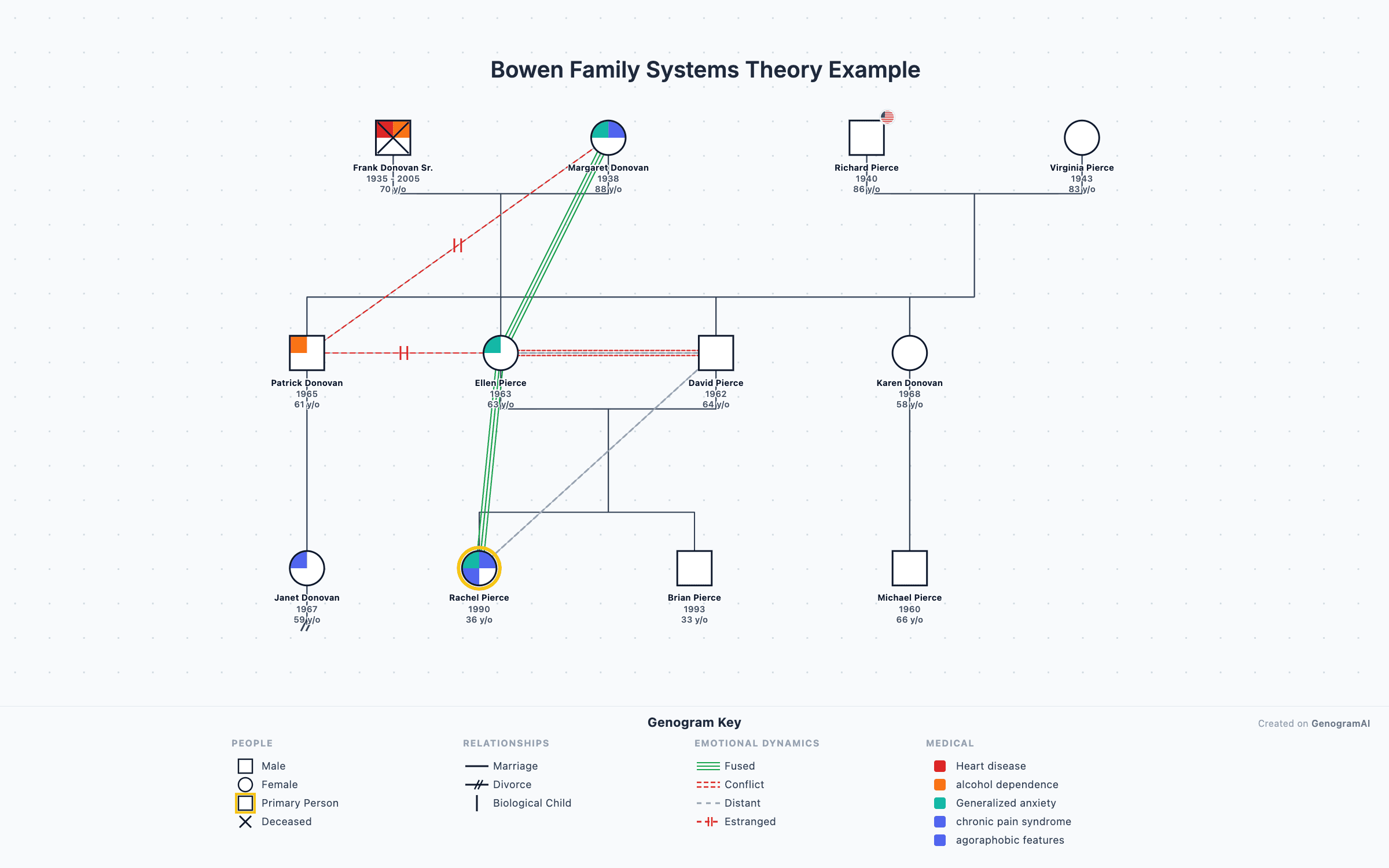
Bowen used family diagrams in his clinical work to track multigenerational patterns, though he never formalized a standardized symbol system. His theoretical concepts provided the "why" that McGoldrick and Gerson would later give visual form.
| Bowen concept | What it describes | How a genogram shows it |
|---|---|---|
| Differentiation of self | The ability to separate thinking from feeling | Fused, enmeshed and cutoff lines |
| Triangles | Three-person relationship systems | Conflict and closeness lines between three people |
| Nuclear family emotional system | Patterns in a single generation | Relationship lines within one household |
| Family projection process | How parents transmit anxiety to children | Focused-on lines from parent to child |
| Multigenerational transmission | Patterns across generations | Repeated symbols across three or more generations |
| Emotional cutoff | Managing unresolved issues through distance | Cutoff line (broken connection) |
| Sibling position | Birth order effects on personality | Children ordered oldest to youngest, left to right |
| Societal emotional process | Family patterns in society | Notes on migration, culture and community context |
How did McGoldrick and Gerson standardize the genogram?
Dr. Monica McGoldrick turned Bowen-style family diagrams into the standardized genogram system used today. Working with Randy Gerson, she created a consistent symbol language that could be used across clinical settings.
Their 1985 book "Genograms in Family Assessment" established standard symbols for gender, relationships, medical conditions, and family events. The word "genogram" was already in use among family therapists; the book gave it one shared format and included detailed case examples showing how to gather information and interpret patterns.
McGoldrick has continued to expand the genogram framework, incorporating cultural factors, diverse family structures, and contemporary understanding of trauma and resilience. Now in its 4th edition (2020), the book remains the standard clinical reference. The genogram rules page summarizes the conventions.
McGoldrick's contributions
- Standardized genogram symbols
- Systematic assessment framework
- Cultural genogram methodology
- Gender and power analysis in families
- Integration with family life cycle theory
- Trauma-informed genogram practices
- LGBTQ+ inclusive family mapping
- Training curriculum for clinicians
Genogram timeline
1950s
Murray Bowen develops family systems theory
At the Menninger Clinic and later NIMH, Bowen begins treating entire families together, observing multigenerational patterns of emotional functioning. He starts using simple family diagrams in his clinical work.
1959
Bowen moves to Georgetown University
Bowen continues his work at Georgetown, where he trains clinicians in family systems theory and the use of family diagrams for assessment and treatment planning. The Georgetown Family Center follows in 1975.
1970s
The word "genogram" enters clinical use
Family therapists in and around Bowen's circle, including Philip Guerin, describe the family diagram as a "genogram" and use it to gather multigenerational family information.
1978
Bowen publishes "Family Therapy in Clinical Practice"
This seminal work collects Bowen's papers and his eight concepts of family systems theory, the theoretical foundation the genogram is built to show.
1985
McGoldrick and Gerson standardize the genogram
"Genograms in Family Assessment" sets out a standard format and symbol set for the genogram, which until then varied from clinician to clinician. The book becomes required reading in therapy training programs.
1999
Second edition expands applications
McGoldrick, Gerson, and Shellenberger publish an expanded edition with more case examples and applications across diverse populations and clinical settings.
2008
Third edition by McGoldrick, Gerson and Petry
Sueli Petry joins as co-author. This edition expands coverage of cultural genograms and diverse family structures.
2020
Fourth edition released
Published as "Genograms: Assessment and Treatment", it updates symbols and expands coverage of LGBTQ+ families, trauma-informed approaches, and current clinical practice.
2024+
AI-assisted genogram creation
Digital tools and AI assistants, including GenogramAI, emerge to help clinicians create genograms more efficiently while keeping to standard notation.
How genograms spread
Clinical education
Cross-cultural adoption
Multiple professions
Research tool
Personal insight
Continuing evolution
Genogram history: questions
Who invented the genogram?
No single person invented it. Murray Bowen's family systems theory (1950s-1970s) supplied the ideas, and clinicians in his circle were drawing and naming "genograms" in the 1970s. Monica McGoldrick and Randy Gerson then standardized the symbols and format used today in their 1985 book "Genograms in Family Assessment."
What is Murray Bowen's contribution to genograms?
Murray Bowen developed family systems theory, which views the family as an emotional unit across generations. His concepts of differentiation, triangulation, and multigenerational transmission of anxiety provided the theoretical foundation that genograms were designed to visualize. Bowen used family diagrams in his clinical work before McGoldrick formalized them.
How have genograms changed over time?
Genograms have evolved from simple hand-drawn diagrams to digital tools. The symbol set has expanded to include more relationship types, cultural factors, and medical conditions. Software such as GenogramAI now offers 64 relationship types, emotional patterns, and AI assistance, though the core symbols described by McGoldrick and Gerson remain the standard.
Why are genograms called genograms?
The term "genogram" combines "geno-" (from Greek génos meaning family, race, or kind) with "-gram" (meaning something written or drawn). It literally means "family diagram." The term was coined to distinguish these clinical family maps from traditional genealogical family trees.
What is McGoldrick genogram notation?
"McGoldrick notation" is the informal name for the genogram conventions described by Monica McGoldrick, Randy Gerson, and Sueli Petry in their book Genograms: Assessment and Treatment (W. W. Norton). The conventions cover symbols for gender, relationships, medical conditions, emotional bonds, and family events, and are widely used in clinical practice and education. GenogramAI follows these conventions but is an independent product, not affiliated with or endorsed by the authors or the publisher.
Further Reading
- McGoldrick, M. & Gerson, R. — Genograms in Family Assessment. W.W. Norton & Company, 1985.
- Bowen, M. — Family Therapy in Clinical Practice. Jason Aronson, 1978.
- McGoldrick, M., Gerson, R., & Petry, S. — Genograms: Assessment and Treatment (4th ed.). W.W. Norton & Company, 2020.
- Kerr, M.E. & Bowen, M. — Family Evaluation: An Approach Based on Bowen Theory. W.W. Norton & Company, 1988.