Theory application
Bowen family systems theory and genograms
Quick answer
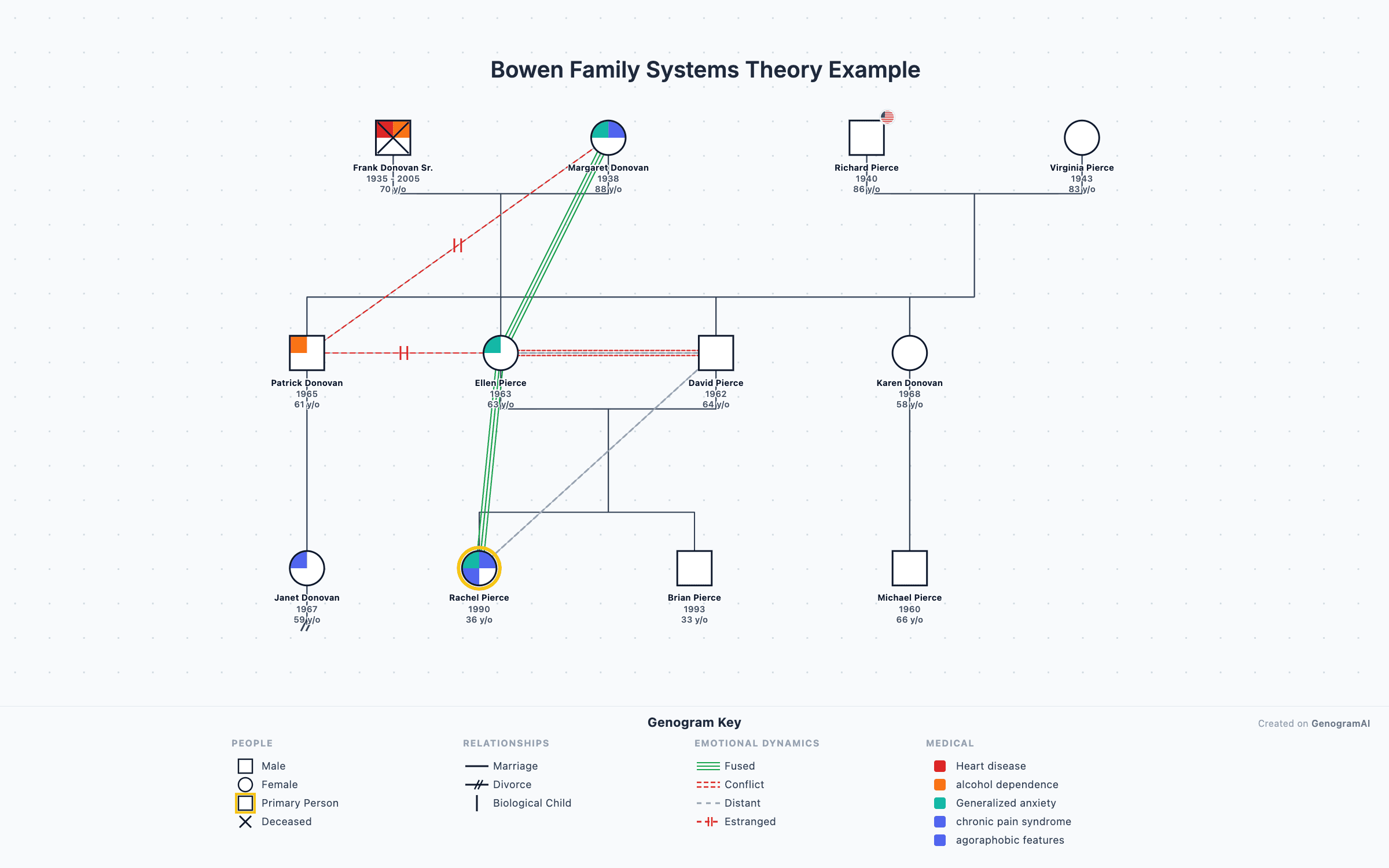
The theoretical foundation of genograms
The genogram grew out of Murray Bowen's family systems work and was standardized by Monica McGoldrick and Randy Gerson in 1985. While McGoldrick and Gerson created the standardized symbols, the underlying concepts come from Bowen's understanding of how families function as emotional systems across generations.
Understanding Bowen's eight concepts transforms genogram work from simple family mapping to powerful clinical assessment. Each concept provides a lens for understanding why patterns repeat and how change might happen. For an overview of the theory itself, including Minuchin and other schools, see family systems theory; this page focuses on putting the concepts on the chart.
Core principle
How do Bowen's concepts appear on a genogram?
| Bowen concept | Genogram notation | What to look for |
|---|---|---|
| Differentiation of self | 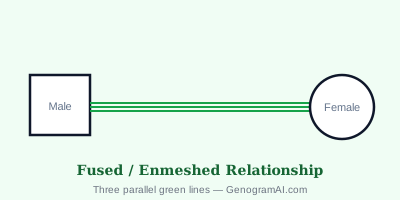 Fused or Fused or 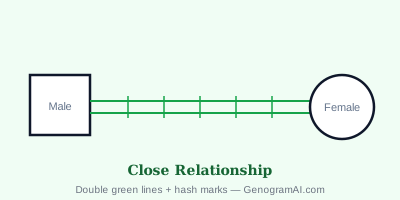 Close Close | Fused or cutoff ties (lower) versus close ties that tolerate disagreement (higher) |
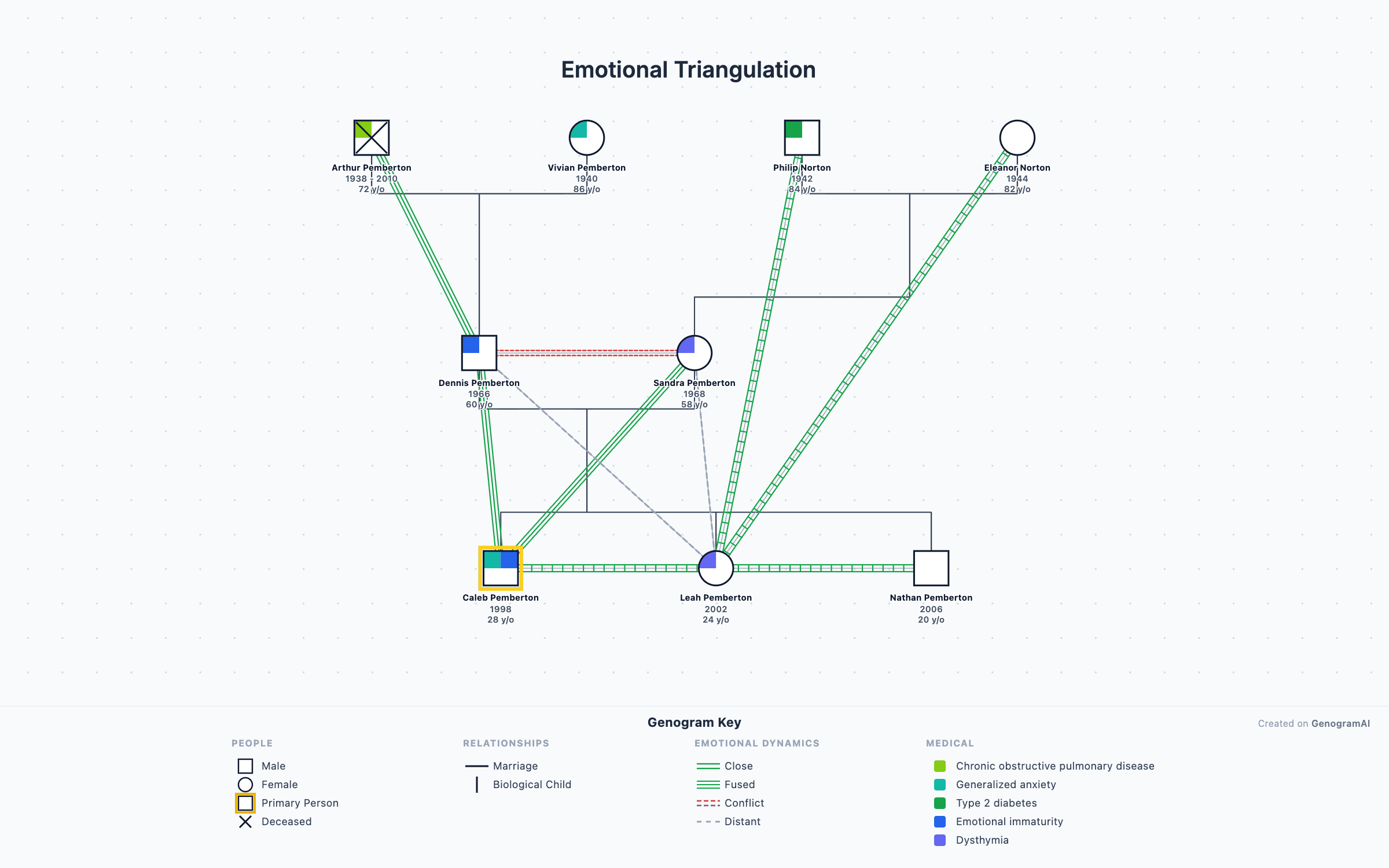
| Triangles | Close plus 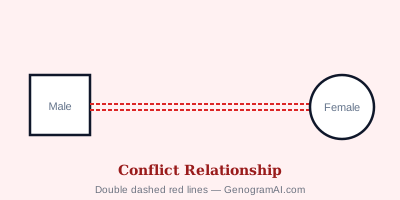 Conflict Conflict | Two people allied, both distant or in conflict with a third; who is pulled in when tension rises |
| Nuclear family emotional system | Conflict lines, symptoms, distance | Which of the four patterns dominates: conflict, a symptomatic spouse, an impaired child, or distance |
| Family projection process | Symptom notes on one child | The child who was the focus of parental worry, generation after generation |
| Multigenerational transmission | Repeating marks over 3+ generations | The same triangle, cutoff or symptom recurring at similar ages or life stages |
| Emotional cutoff | 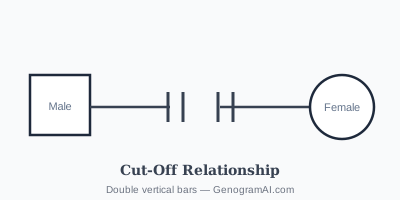 Cutoff Cutoff | Estrangement and what happened just before it; cutoffs repeating across generations |
| Sibling position | Birth order, left to right | Roles by position, such as oldest daughters becoming caretakers |
| Societal emotional process | Dates and notes on events | War, migration and economic hardship on the family timeline |
Every emotional line is drawn and explained in the genogram symbols guide.
Bowen's eight concepts in genogram practice
Differentiation of Self
The ability to be an individual while remaining connected to family. High differentiation means being able to think clearly under emotional pressure.
Genogram application: Map relationship patterns—enmeshment (low differentiation) vs. balanced closeness (higher differentiation). Look for who can disagree without cutting off.
Questions to explore
- Who in the family can hold different opinions without conflict?
- Who gets most reactive under stress?
- Are there people who lose themselves in relationships?
Triangles
Three-person emotional systems that form when anxiety increases between two people. A third person is drawn in to stabilize the dyad.
Genogram application: Identify recurring three-person patterns. Who gets pulled in when parents fight? Who mediates? Who is excluded?
Questions to explore
- When your parents had conflict, who got involved?
- Is there someone who always seems to be in the middle?
- Who are the insiders and outsiders in family groupings?
Nuclear Family Emotional System
Four patterns for managing anxiety in a family: marital conflict, dysfunction in a spouse, impairment in children, and emotional distance.
Genogram application: Note which pattern dominates. Is anxiety managed through fighting? Through one person becoming symptomatic? Through distance?
Questions to explore
- How did your parents deal with stress?
- Did anyone develop symptoms during family tension?
- How was conflict handled—fought, avoided, or both?
Family Projection Process
How parents transmit their anxiety and low differentiation to children. Usually one child is most "triangled" and absorbs family anxiety.
Genogram application: Identify which child(ren) became the focus of parental anxiety. Who was the "problem child" or the "perfect child"?
Questions to explore
- Which child did parents worry about most?
- Was there a child who seemed most affected by family stress?
- Who was seen as the successful one vs. the troubled one?
Multigenerational Transmission
How patterns of functioning pass through generations. Each generation's differentiation level tends to match or decrease from the previous.
Genogram application: Trace patterns across three or more generations. Do you see the same triangles, cutoffs, or symptoms repeating?
Questions to explore
- Are there patterns that seem to repeat each generation?
- Who in the family is most like a grandparent?
- What family patterns would you want to change for your children?
Emotional Cutoff
Managing unresolved emotional issues by reducing contact. May look like independence but indicates unresolved fusion.
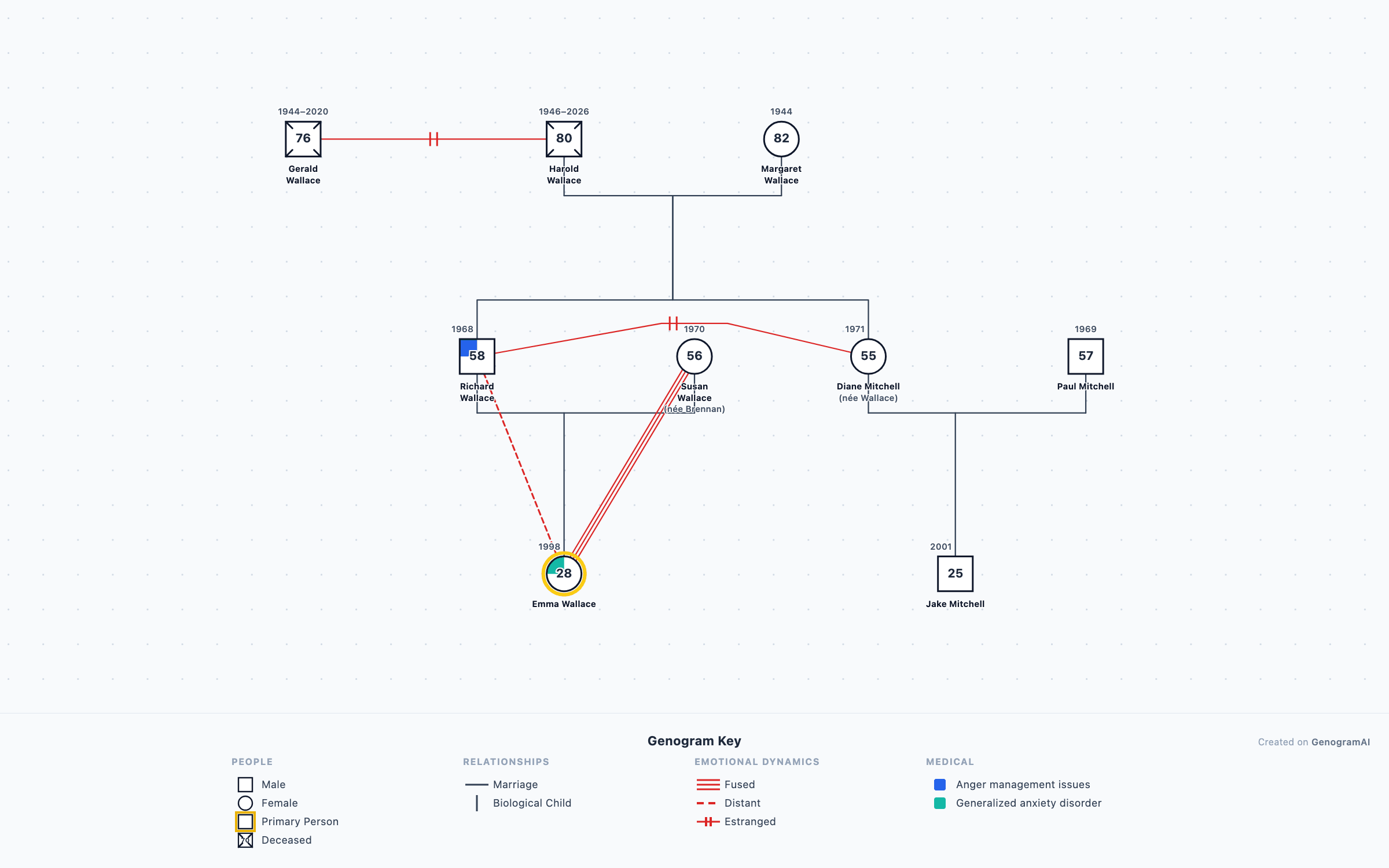
Genogram application: Mark cutoffs with the cutoff line (a line broken by two short bars). Look for patterns—do people cut off around certain ages or events?
Questions to explore
- Is anyone in the family not speaking to others?
- Have there been estrangements in previous generations?
- What happened before the cutoff?
Sibling Position
Birth order affects personality characteristics. Oldest children tend to be leaders, youngest more carefree, middles often mediators.
Genogram application: Note birth order for all family members. Look for patterns—do oldest daughters always become caretakers?
Questions to explore
- What role did you play in your sibling group?
- Is there a pattern of oldest children taking certain roles?
- How does birth order play out in your parents' generation?
Societal Emotional Process
Family patterns exist within and are influenced by broader societal emotional processes.
Genogram application: Consider historical context—war, immigration, economic hardship. How did societal events affect family patterns?
Questions to explore
- How did historical events affect your family?
- Were there societal stressors that shaped family patterns?
- How does culture influence family emotional processes?
How do you show triangulation on a genogram?
Common family triangles
- Mother-Father-Child: Child stabilizes parental tension
- Spouse-Spouse-In-law: In-law becomes the "problem"
- Parent-Child-Therapist: Professional as third party
- Spouses-Work/Affair: Outside focus reduces marital anxiety
- Parent-Parent-Symptom: Child's symptoms unite parents
Interlocking triangles
Triangles connect to form larger systems. A child triangled with parents may triangle their own child, creating an interlocking pattern across generations.
On genograms, trace how triangles link: the grandmother who was triangled with her parents now triangles with her daughter and grandson.
"Detriangling", learning to stay connected to both parties without taking sides, is a key therapeutic goal in Bowenian work.
Mapping differentiation levels
| Lower differentiation | Moderate differentiation | Higher differentiation |
|---|---|---|
| Enmeshed/fused relationships | Some enmeshment patterns | Close but not fused |
| Emotional cutoffs | Partial cutoffs possible | Connected without reactivity |
| High reactivity to family | Some ability to stay calm | Stays calm under pressure |
| Difficulty with disagreement | Can function well normally | Tolerates differences |
| Symptoms under stress | Struggles under high stress | Maintains positions calmly |
Using Bowenian genograms therapeutically
1. Assessment: create a three-generation genogram while noting Bowenian concepts
- Where are the triangles?
- Who has cut off from whom?
- Which relationships show fusion?
- Who carries family anxiety?
- What patterns repeat across generations?
- How do sibling positions affect roles?
2. Psychoeducation
Help clients understand their position in the system.
Try saying: "Looking at your genogram, I see a pattern where the oldest daughter in each generation becomes the family caretaker and peacekeeper. Your grandmother did it, your mother did it, and now you're doing it. This isn't coincidence; it's a family emotional process. You inherited this role."
3. Differentiation work
Use the genogram to plan differentiation moves.
Try saying: "You've been in this triangle with your parents your whole life: when they fight, you get pulled in to mediate. One differentiation goal might be staying connected to each of them without taking sides or fixing things. What would it be like to let them work it out themselves?"
4. Reconnecting after cutoff
Plan thoughtful reconnection with cut-off family members.
Try saying: "The cutoff with your brother mirrors your father's cutoff with his brother. In Bowenian work, we'd say the emotional issue didn't go away; it just got managed through distance. Healing that cutoff could increase your differentiation and break the pattern for the next generation."
Bowen genograms: questions
What is a Bowen family systems genogram?
A Bowen family systems genogram is a genogram specifically designed to visualize concepts from Murray Bowen's family systems theory: differentiation of self, triangles, nuclear family emotional processes, multigenerational transmission, emotional cutoffs, and sibling position. It maps how these dynamics operate across generations.
How do I show triangulation on a genogram?
Triangles can be shown by drawing a triangle shape connecting three people, or by using relationship lines that show how two people relate through a third. For example, an enmeshed mother-son relationship with a distant father-son relationship suggests the mother-son dyad may be stabilized by excluding the father.
What is differentiation of self and how do I map it?
Differentiation is the ability to maintain your sense of self while staying emotionally connected to others. On genograms, lower differentiation shows as enmeshed or cutoff relationships (both are fusion). Higher differentiation shows as close but not enmeshed relationships with the ability to tolerate differences.
How do I identify emotional cutoffs on a genogram?
Emotional cutoffs are shown with a broken line with two perpendicular marks. Look for family members who are estranged, don't speak, or have minimal contact. Cutoffs often occur after conflict and may repeat across generations—a family pattern of dealing with tension by distance.
What is multigenerational transmission and how does the genogram show it?
Multigenerational transmission is how family patterns, anxiety levels, and differentiation levels pass through generations. The genogram reveals this by showing similar patterns repeating: triangles forming in each generation, cutoffs at similar life stages, or certain roles (like caretaker) being passed to specific children.
Further Reading
- Bowen, M. — Family Therapy in Clinical Practice. Jason Aronson, 1978
- Kerr, M.E., & Bowen, M. — Family Evaluation: An Approach Based on Bowen Theory. W.W. Norton & Company, 1988
- McGoldrick, M., Gerson, R., & Petry, S. — Genograms: Assessment and Treatment (4th ed.). W.W. Norton & Company, 2020
- DeMaria, R., Weeks, G., & Twist, M. — Focused Genograms: Intergenerational Assessment of Individuals, Couples, and Families (2nd ed.). Routledge, 2017