Clinical guide
Attachment theory genograms
Quick answer
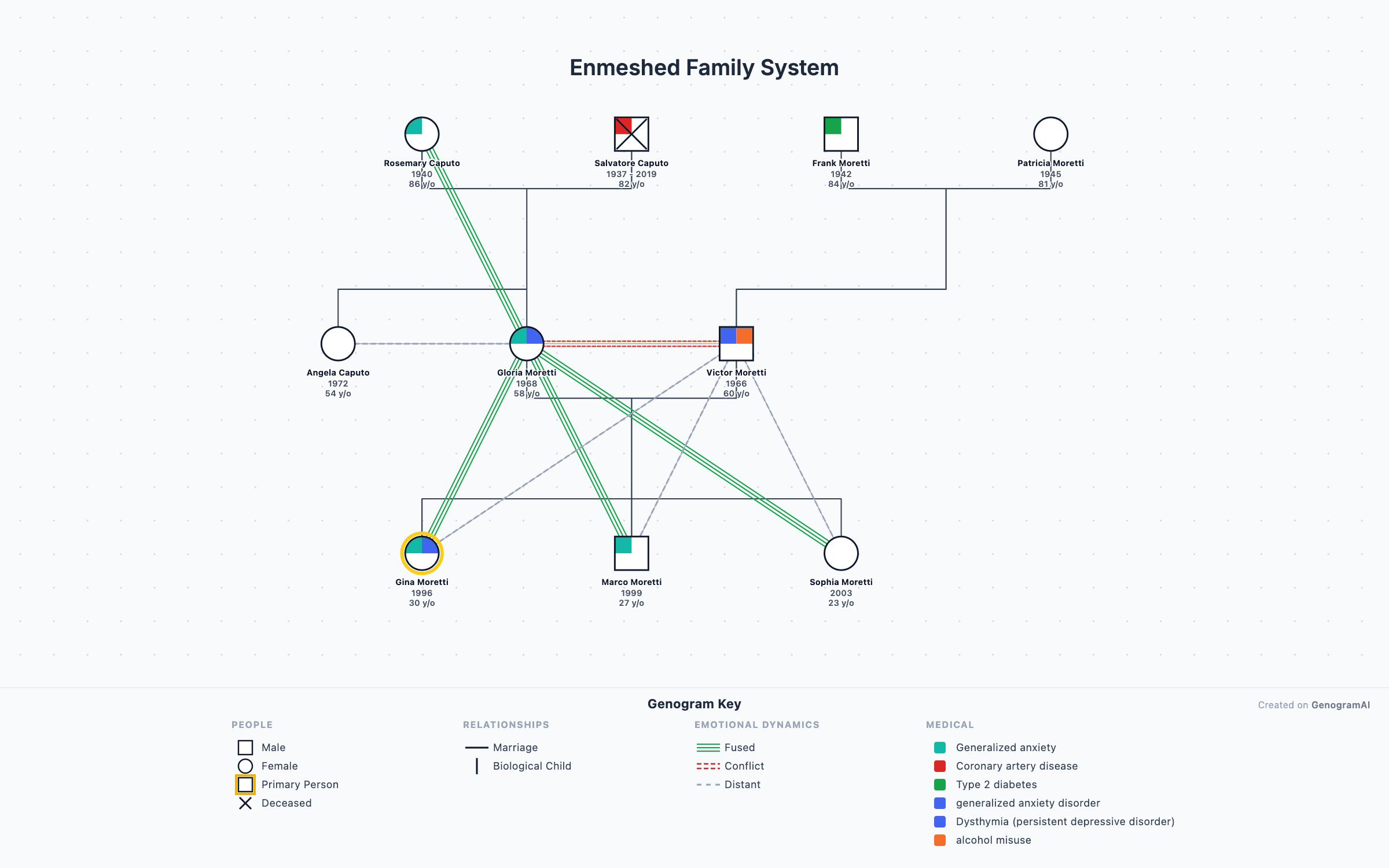
Attachment meets family systems
Attachment theory, developed by John Bowlby and expanded by Mary Ainsworth, explains how early caregiver relationships shape our capacity for intimacy throughout life. When we combine attachment theory with genogram mapping, we can see how attachment patterns flow through generations.
An anxiously attached parent, for example, may have had an anxiously attached parent themselves. Or they may have developed anxious attachment in response to an avoidant caregiver. The genogram makes these patterns visible, helping clients understand their attachment style in context.
Research foundation
What are the four attachment styles on a genogram?
Secure attachment
Comfortable with intimacy and independence. Can depend on others and be depended upon.
Origins: Consistent, responsive caregiving. Caregiver attuned to child's needs.
Genogram indicators
- Close but not enmeshed parent-child relationships
- Healthy autonomy alongside connection
- Stable family structure
- Effective repair after conflict
Anxious attachment
Craves closeness but fears abandonment. Hypervigilant to relationship threats.
Origins: Inconsistent caregiving. Caregiver sometimes responsive, sometimes unavailable.
Genogram indicators
- Enmeshed or fused relationships
- Caretaking roles from young age
- Parental anxiety or depression
- Patterns of pursuing/withdrawing in relationships
Avoidant attachment
Values independence highly. Uncomfortable with closeness and emotional expression.
Origins: Emotionally unavailable caregiving. Child learned to self-soothe and minimize needs.
Genogram indicators
- Distant or cutoff relationships
- Emotional restraint in family culture
- Parents who were physically present but emotionally absent
- Multiple generations of emotional distance
Disorganized attachment
Conflicted about relationships. May both seek and fear closeness.
Origins: Frightening or frightened caregiving. Caregiver was source of both comfort and fear.
Genogram indicators
- Trauma, abuse, or neglect in family history
- Unresolved parental loss or trauma
- Chaotic family patterns
- Contradictory relationship patterns (close-hostile)
Which relationship lines suggest an attachment pattern?
| Relationship line | Possible attachment indicator | Caveat |
|---|---|---|
| Close (parent-child) | Secure base: responsive, attuned caregiving | Closeness alone does not confirm security; check for repair after conflict |
| Fused / enmeshed | Anxious attachment, parentified child | Can also reflect cultural norms of family closeness |
| Distant | Avoidant attachment, emotionally unavailable caregiver | May be recent or situational (geography, illness) |
| Cutoff | Avoidant strategy, or a protective response to harm | A cutoff can be healthy when it ends exposure to abuse |
| Hostile / close-hostile | Disorganized attachment, frightening caregiving | Ask about trauma history before drawing conclusions |
| Abuse / neglect lines | High risk for disorganized attachment | Document carefully; follow safeguarding duties |
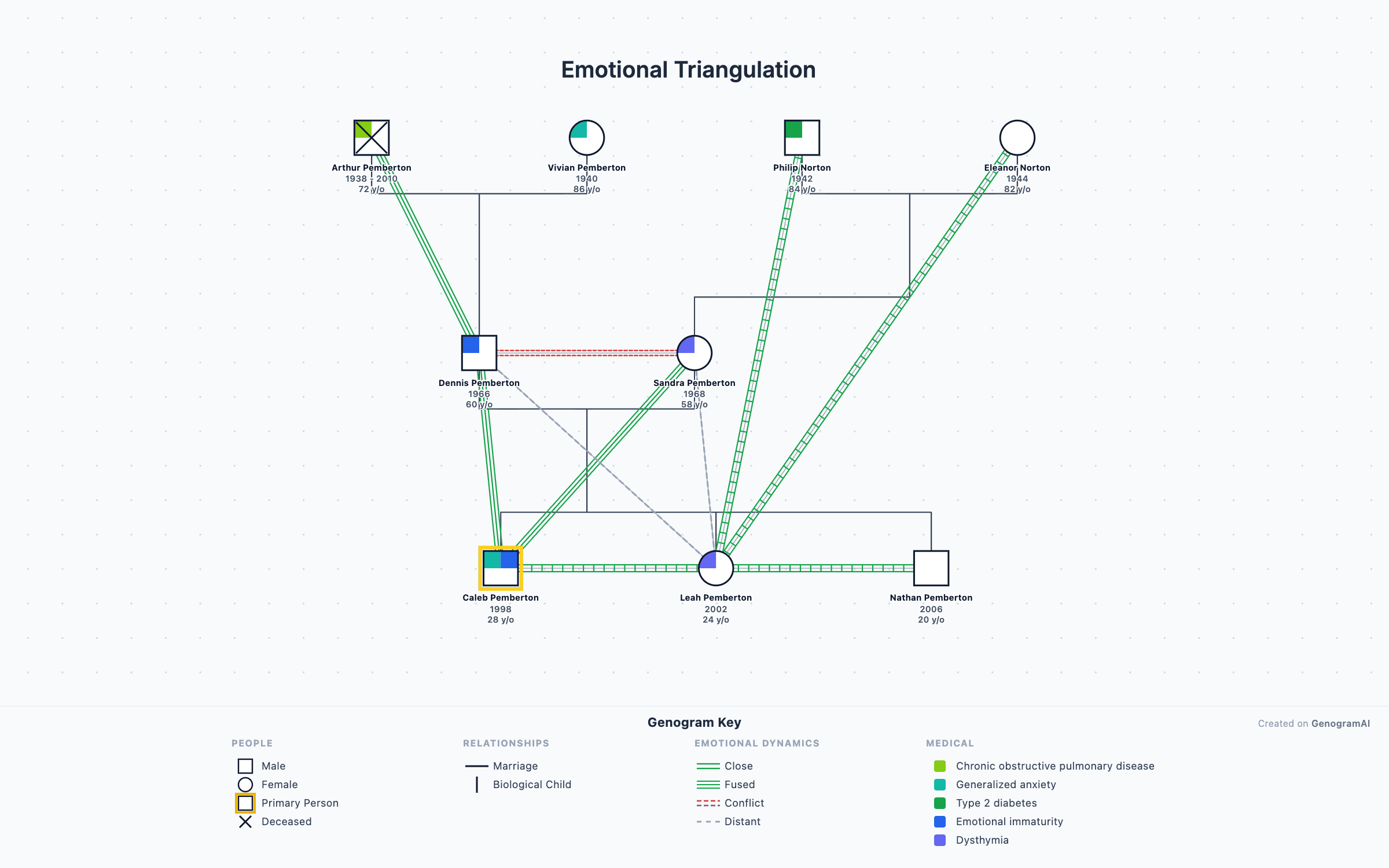
How do you mark attachment styles on a genogram?
- 1
Start with standard structure
Begin with a standard three-generation genogram showing family structure, deaths, and basic relationship patterns. This provides the foundation for attachment analysis. - 2
Gather attachment history
Ask specific questions about early caregiving experiences: Who was your primary caregiver? How would you describe that relationship? Were they emotionally available? Were there separations or losses? How did they respond when you were upset? What happened when you needed comfort? - 3
Identify attachment-relevant events
Mark events that impact attachment: early parental loss or separation, hospitalizations (parent or child), parental mental illness or addiction, abuse, neglect, or trauma, divorce or family disruption, immigration or displacement. - 4
Code attachment styles
Add attachment style information using your chosen notation: a colour per style or a short letter code next to each person (see the legend below). - 5
Trace transmission patterns
Look for patterns in how attachment styles move through generations. Note where patterns continue (anxious parent to anxious child) and where they shift (avoidant parent to anxious child who sought connection elsewhere).
| Style | Letter code | Common colour code |
|---|---|---|
| Secure | S | Green |
| Anxious | A | Yellow / amber |
| Avoidant | Av | Blue |
| Disorganized | D | Red |
How do clinicians use an attachment genogram?
Individual therapy
Help clients understand their attachment style in context:
"Looking at your genogram, I notice both your mother and grandmother had relationships where they pursued partners who withdrew. This anxious pattern has been in your family for generations. It makes sense that you learned to relate this way. It's what was modeled for you."
Couples therapy
Compare attachment histories to understand couple dynamics:
"Your genograms show a classic anxious-avoidant pairing. Sarah, your family was enmeshed; closeness was everything. Mike, your family valued independence above all. You're each doing what you learned, but it creates a painful cycle."
Parenting work
Help parents break intergenerational cycles:
"Your genogram shows that emotional distance was normal in your family. No one hugged or said "I love you." You're working to be different with your kids. That's you actively changing the pattern."
Trauma-informed work
Understand disorganized attachment in context of family trauma:
"The disorganized attachment you experience makes sense when we see the unresolved trauma in your family. Your mother's own unprocessed grief meant she was sometimes frightened herself when you needed comfort."
Signs the pattern continued
- Same line type repeats parent-child in two or more generations
- Similar losses at similar ages
- Partner choice mirrors a parent's relationship
Signs the pattern shifted
- A close line appears after generations of distance
- A parent who sought therapy or a secure partner
- Earned security after a difficult childhood
Frequently asked questions
What is an attachment-focused genogram?
An attachment-focused genogram maps attachment styles and patterns across generations. It shows how secure, anxious, avoidant, or disorganized attachment develops in family contexts, revealing caregiver relationships, early separations, trauma, and the transmission of attachment patterns from parent to child.
How do I mark attachment styles on a genogram?
There's no universal standard, but common approaches include: using color coding (e.g., green for secure, yellow for anxious, blue for avoidant, red for disorganized), adding letter codes near individuals (S, A, Av, D), or using relationship lines that indicate attachment quality between parent and child.
How does attachment relate to genogram relationship lines?
Standard genogram relationship lines (close, enmeshed, distant, conflictual) often correlate with attachment patterns. Enmeshed relationships may indicate anxious attachment; distant relationships often reflect avoidant attachment. However, attachment is specifically about early caregiver bonds, while relationship lines describe current dynamics.
Can attachment patterns be seen across generations in genograms?
Yes. A meta-analysis of Adult Attachment Interview studies (van IJzendoorn, 1995) found about 75% correspondence between a parent's attachment classification and their infant's (secure vs. insecure). Genograms can reveal these patterns: an anxiously attached parent often had an anxiously attached parent themselves, creating multigenerational cycles.
How is attachment theory different from Bowen family systems theory?
Both examine multigenerational patterns but from different angles. Bowen focuses on differentiation and emotional reactivity in the family system. Attachment theory focuses specifically on early caregiver bonds and their lasting impact. Many clinicians integrate both perspectives in their genogram work.
Further Reading
- McGoldrick, M., Gerson, R., & Petry, S. — Genograms: Assessment and Treatment (4th ed.). W.W. Norton & Company, 2020
- DeMaria, R., Weeks, G., & Twist, M. — Focused Genograms: Intergenerational Assessment of Individuals, Couples, and Families (2nd ed.). Routledge, 2017
- Byng-Hall, J. — Rewriting Family Scripts: Improvisation and Systems Change. Guilford Press, 1995
- van IJzendoorn, M. H. — Adult attachment representations, parental responsiveness, and infant attachment: A meta-analysis on the predictive validity of the Adult Attachment Interview. Psychological Bulletin, 117(3), 387-403, 1995
- Bowlby, J. — A Secure Base: Parent-Child Attachment and Healthy Human Development. Basic Books, 1988