Genogram Symbols
Complete visual reference — 150+ symbols across 11 categories
Last updated: · Based on McGoldrick, Gerson & Petry (2020, 4th ed.)
Genogram symbols are standardized shapes, lines, and icons used to represent people, relationships, and clinical information in a genogram. The international standard — defined by Monica McGoldrick, Randy Gerson, and Sueli Petry in Genograms: Assessment and Intervention (4th ed., W.W. Norton, 2020) — specifies squares for males, circles for females, horizontal lines for couple relationships, and vertical lines for parent-child connections, with line styles, colors, and overlays conveying emotional, medical, and cultural data.
This reference covers all 150+ symbols supported in GenogramAI: person shapes, life status indicators, family relationship lines, child connections, twins, emotional dynamics, medical conditions, cultural heritage patterns, religion, social class, and immigration markers.
The core symbols at a glance
| Symbol | Meaning |
|---|---|
| Square | Male |
| Circle | Female |
| Diamond | Gender unknown / unspecified |
| X through a shape | Deceased |
| Double outline | Index person (the subject of the genogram) |
| Horizontal line between two people | Marriage / partnership |
| Two slashes (//) on the line | Divorce |
| One slash (/) on the line | Separation |
| Dashed horizontal line | Cohabitation / unmarried partnership |
| Vertical line from a couple | Biological child |
| Dashed vertical line | Adopted or foster child |
| Triangle | Pregnancy; with an X, miscarriage or abortion |
| Zigzag line | Conflictual / hostile relationship |
| Three parallel lines | Fused (enmeshed) relationship |
| Cut line with a break | Estrangement / cutoff |
Click any row for the full notation, variants, and clinical usage. One-page version: genogram key & legend.
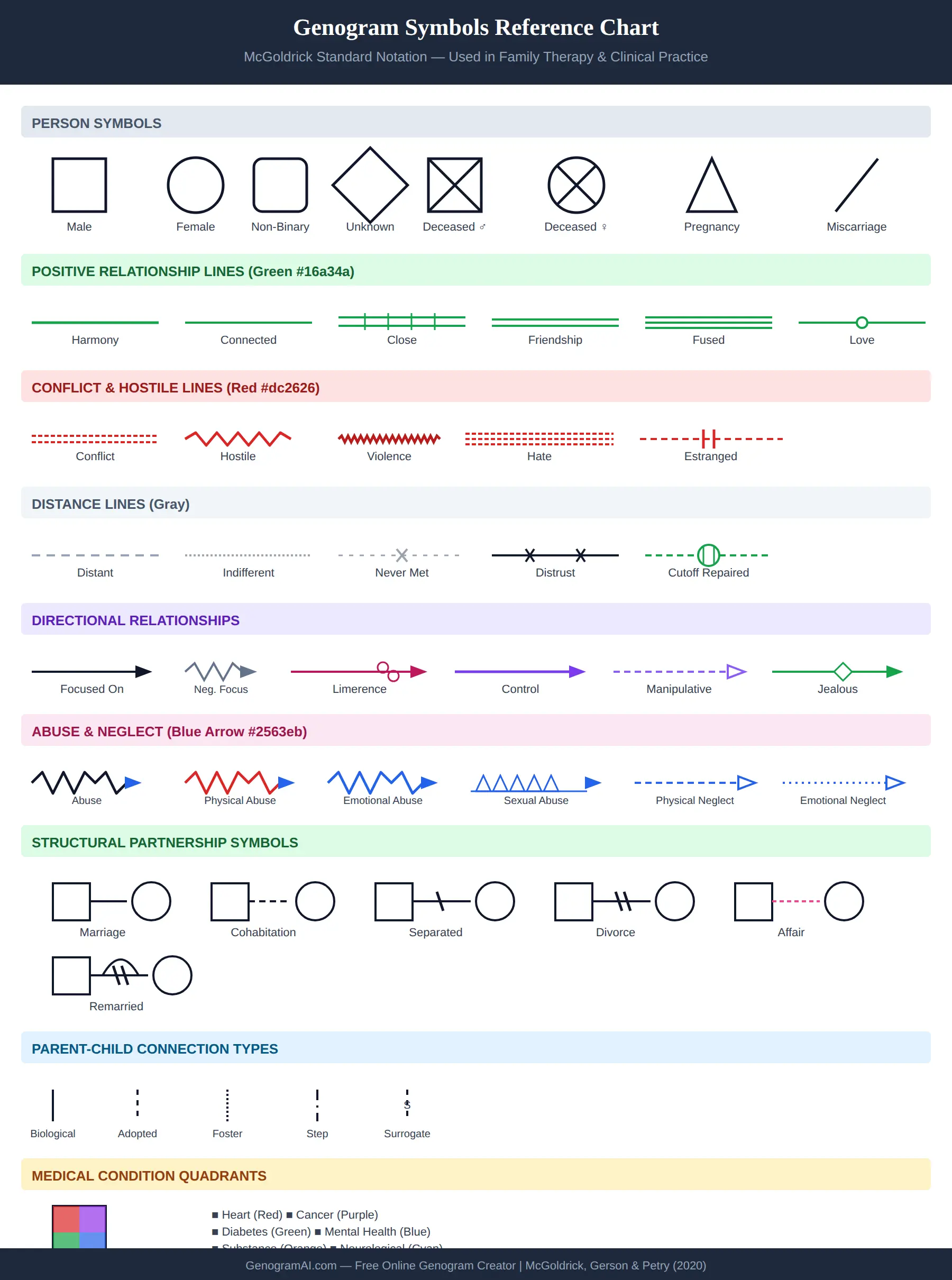
About these guides: Each symbol page includes the standard notation, clinical significance, therapeutic applications, and step-by-step instructions for use in GenogramAI. Content is based on “Genograms: Assessment and Treatment” (4th ed.) by McGoldrick, Gerson, and Petry.
Person Symbols
Each person in a genogram is represented by a shape that indicates their gender identity. These shapes are the foundational building blocks of every genogram.
Life Status Indicators
Symbols overlaid on or replacing person shapes to indicate alive, deceased, pregnancy, and pregnancy loss.
Family Relationship Lines
Horizontal lines connecting partners represent different types of romantic, legal, and sexual relationships. Stroke styles, dash patterns, and slash marks distinguish each type.
Marriage Symbol
Solid line connecting partners, clinical context
Divorce Symbol
Double slash marks indicating legal dissolution
For an in-depth breakdown of every line style used in genograms, see our complete genogram relationship lines guide. Need a compact one-page reference instead? See the genogram key — every symbol and line at a glance.
Child Connection Lines
Vertical lines descending from a couple's relationship line to a child. Different dash patterns indicate the type of parent-child connection.
When a parent has children across more than one marriage, each union gets its own separated child line back to the correct couple bar. Where these descent lines must cross marriage bars, sibling brackets, or staircase connectors, GenogramAI tunnels them automatically so the chart stays readable — see Line tunneling in genogram design.
Twin Types
Twins are shown as two child lines emerging from a single point on the couple line. A horizontal bar between the lines distinguishes identical from fraternal twins.
Emotional Dynamics
Wavy, dashed, and colored lines drawn alongside or between people to document the emotional quality of relationships. All 38 types are listed below, grouped by what they describe: positive bonds, fusion, distance and cutoff, conflict, abuse and neglect, and directional patterns.
Visual Reference
Positive bonds
7Fusion & enmeshment
4Distance & cutoff
7Conflict & hostility
8Abuse & neglect
8Directional
4All 38 emotional line types, drawn exactly as GenogramAI renders them on the canvas. Line colour carries meaning: blue for closeness, green for positive regard, red for conflict, slate for distance.
Positive Bonds
Harmony
Balanced, peaceful relationship
Close
Warm, supportive emotional bond with healthy boundaries
Fused/Enmeshed
Over-involved relationship with blurred boundaries
Love
Deep affection and caring bond
In Love
Romantic love between partners
Attachment
Secure attachment bond
Friendship
Non-familial supportive bond
Limerence
Intense involuntary romantic attraction
Connected
Basic relationship connection exists
Distance & Boundaries
Distant
Emotional disconnection despite structural relationship
Estranged
Between distant and complete cutoff
Cutoff
Complete emotional disconnection
Cutoff Repaired
Previously cutoff, now restored
Indifferent
Lack of emotional investment
Never Met
Family members who have never had contact
Conflict & Hostility
Conflict
Active tension and arguments
Hostile
Active antagonism and tension
Violence
Physical violence or threat
Hate
Deep-seated animosity and rejection
Distrust
Lack of trust or suspicion
Close-Hostile
Volatile intimacy with conflict
Distant-Hostile
Cold antagonism with limited contact
Fused-Hostile
Enmeshment combined with active conflict
Abuse & Control
Abuse (General)
Generic abuse pattern
Physical Abuse
Physical violence or harm
Emotional Abuse
Psychological harm and manipulation
Sexual Abuse
Sexual violation or exploitation
Physical Neglect
Failure to provide adequate care
Emotional Neglect
Failure to provide emotional support
Control
Exerts dominant control over another
Manipulative
Covert influence or psychological manipulation
Directional Patterns
Focused On
Intensely focused on another person
Focused On Negatively
Persistent negative attention
Caretaker
Provides care for another
Fan/Admirer
Admiration or fan relationship
Jealous
Jealousy-driven dynamic
Want to see these emotional dynamics drawn on a real family map? Browse our emotional patterns genogram example or explore the full relationship lines reference.
Medical Categories
GenogramAI supports 21 color-coded medical categories. Each category fills a quadrant of the person shape, allowing up to four conditions per individual. Colors follow clinical conventions.
Medical Status Modifiers
Each medical condition can carry a status modifier that changes how the quadrant fill is rendered.
Active
Solid fill
Recovery / Remission
Diagonal stripes
Suspected
Faded (30% opacity)
Example: Person with 4 medical conditions
Top-left: Heart Disease
Top-right: Cancer
Bottom-left: Diabetes
Bottom-right: Mental Health
Cultural Heritage Patterns
Pattern fills applied to person shapes to represent cultural or ethnic heritage. Assign different patterns to visually distinguish heritage backgrounds across the genogram.
Example: Family with different cultural backgrounds
A couple where each partner has a different cultural background. The male (crosshatch) and female (horizontal lines) each have a distinct pattern. Assign one pattern per family member to visually distinguish heritage.
Religion Indicators
Small icons in the top-left corner of a person shape indicate religious affiliation. GenogramAI supports 13 religion indicators. A non-practicing person keeps the faith icon but the badge is drawn with a dashed ring and the label gains a "(non-practicing)" suffix.
Non-practicing: any faith can be marked non-practicing. The faith icon stays, but the badge ring is drawn dashed and the person's label picks up a "(non-practicing)" suffix — for example Christianity (non-practicing).
Other Markers
Additional visual indicators that can be applied to person nodes for immigration status, primary person designation, and location.
Sexual Orientation Indicators
A small triangle icon placed in the top-right corner of a person shape indicates sexual orientation. Heterosexual is the default (no indicator shown). All other orientations display a triangle; the asexual indicator adds a filled circle inside the triangle.
Education Level Indicators
A color-coded badge displayed below the person shape indicates highest educational attainment. Each level has a standardized abbreviation and color. This is a GenogramAI extension beyond the McGoldrick standard.
McGoldrick Standard vs. GenogramAI Extended
GenogramAI implements the full McGoldrick-Gerson-Petry 4th edition (2020) standard and extends it with additional symbol types for modern clinical practice. The table below distinguishes what is standardized notation from what GenogramAI has added.
| Symbol Category | McGoldrick 2020 Standard | GenogramAI Extensions |
|---|---|---|
| Person Shapes | Male (square), Female (circle), Unknown (diamond) | Non-Binary (rounded square), Trans Male, Trans Female, Intersex, Pet (hexagon) |
| Life Status | Alive, Deceased (X), Pregnancy (triangle), Miscarriage, Stillbirth, Abortion | Childless marker (diagonal slash) |
| Couple Relationships | Marriage, Divorce, Separation, Legal Separation, Cohabitation | Engagement, Dating, Life Partner, Living Apart Together, Annulment, Remarriage, Widowed, Affair, Affair-Separation, Affair-Divorce, One Night Stand, Rape |
| Child Connections | Biological, Adopted, Foster | Step Child, Surrogate, Sperm Donor, Egg Donor |
| Twin Types | Identical twins, Fraternal twins | — |
| Emotional Dynamics | Close, Distant, Conflict, Fused/Enmeshed, Cutoff, Hostile, Abuse (~10 types) | 38 total types including: Harmony, Love, In Love, Attachment, Friendship, Limerence, Estranged, Never Met, Hate, Distrust, Violence, Close-Hostile, Distant-Hostile, Fused-Hostile, Close-Violence, Distant-Violence, Physical/Emotional/Sexual Abuse, Physical/Emotional Neglect, Control, Manipulative, Focused On, Caretaker, Jealous, Cutoff Repaired |
| Medical Information | 4 color-coded quadrants (conditions unspecified) | 21 named categories (Heart, Cancer, Diabetes, Mental Health, Substance, Neurological, Respiratory, Autoimmune, Genetic, Reproductive, Anxiety, Bipolar, Depression, PTSD, OCD, ADHD, Eating Disorder, Schizophrenia, Trauma, Learning Disability, Other) + Active/Recovery/Suspected status modifiers |
| Cultural Heritage | Pattern fills mentioned (no specific patterns defined) | 12 patterns: Horizontal, Vertical, Diagonal Right/Left, Crosshatch, Dots, Checkerboard, Zigzag, Waves, Diamonds, Braid |
| Religion | Not defined in 4th edition standard | 13 indicators: Christianity, Catholic, Orthodox, Mormon, Jehovah's Witness, Judaism, Islam, Buddhism, Hinduism, Sikhism, Spiritual, None, Other — plus a non-practicing modifier (dashed ring + label suffix) |
| Social Class | Not defined in 4th edition standard | 5 levels: Upper, Upper-Middle, Middle, Working, Poverty (five-slot filled $ scale — filled green $ glyphs count the level) |
| Sexual Orientation | Not defined in 4th edition standard | 8 types via triangle indicator: Heterosexual, Gay, Lesbian, Bisexual, Asexual, Pansexual, Queer, Unknown |
| Education Level | Not defined in 4th edition standard | 10 levels via color-coded badge: No Formal, Primary, High School, Vocational, Some College, Associate's, Bachelor's, Master's, Doctorate, Professional |
| Immigration Markers | Squiggle lines mentioned for immigration | Single squiggle (lived in 2+ cultures), Double squiggle (immigrant) |
Reference: McGoldrick, M., Gerson, R., & Petry, S. (2020). Genograms: Assessment and Intervention (4th ed.). W.W. Norton & Company.
Frequently Asked Questions About Genogram Symbols
What are the standard genogram symbols?
Squares for males, circles for females, triangles for pregnancies. Horizontal lines connect couples, vertical lines show parent-child relationships. An X overlay marks deceased individuals. These shapes follow the McGoldrick-Gerson-Petry 4th edition (2020) international standard used by therapists, social workers, and physicians worldwide.
What does a square mean in a genogram?
A square represents a male individual. If the square has an X drawn through it, the person is deceased. A small square with an X indicates a stillbirth. Squares with inner circles indicate a transgender male identity. The square shape has been the standard male symbol in genograms since the notation was formalized by Murray Bowen and standardized by McGoldrick and Gerson in 1985.
What do the lines mean in a genogram?
Horizontal lines between shapes represent couple relationships — solid lines for marriage, dashed lines for cohabitation, and slashed lines for divorce or separation. Vertical lines descending from a couple line represent children — solid for biological, dashed for adopted, dotted for foster. Wavy or colored lines drawn alongside these structural lines represent emotional relationship qualities such as close, conflict, distant, or fused.
How many genogram symbols are there?
The McGoldrick-Gerson-Petry standard includes over 150 symbols covering person shapes (male, female, non-binary, trans, intersex), life status (alive, deceased, pregnancy, miscarriage, stillbirth), family relationships (marriage, divorce, cohabitation, separation), child connections (biological, adopted, foster, step), emotional dynamics (38 types spanning close to cutoff), medical categories (21 color-coded conditions), and cultural/social markers (heritage, religion, social class, immigration).
What is the symbol for divorce in a genogram?
Divorce is represented by two diagonal slash marks (/ /) across the horizontal couple line. A single slash (/) indicates separation. A vertical bar (|) indicates legal separation. An X mark on the line indicates widowhood. These slash marks have been the standard divorce notation since McGoldrick and Gerson codified the system in Genograms in Family Assessment (1985).
What does a circle mean in a genogram?
A circle represents a female individual. A circle with an X through it indicates a deceased female. A small circle marked with an X is a miscarriage. If a circle contains a small inner square, it represents a transgender female. The circle symbol originated with Murray Bowen's family systems theory work in the 1960s and was formally standardized by Monica McGoldrick and Randy Gerson.
What does "fused" mean in a genogram?
A fused (or enmeshed) relationship in a genogram is drawn as three parallel lines between two people instead of one. It indicates an overly close bond where individual boundaries are blurred — common in parent-child dynamics or couple relationships characterized by emotional enmeshment. Murray Bowen termed this "fusion," and it is one of the most clinically significant emotional patterns captured in genogram notation.
What does a fused-hostile relationship look like in a genogram?
A fused-hostile relationship combines the three-parallel-line enmeshment symbol with a jagged zigzag line running alongside it. This pattern represents a relationship that is simultaneously overinvested and conflictual — sometimes called a "can't live with them, can't live without them" dynamic. It is drawn as three close parallel lines with a red zigzag underneath, and it is one of the more complex emotional relationship types in the McGoldrick-Gerson-Petry standard.
What does an arrow mean in a genogram?
An arrow (arrowhead) on a relationship line in a genogram indicates directionality — for example, a one-sided attachment or an influence that flows primarily from one person to another. In McGoldrick notation, certain emotional lines such as limerence (one-sided intense attraction) are drawn with an arrowhead to show the directionality of the feeling. Arrows can also mark the flow of abuse or neglect when combined with the appropriate line pattern.
What does a dashed line mean in a genogram?
A dashed line in a genogram has two distinct meanings depending on context. In structural (family) relationships, a horizontal dashed line between two people indicates cohabitation (living together without marriage). In child connection lines, a dashed vertical line indicates an adopted child. Separately, some emotional relationship types — such as "connected" or "distant" — also use dashed patterns in varying densities to convey the quality of the bond.
What is the symbol for estrangement in a genogram?
Estrangement in a genogram is shown as a solid red horizontal line with two vertical bars (||) crossing through it — the bars mark the break in contact. A relationship that was cut off and has since been repaired keeps the two bars but adds a small circle at the break, drawn in blue. Both belong to the McGoldrick-Gerson-Petry emotional line set.
What is the symbol for adoption in a genogram?
An adopted child is connected to the parents by a dashed vertical line descending from the couple line, in contrast to the solid vertical line used for biological children. The child's shape (square or circle) remains the same — only the connecting line changes. A dotted vertical line indicates a foster child. This notation has been part of the McGoldrick standard since the 1985 first edition.
What does a triangle mean in a genogram?
A triangle in a genogram represents a pregnancy. A triangle with an X through it indicates a miscarriage, and a triangle with an X plus a bar across the base indicates an elective abortion. A stillbirth is drawn differently: it keeps the person’s gender shape (square, circle, diamond or rounded square) but at half size, with an X through it. The triangle shape visually distinguishes in-progress or incomplete life events from living individuals represented by squares and circles.
What is the difference between a genogram key and a genogram legend?
In genogram practice, "key" and "legend" are used interchangeably — both refer to the reference box on the genogram that explains what each symbol, line type, and color means. Neither term has a distinct technical meaning in McGoldrick-Gerson-Petry notation. A complete legend typically shows person shapes (square, circle, triangle), vital status markers (X for deceased), structural relationship lines (marriage, divorce, cohabitation), child connection types, and a sample of emotional relationship line styles.
What are McGoldrick genogram symbols?
McGoldrick genogram symbols refer to the standardized visual notation system developed by Monica McGoldrick and Randy Gerson in their 1985 book Genograms in Family Assessment, later updated with Sueli Petry in the 4th edition (2020). The system covers over 150 symbols: squares (male), circles (female), triangles (pregnancy), X overlays (deceased), horizontal lines for couple relationships (solid = marriage, dashed = cohabitation, slashed = divorce), vertical lines for children, and a full library of emotional relationship line patterns. It is the universal clinical standard used by therapists, social workers, and physicians worldwide.
What do colors mean in a genogram?
Colors in a genogram are used in two main ways. First, medical condition quadrants inside person shapes use color-coded fills to mark specific health categories — for example, red for cardiovascular conditions, blue for mental health, yellow for substance use. Second, emotional relationship lines use color to distinguish relationship quality: green for positive/close bonds, red for conflict or hostility, gray for distance or indifference, and black for abuse or severe dynamics. GenogramAI follows the McGoldrick-Gerson-Petry 4th edition color conventions across Relational, Medical, Cultural, and other canvas views.
Continue Learning
Explore related genogram resources to deepen your understanding of family mapping.
Genogram Relationship Lines
In-depth guide to every line style — marriage, divorce, emotional bonds, conflict, and more.
Genogram Examples
Real-world and fictional family genograms showing these symbols in context.
Genogram Templates
Ready-made templates using these symbols — therapy, social work, medical, and nursing formats.
What Is a Genogram?
A beginner-friendly introduction to genograms, their history, and clinical applications.
Cite This Page
If you reference this genogram symbols guide in academic work, clinical training materials, or published content, please use one of the formats below.
APA
GenogramAI. (2026, June). Genogram symbols: Complete visual reference. https://genogramai.com/guide/genogram-symbols
MLA
“Genogram Symbols — Complete Visual Reference.” GenogramAI, June 2026, genogramai.com/guide/genogram-symbols.
Chicago
GenogramAI. “Genogram Symbols: Complete Visual Reference.” Last modified June 2026. https://genogramai.com/guide/genogram-symbols.
Further Reading
- McGoldrick, M., Gerson, R., & Petry, S. — Genograms: Assessment and Intervention (4th ed.). W.W. Norton & Company, 2020
- DeMaria, R., Weeks, G., & Twist, M. — Focused Genograms: Intergenerational Assessment of Individuals, Couples, and Families (2nd ed.). Routledge, 2017
- Hardy, K.V., & Laszloffy, T.A. — The cultural genogram: Key to training culturally competent family therapists. Journal of Marital and Family Therapy, 21(3), 227–237, 1995
- Bowen, M. — Family Therapy in Clinical Practice. Jason Aronson, 1978
Get the free 22-page Genogram Symbols Reference
All 150+ symbols, relationship types, and medical markers — plus free access to GenogramAI. No credit card required.
Free forever plan available. No spam.
Free Downloadable Guides
Print-ready PDFs you can reference anytime — no sign-up required.
Download Genogram Symbol Chart (PDF)
Get a printable reference with all 150+ genogram symbols. Perfect for quick reference during sessions or teaching.
- All person shapes & life status indicators
- All family relationship & child connection lines
- 31 emotional dynamics types
- Medical, cultural, religion & social class symbols
Try These Symbols in GenogramAI
Create professional genograms with all 150+ symbol types. Our AI can even generate genograms from text descriptions.
No download required • Free to start
Social Class Indicators
A fixed five-slot dollar-sign scale in the corner of a person shape indicates socioeconomic status. Every level shows the same five $ glyphs — the number filled solid green marks the level (Upper = 5, Poverty = 1) while the remaining slots stay ghost gray. There are no colored circles: the count of green $ signs, not a color, encodes the class.
Example: People with socioeconomic indicators
Male with a Middle-class indicator (three of five $ filled green) and Female with an Upper-Middle indicator (four of five filled). The five-slot $ scale sits in the corner of the node — filled glyphs are green (#059669), the remaining slots stay ghost gray. The same scale appears in the legend/key and in exports.