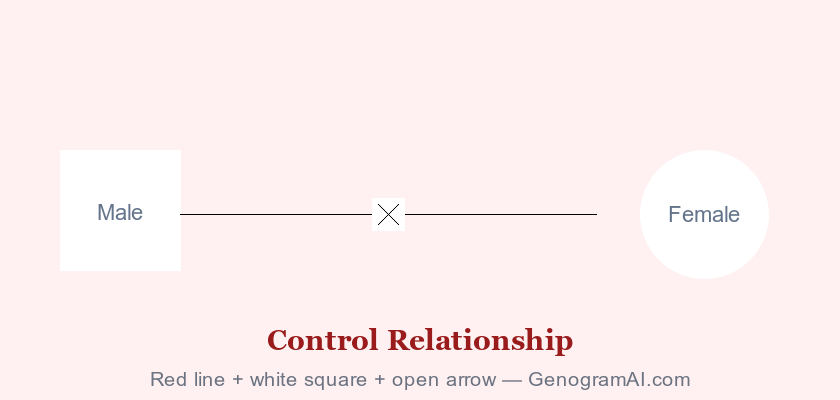
Understanding Control in Genograms
Control represents dominating behavior that restricts another's autonomy. This may include:
- Financial control (limiting access to money)
- Social control (isolating from friends/family)
- Decision control (making all decisions for another)
- Information control (limiting access to information)
- Movement control (restricting where someone can go)
Control vs. Abuse
Control can exist without overt abuse, but coercive control is increasingly recognized as a form of abuse. The distinction matters clinically:
- Some control may be culturally normative (parent-child)
- Coercive control in intimate relationships is abuse
- Control may precede or accompany other abuse forms
When to Use This Symbol
- Financial dependency dynamics: When one family member controls another's access to money, employment decisions, or financial information — whether a spouse managing all accounts or an adult child controlling an elderly parent's finances — the control symbol documents this power imbalance explicitly.
- Overprotective parenting patterns: When a parent's involvement crosses from protective to controlling — monitoring an adult child's every decision, vetoing career choices, or dictating social relationships — this symbol captures the dynamic without automatically labeling it as abuse.
- Multigenerational authority patterns: In some families, one person (often a matriarch or patriarch) exerts disproportionate influence over multiple family members' decisions. Mapping control lines from this person to several relatives reveals the power structure of the family system.
How This Differs From the Abuse Symbol
Control and abuse overlap significantly, but using the correct symbol matters for accurate clinical documentation:
- Control documents a power imbalance where one person restricts another's autonomy. It may or may not involve malicious intent — some controlling behavior stems from anxiety, cultural norms, or misguided protectiveness.
- Abuse documents patterns of active harm — emotional, physical, or sexual. Abuse symbols use zigzag lines to indicate the damaging nature of the interaction.
- The clinical distinction: control may be the mechanism through which abuse operates, but it can also exist independently. A parent who controls an adult child's finances out of anxiety is different from one who does so to punish or dominate. Both warrant documentation, but with different symbols.
How to Add in GenogramAI
- 1Press E to activate the Emotional Relationship tool, then click the controlling person first and drag to the controlled person (the arrow indicates direction of control).
- 2In the relationship type menu, select Control. A purple directional arrow line will appear showing the power flow from controller to controlled.
- 3Add a note specifying the domain of control (financial, social, decision-making, movement) and whether the controlled person recognizes and resists the dynamic or accepts it.
Frequently Asked Questions
Is all parental control considered a negative pattern?
No. Age-appropriate parental guidance and limit-setting are healthy and expected. The control symbol is used when the dynamic exceeds developmental or cultural norms — for example, a parent who dictates an adult child's career, relationships, or daily schedule. Context and cultural sensitivity are essential when making this assessment.
Can control be mutual?
Yes, though it is uncommon. In some relationships, both parties attempt to control different domains (one controls finances, the other controls social interactions). In these cases, you can draw two control arrows in opposite directions, each with a note specifying the domain.
How does coercive control differ from general controlling behavior?
Coercive control is a recognized pattern of abuse involving systematic domination through intimidation, isolation, surveillance, and micromanagement of daily life. It goes beyond individual controlling behaviors to create an environment of ongoing subordination. When coercive control is identified, the abuse symbol may be more appropriate than the control symbol.
Should I document control that the client does not recognize as problematic?
This requires clinical judgment. If a client describes a dynamic that meets the criteria for controlling behavior but does not perceive it as such, you can note the pattern on the genogram while being transparent with the client about what you are documenting. The genogram becomes a tool for gently exploring the dynamic over time.
Related Symbols