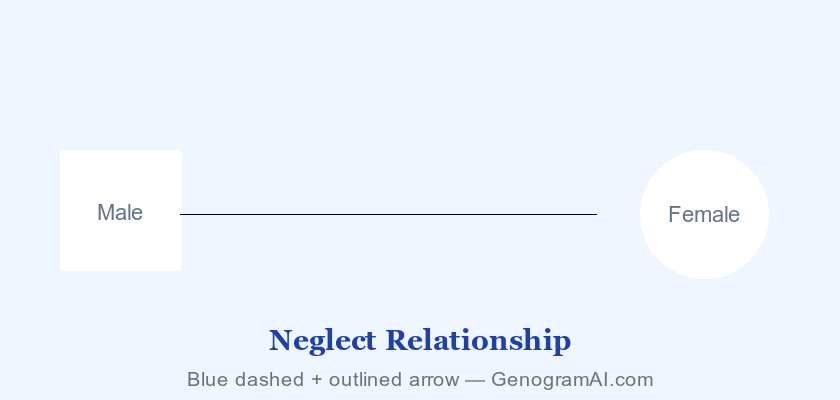
The neglect symbol—a blue dashed arrow line—represents relationships characterized by failure to provide necessary care, attention, or support. Unlike active abuse, neglect is abuse by omission—the harm comes from what isn't done.
Neglecter
Victim
Neglect: Gray arrow with circle
Understanding Neglect
Neglect represents failure to provide necessary care rather than active harm. Types include:
Physical neglect: Failure to provide food, shelter, medical care
Emotional neglect: Failure to provide warmth, attention, responsiveness
Educational neglect: Failure to provide appropriate education
Supervisory neglect: Failure to appropriately monitor children
Clinical Note
Neglect is often harder to identify than active abuse because it involves absence rather than presence of harmful behavior. Its effects can be equally or more damaging, particularly emotional neglect's impact on attachment.
When to Use This Symbol
Parent-child attachment assessment: When a client describes a childhood characterized by emotional unavailability — parents who were physically present but consistently unresponsive to emotional needs — the neglect symbol documents this pattern more precisely than a distant or indifferent line.
Elder care concerns: When mapping dynamics involving aging family members, the neglect symbol can indicate situations where a responsible party (adult child, spouse, or designated caregiver) fails to provide adequate care, supervision, or attention.
Multigenerational neglect patterns: Neglect frequently repeats across generations. Parents who were themselves neglected may lack the emotional skills to provide attentive care. Mapping neglect lines across two or three generations makes this transmission pattern visible.
How This Differs From the Distant Symbol
Neglect and distance can look similar on the surface — both involve low engagement. The critical difference is responsibility:
Distant relationships describe a mutual or situational lack of closeness. Neither party necessarily owes the other more than they are providing. Distance is a quality of the relationship.
Neglect implies a duty of care that is not being met. One person has a responsibility to provide (parent to child, caregiver to dependent) and is failing to do so. Neglect is a failure of one party, not merely a characteristic of the relationship.
This distinction matters legally and clinically: neglect may trigger mandatory reporting obligations, while distance does not. The symbol choice carries weight beyond the genogram.
How to Add in GenogramAI
1Press E to activate the Emotional Relationship tool, then click the neglecting person first and drag to the neglected person (the arrow indicates direction).
2In the relationship type menu, select Neglect. A gray directional arrow line with a circle will appear showing the direction of neglect.
3Add a note specifying the type of neglect (physical, emotional, educational, supervisory), the timeframe, and whether it is current or historical.
Frequently Asked Questions
Is emotional neglect really as damaging as active abuse?
Research consistently shows that emotional neglect can be equally or more damaging than overt abuse, particularly for attachment development. Children who experience emotional neglect often struggle with self-worth, emotional regulation, and relationship formation in adulthood. The absence of warmth and responsiveness during critical developmental periods leaves lasting effects that are harder to identify and treat precisely because there is no specific incident to point to.
How do I document neglect that the client minimizes?
Many clients who experienced childhood neglect do not recognize it as such — they may describe their upbringing as "normal" or "fine" while describing patterns that clearly indicate neglect. Use the genogram as an exploratory tool: mapping what care was and was not provided across generations can help clients recognize patterns without direct confrontation.
Can neglect coexist with other relationship types on a genogram?
Yes. A parent-child relationship may simultaneously involve neglect and enmeshment in different domains — for example, a parent who is emotionally neglectful but physically overprotective. In GenogramAI, you can layer multiple relationship lines between the same two people to capture this complexity.
Does documenting neglect on a genogram trigger mandatory reporting?
If the neglect involves a current minor or vulnerable adult, clinicians have mandatory reporting obligations regardless of whether it appears on a genogram. Historical neglect involving adults reflecting on their childhood does not typically trigger reporting requirements, but clinicians should be aware of jurisdictional variations and consult their licensing board's guidelines when uncertain.