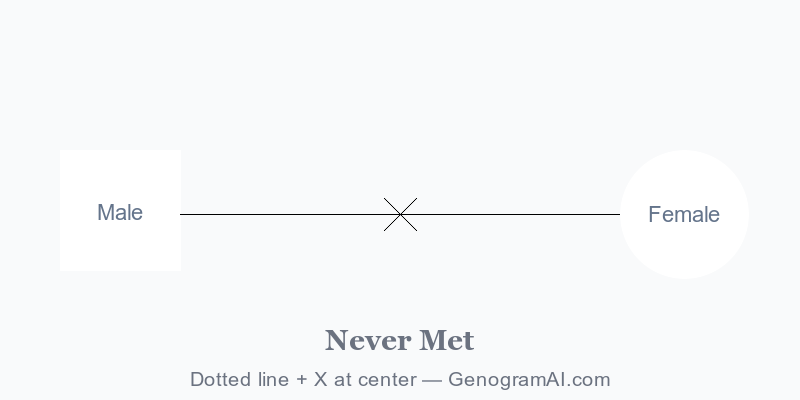
Understanding "Never Met" in Genograms
The never met symbol documents relationships that exist structurally (people are related) but have never been established through any actual contact.
Common Scenarios
- Adopted children and birth family members
- Children of cutoff relatives (cousins never met)
- Relatives who emigrated before birth
- Children of sperm/egg donors
- Family separated by war or political circumstances
Clinical Significance
Never-met relationships may be sources of curiosity, fantasy, longing, or complete indifference. Understanding client attitudes toward these unknown relatives provides insight into identity and attachment patterns.
Clinical Examples
The following scenarios illustrate how never-met relationships carry clinical weight despite the absence of direct contact.
1. Adoptee and Birth Parent
A 30-year-old woman adopted at birth enters therapy to process identity questions as she prepares to become a mother herself. She has never met her birth mother and has limited information — a first name, an age at the time of birth, and a medical history form. On the genogram, the never-met line between client and birth mother makes the absence visible. In therapy, the client reveals that she has constructed an elaborate mental image of her birth mother — compassionate, self-sacrificing, and forced to give her up by circumstance. The therapist explores how this idealized phantom shapes the client's expectations of herself as a mother and whether the fantasy prevents her from fully bonding with her adoptive family.
2. Family Member Who Emigrated Before the Client Was Born
A 22-year-old man from a Mexican-American family describes his grandfather, who remained in Mexico when the rest of the family emigrated. The grandfather died before the client was born. Despite never meeting him, the client feels a strong connection — the family tells stories constantly, the grandfather's photograph hangs in the living room, and the client was given his name. On the genogram, the never-met line combined with the deceased symbol captures this specific dynamic. The therapist explores how the grandfather's legacy shapes family expectations: the client feels pressure to embody qualities attributed to a man he never knew, and any failure feels like a betrayal of the family narrative.
3. Donor-Conceived Half-Siblings
A teenager conceived via sperm donation discovers through a DNA registry that they have seven half-siblings scattered across the country. They have never met any of them. On the genogram, multiple never-met lines fan out from the donor (who may also be unknown). The therapist explores the client's reaction to this discovery — curiosity, overwhelm, a sense of expanded identity, or anxiety about what these strangers might reveal about the client's own traits and predispositions. The never-met symbol here documents relationships that are biologically real but experientially empty, creating a unique clinical territory.
Never Met vs. Cutoff vs. Estranged: Comparison
These three zero-contact or low-contact relationship types differ in origin, emotional quality, and therapeutic approach.
| Dimension | Never Met | Cutoff | Estranged |
|---|
| Origin | No contact ever existed | Contact existed, then was deliberately severed | Contact gradually withdrew over time |
| Emotional quality | Curiosity, fantasy, or indifference about the unknown person | Intense — anger, grief, self-protection | Sadness, resignation, lingering discomfort |
| Agency | Often circumstantial — neither party chose the absence | One or both parties actively chose to sever contact | Drift rather than decision — both parties let the connection fade |
| Therapeutic focus | Identity, phantom narratives, meaning of absence | Processing the original wound, deciding about reconnection | Understanding what caused the drift, whether reconnection is desired |
| Genogram symbol | Dotted line with X | Line with break/fence marks | Dashed line with single break |
Therapeutic Considerations
Never-met relationships present a unique clinical challenge: the relationship exists structurally but has no experiential content. The therapeutic work centers on what fills that vacuum.
Phantom Narratives and Idealization
When a family member is unknown, clients often construct narratives to fill the gap. A child who never met their birth father may imagine him as heroic, villainous, or tragically prevented from being present. These phantom narratives function as internal working models — they shape expectations about relationships, self-worth, and identity even though they are based on imagination rather than experience. The therapist's task is to surface these narratives and examine how they influence the client's current functioning. Often the client is not fully aware of the story they have constructed until it is named.
Projected Identity
Clients sometimes project aspects of their own identity onto the unknown family member. A client who struggles with anger may attribute that trait to the never-met parent: "I must get my temper from him." This projection can serve as either an explanation or an excuse — and sometimes both. On the genogram, the never-met line becomes a prompt for the therapist to ask: "What do you imagine you inherited from this person? What does it mean to you that you share their genes but not their presence?"
The Influence of Family Storytelling
Even when a client has never met a family member, they may have been profoundly influenced by how other family members talk about that person. A grandmother who constantly says, "You're just like your father," shapes the client's self-concept around someone they have never seen. The therapist should map not only the never-met line but also the information channels — who tells the stories, what version they tell, and what agenda those stories serve within the family system.
When the Never-Met Status Changes
DNA testing, adoption reunions, and social media have made it increasingly common for never-met relationships to shift. When a client locates and meets an unknown family member, the genogram should be updated — but the therapeutic work does not end. The transition from phantom to real person is often destabilizing. The actual person rarely matches the imagined one, and clients may grieve the loss of their fantasy even as they gain a real relationship. Preparing clients for this dissonance is an important part of reunion work.
When to Use This Symbol
- Adoption and donor-conception cases: When mapping birth families alongside adoptive families, the never-met symbol clarifies which biological relatives the client has had zero contact with — distinguishing these from relationships that were once active and later cut off.
- Migration and diaspora genograms: Families separated by immigration, war, or political upheaval often have members across generations who share blood ties but have never been in the same room. This symbol documents the structural gap without implying conflict.
- Intergenerational family secrets: When a client discovers previously unknown relatives (e.g., a half-sibling from a parent's prior relationship), the never-met symbol marks the relationship as structurally real but experientially absent.
How This Differs From the Cutoff Symbol
The cutoff and never-met symbols both represent zero-contact relationships, but they carry very different clinical meanings:
- Cutoff implies a relationship that once existed and was deliberately severed. It carries emotional weight — anger, grief, unresolved conflict, or self-protection.
- Never met means no relationship was ever established. The two people are connected structurally (by blood, marriage, or legal ties) but have had no direct interaction.
- Therapeutically, cutoff work focuses on processing what was lost. Never-met work often explores fantasies, identity questions, and the meaning of the absence — what the client imagines about the unknown person.
How to Add in GenogramAI
- 1Press E to activate the Emotional Relationship tool, then click the first family member and drag to the second.
- 2In the relationship type menu, select Never Met. A dotted line with an X will appear between the two individuals.
- 3Optionally add a note explaining the reason for the lack of contact (adoption, geographic separation, family secret, etc.) for clinical context.
Frequently Asked Questions
Should I include never-met relatives on a genogram?
Yes — especially when the absence is clinically meaningful. A client who knows they have a biological father they have never met carries that relationship as part of their identity, even without contact. Documenting it makes the absence visible for therapeutic exploration.
What if a client discovers an unknown relative during therapy?
This is a good time to add the never-met symbol to the genogram. The discovery itself often triggers strong reactions — curiosity, anger at being kept from the person, or grief for lost time. Placing the symbol on the map creates a concrete starting point for processing those feelings.
Can a never-met relationship change to another type?
Absolutely. If a client reconnects with a birth parent, locates a long-lost sibling, or meets extended family for the first time, the never-met symbol should be updated to reflect the new relationship quality — whether it becomes close, distant, or conflicted.
How does the never-met symbol apply to deceased relatives?
It is common for clients to have never met grandparents or other relatives who died before they were born. Using the never-met symbol combined with the deceased indicator documents this clearly. The clinical focus shifts to how the family narrative about that person has shaped the client's understanding of their family.
Related Symbols