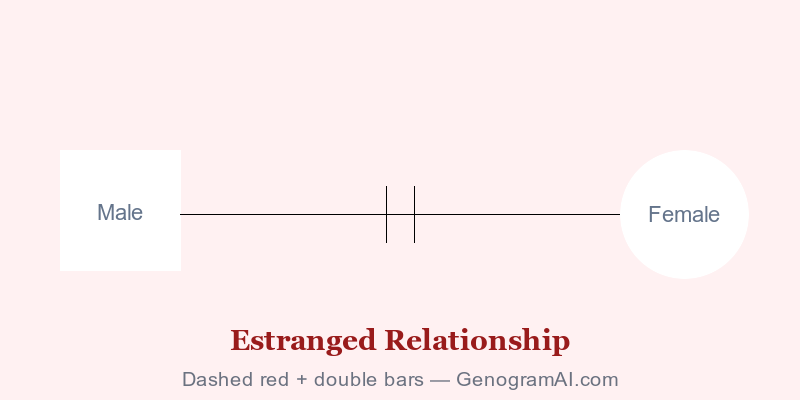
Understanding Estrangement
Estrangement represents a relationship that has significantly deteriorated but hasn't reached complete cutoff. Contact may be rare, strained, or mediated through others.
Characteristics
- Very limited contact (perhaps once a year or less)
- Contact feels obligatory rather than desired
- Conversations remain superficial or awkward
- May communicate through intermediaries
- Unresolved issues hang over the relationship
The Disconnection Spectrum
Distant: Limited but ongoing connection
Estranged: Near-cutoff, minimal contact
Cutoff: No contact at all
When to Use This Symbol
- Family rifts with residual contact: When siblings or parent-child pairs have had a major falling-out but still see each other at weddings, funerals, or holidays — communicating through obligation rather than desire — the estranged symbol captures this liminal state more accurately than either distant or cutoff.
- Pre-cutoff assessment: Estrangement often precedes full cutoff. Identifying relationships at this stage can guide intervention before complete disconnection occurs, making it a clinically important distinction during family therapy intake.
- Post-divorce family dynamics: When extended family members (in-laws, step-relatives) drift into near-nonexistence after a divorce, the estranged symbol documents the deterioration without implying that conflict is the primary driver.
How This Differs From the Cutoff Symbol
Estranged and cutoff are the two most commonly confused disconnection symbols. The distinction matters for treatment planning:
- Estranged relationships retain a thread of connection — however thin. There may be annual holiday cards, brief appearances at family events, or communication through intermediaries. The door is technically still open.
- Cutoff relationships involve complete cessation of contact. There is no communication channel, direct or indirect. One or both parties have actively closed the door.
- The therapeutic implication: estranged relationships can sometimes be repaired through direct intervention (family sessions, mediated conversations). Cutoff relationships typically require more groundwork before any contact is attempted.
How to Add in GenogramAI
- 1Press E to activate the Emotional Relationship tool, then click the first family member and drag to the second.
- 2In the relationship type menu, select Estranged. A gray line with a two vertical bars will appear, indicating the near-severed connection.
- 3Add a note documenting the duration of estrangement, the precipitating event (if known), and whether any indirect contact remains (e.g., through a mutual family member).
Frequently Asked Questions
How long does a relationship need to be strained before it counts as estranged?
There is no fixed timeframe. Estrangement is defined by the quality of contact, not its duration. A relationship where two people see each other monthly but exchange only tense pleasantries may be estranged, while two people who talk quarterly with genuine warmth are not. Focus on the emotional tone and voluntariness of contact.
Can estrangement be one-sided?
Yes. One person may consider the relationship estranged while the other believes things are fine — or vice versa. This discrepancy itself is clinically valuable information. When mapping a genogram from one client's perspective, note that the assessment reflects their experience of the relationship.
Is estrangement always negative?
Not necessarily. Some estrangement is protective — a healthy response to toxic or abusive dynamics. A client who has reduced contact with a manipulative parent to near-zero may be practicing appropriate self-care. The symbol documents the pattern; clinical judgment determines whether it represents a problem or a solution.
What triggers the shift from estranged to fully cutoff?
Common triggers include a specific incident (a confrontation, a betrayal, or a "last straw" event), a life transition (marriage, childbirth, or death of a mediating family member), or simply the gradual erosion of the remaining connection. Identifying where a relationship sits on this continuum helps clinicians assess intervention timing.
Related Symbols