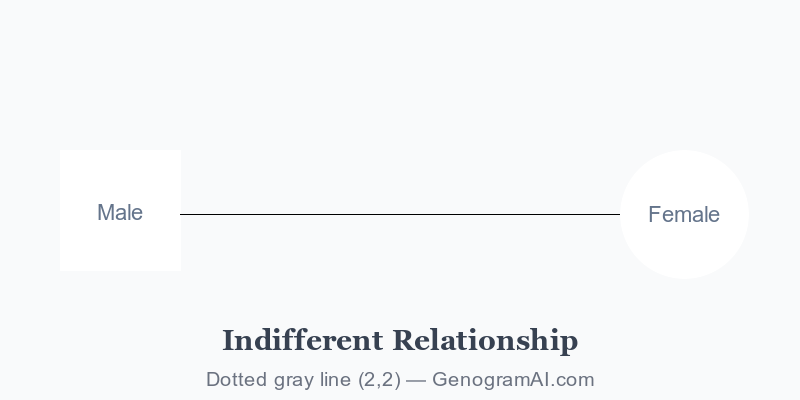
Understanding Indifference in Family Systems
Indifference differs from distance in a crucial way: distant relationships often involve active avoidance or suppressed feelings, while indifferent relationships involve genuine lack of emotional investment.
Clinical Significance
- May indicate attachment difficulties or disorders
- Sometimes masks depression or emotional numbness
- Can protect against expected rejection or disappointment
- May be more common in very large families
Indifference vs. Distance
Distant: "We don't connect, and it's painful/uncomfortable"
Indifferent: "We don't connect, and I don't really care"
Clinical Examples
The following scenarios show how indifference appears in clinical practice and what it may reveal about family dynamics.
1. Adult Child and Absent Parent
A 35-year-old man discusses his biological father, who left the family when the client was two. The client's affect is flat — not angry, not sad, simply uninterested. He says, "He's just a name to me." On the genogram, the indifferent line between father and son captures this accurately. The therapist explores whether this indifference is genuine (the client truly has no emotional investment) or whether it protects against deeper feelings of abandonment that have never been processed. The distinction matters: genuine indifference may require no intervention, while defensive indifference may be blocking grief work.
2. Siblings Who Grew Up Apart
Two half-siblings share a father but were raised in separate households and met only a handful of times during childhood. Now adults, they have no animosity but also no interest in building a relationship. On the genogram, the indifferent line between them contrasts with the conflicted line between their father and each of their mothers. The indifference here is a natural outcome of never having shared daily life — it is not pathological but is clinically noteworthy because it illustrates how family fragmentation can produce relational gaps across generations.
3. Spouse Who Has Emotionally Disengaged
A woman in couples therapy describes her husband with striking neutrality: "I don't love him, I don't hate him, I just don't feel anything." After years of unresolved conflict and failed attempts at reconnection, she has arrived at indifference. On the genogram, this indifferent line replaces what was previously coded as conflicted. This shift is clinically significant — indifference in a marriage often represents a more advanced stage of disconnection than active conflict, and it can be harder to reverse. The therapist assesses whether couples work is still viable or whether the indifference signals an irreversible emotional withdrawal.
Indifferent vs. Distant vs. Cutoff: Comparison
These three low-contact relationship types are frequently confused. The following table clarifies the distinctions.
| Dimension | Indifferent | Distant | Cutoff |
|---|
| Emotional charge | None — the relationship does not register | Residual feelings present but suppressed or avoided | High — anger, grief, or self-protection drives the severing |
| Contact level | Minimal or none, without effort to change it | Minimal, often with awkwardness or avoidance | Zero — deliberately maintained |
| Internal experience | "I don't think about them" | "I wish things were different" or "It's complicated" | "I can't have them in my life" |
| Therapeutic potential | May require exploring whether apathy is a defense | Responds well to reconnection and communication work | Requires processing the original wound before reconnection is possible |
| Genogram symbol | Dotted gray line | Long-dashed line | Line with break/fence marks |
Therapeutic Considerations
Indifference on a genogram raises several important clinical questions that therapists should explore carefully.
Is the Indifference a Defense Mechanism?
Apparent indifference sometimes functions as an emotional shield. A client who was repeatedly hurt by a parent may present as indifferent because caring feels too dangerous. The therapist can probe gently: "You say you don't care about your father at all — was there ever a time when you did?" If the client once cared and stopped, the indifference may be a learned protective response rather than a genuine absence of feeling. This distinction shapes the therapeutic approach — defensive indifference may benefit from trauma-informed exploration, while genuine indifference may simply be accepted.
Does the Indifference Protect Against Further Hurt?
In relationships where one party has been consistently unreliable, indifference can be an adaptive strategy. A client who stops investing emotionally in an alcoholic sibling, for example, may be protecting their own mental health. The therapist should assess whether this self-protective indifference is serving the client well or whether it has generalized to other relationships, creating a broader pattern of emotional unavailability.
Can Indifference Shift During Therapy?
Yes — and this shift can go in multiple directions. As a client processes underlying grief, they may discover that what they labeled indifference was actually suppressed pain, and the relationship may become emotionally charged again. Alternatively, a client in conflict with a family member may work through their anger and arrive at genuine indifference as a healthy endpoint. Tracking these shifts on the genogram over time provides a visual record of therapeutic progress.
What Does Indifference Signal in Close Family Bonds?
Indifference between extended family members may be unremarkable, but indifference within nuclear family bonds — parent-child, between spouses, between siblings who grew up together — often signals a significant clinical issue. It may point to attachment disruption, emotional neglect during formative years, or a prolonged period of unaddressed conflict that eventually depleted all emotional reserves.
When to Use This Symbol
- Attachment assessment: When a client describes a family member with flat affect and genuine lack of interest rather than suppressed emotion, the indifferent symbol captures this dynamic more accurately than the distant symbol.
- Large family mapping: In families with many siblings or extended members, some relationships naturally lack emotional investment. Marking these as indifferent (rather than leaving them unconnected) documents that the relationship was assessed, not overlooked.
- Post-therapy re-evaluation: When a client has processed grief or anger toward a family member and arrived at genuine detachment, updating a previously hostile or distant line to indifferent can mark therapeutic progress.
How This Differs From the Distant Symbol
The distant and indifferent symbols are easily confused because both represent low-contact relationships. The key distinction is emotional charge:
- Distant relationships often carry underlying pain, avoidance, or unresolved feelings. The person may wish things were different or actively work to maintain separation from something that once mattered.
- Indifferent relationships lack that emotional charge entirely. There is no longing, resentment, or avoidance — simply an absence of caring about the connection.
- Clinically, a distant relationship may respond to intervention and reconnection work, while an indifferent relationship may require exploring whether the apathy itself is a protective defense or a genuine lack of attachment.
How to Add in GenogramAI
- 1Press E to activate the Emotional Relationship tool, then click the first family member and drag to the second.
- 2In the relationship type menu, select Indifferent. The dotted gray line will appear between the two individuals.
- 3Optionally add a note to document whether the indifference is mutual or one-sided, and whether it has always been the case or developed over time.
Frequently Asked Questions
Is indifference the same as emotional cutoff?
No. Emotional cutoff is an active, deliberate severing of contact — often driven by intense feelings. Indifference, by contrast, implies the relationship simply does not register emotionally. A cutoff relationship once mattered; an indifferent one may never have.
Can indifference be one-sided?
Yes, and this is clinically important. One person may feel indifferent while the other feels rejected or hurt by that indifference. In genogram documentation, you can note directionality or add a second line to capture the other person's experience of the relationship.
Does indifference always indicate a problem?
Not necessarily. In large extended families, it is normal for some relationships to carry little emotional weight. Indifference becomes clinically significant when it appears in close family bonds (parent-child, siblings) where emotional investment would typically be expected.
How do I distinguish indifference from depression-related emotional numbness?
Depression can produce a global flattening of affect that mimics indifference across many relationships. If a client shows indifference toward multiple family members simultaneously — especially if this represents a change — screen for depression. True relational indifference tends to be specific to certain people rather than generalized.
Related Symbols