For frustrated Lucidchart users
Lucidchart wasn’t built for genograms
Quick answer
GenogramAI vs Lucidchart: feature comparison
| Feature | GenogramAI | Lucidchart |
|---|---|---|
| Medical conditions | Heart disease, cancer, diabetes, mental illness: 22 categories | No (layer shapes by hand) |
| Emotional relationship lines | 39 emotional types | No |
| Genogram symbol library | Miscarriage, stillbirth, adoption, twins, pregnancy | No |
| AI text-to-genogram | Describe the family in words (5 AI credits a month free) | No genogram-specific AI |
| AI image upload | Convert hand-drawn genograms to digital (Pro) | No |
| Cultural heritage patterns | 9 fill patterns for heritage | No |
| Deceased indicators | Standard X-through notation | Draw by hand |
| Index person marking | Double border for the identified patient | Draw by hand |
| Basic shapes and connectors | Yes | Yes |
| Cloud storage | Yes | Yes |
| Sharing | View-only links and embeds; no real-time co-editing | Real-time team collaboration |
| Price to start | Free (2 genograms); Pro $12/mo | Free plan (3 editable documents); paid from $7.95/mo |
We’ve heard these stories before
Hours lost on workarounds
No emotional relationship lines
Paying for features you can’t use
Templates that don’t fit
What genogram software should actually do
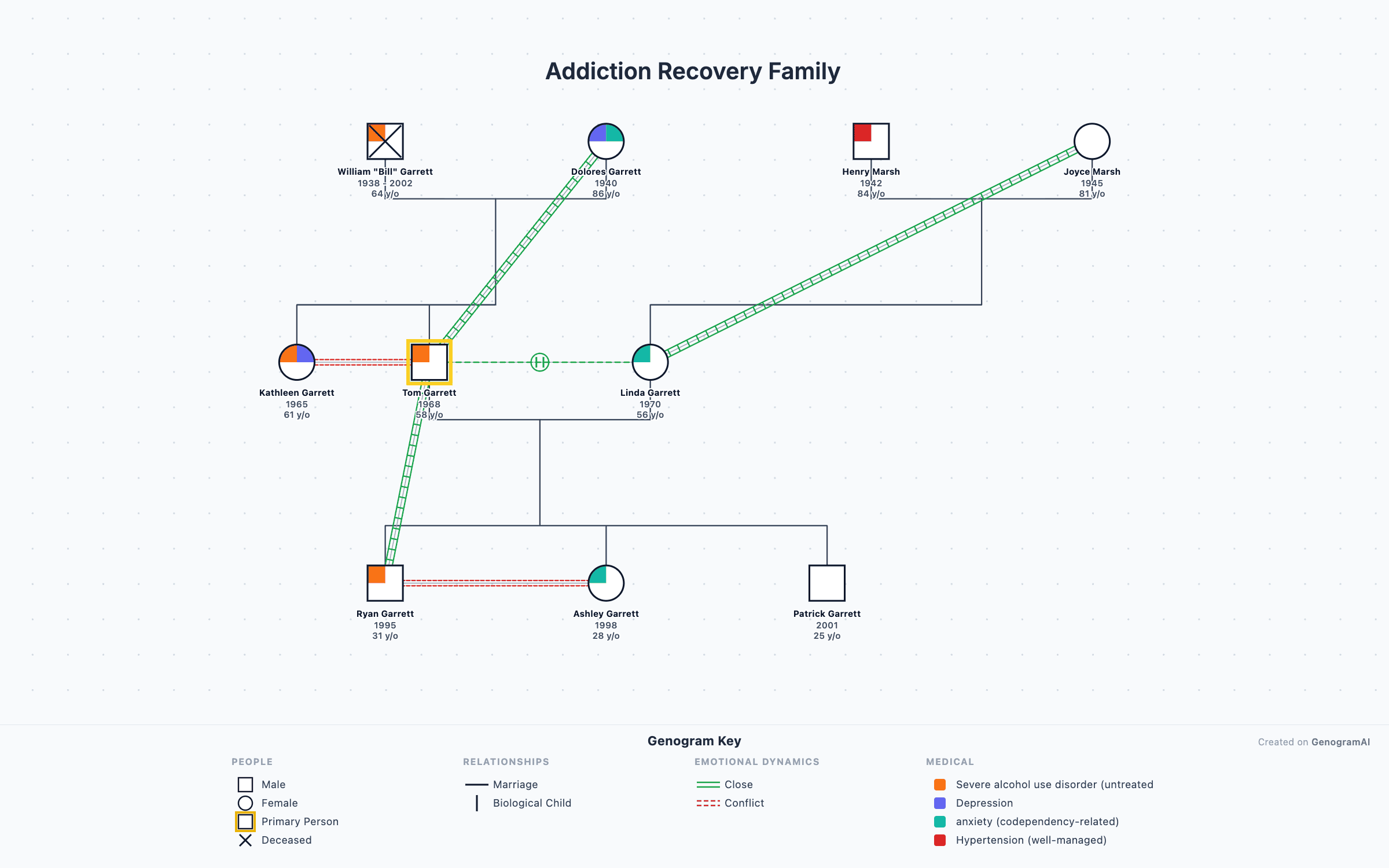
Medical shading
39 emotional relationship types
Clinical symbols built in
AI that understands families
Your time is better spent on clients
You became a therapist to help families, not to fight with diagram software. Add a child, mark a divorce or record a death in a click or two, using standard McGoldrick-style symbols that supervisors and colleagues recognize. Or describe the family system in plain English and let the AI draft it.
Lucidchart vs GenogramAI FAQs
Can Lucidchart make genograms?
Lucidchart can draw basic shapes like squares and circles, but it lacks the specialized clinical notation genograms need. There are no medical quadrants, no emotional relationship lines, and no standard genogram symbols like pregnancy-loss triangles or adoption brackets, so each clinical element is built by hand.
What’s missing in Lucidchart for clinical genograms?
The core genogram features: medical condition shading (22 categories), emotional relationship lines (39 types including fused, hostile and cutoff), deceased indicators, index person marking, cultural heritage patterns and genogram-specific AI. GenogramAI includes all of these.
Is GenogramAI better than Lucidchart for therapists?
For genograms, yes. GenogramAI is purpose-built for clinical work with 64 relationship types (18 partner, 39 emotional, 7 child connection types), medical shading and standard McGoldrick-style symbols, plus AI text-to-genogram drafting. Lucidchart remains the stronger choice for flowcharts, org charts and real-time team diagramming.
Does Lucidchart have genogram symbols?
Lucidchart does not include a clinical genogram symbol library. It has basic shapes and lines but no notation like pregnancy-loss triangles, stillbirth symbols, twin connectors or pregnancy indicators. GenogramAI includes the standard McGoldrick-style symbol set.
How much does GenogramAI cost compared to Lucidchart?
GenogramAI’s free plan includes 2 genograms, every symbol and relationship type, 5 AI credits a month and PNG export. Pro is $12/mo (or $99/yr) for 25 genograms and unlimited AI; Clinical ($29/mo) removes the genogram limit. Lucidchart’s paid plans started at $7.95/mo when we checked, without genogram-specific features.
There’s a better way for genograms
- Free plan includes 2 genograms
- No credit card required
- Every clinical symbol and relationship type on the free plan
- Works in any modern browser