Family Genogram
Map Your Family Relationships & Patterns
Discover what a family genogram reveals that a family tree never could — emotional bonds, medical history, behavioral patterns, and the hidden rules that shape every generation.
What Is a Family Genogram?
A family genogram is a detailed visual map of your family system across multiple generations. While it includes the basic structural information of a family tree — names, dates, and lineage — it goes dramatically further by capturing the emotional, medical, and behavioral dimensions of family life.
Developed from Murray Bowen's family systems theory and standardized by Monica McGoldrick and Randy Gerson in the 1980s, the family genogram uses a set of internationally recognized symbols to represent individuals, relationships, and patterns. A square represents a male, a circle represents a female, and various line types indicate the quality of each relationship — from close and supportive to hostile and estranged.
The power of a family genogram lies in what it makes visible: patterns that repeat across generations. When you see that divorce has occurred in three consecutive generations, or that anxiety appears in every firstborn daughter, or that the family produces a "black sheep" in every generation — these are not coincidences. They are systemic patterns carried through family culture, learned behavior, and sometimes genetics. A genogram is the tool that makes these patterns impossible to ignore.
Family Trees vs. Family Genograms
A family tree tells you that your grandmother married your grandfather in 1952. A family genogram tells you that their relationship was distant, that your grandmother was enmeshed with her eldest daughter (your mother), that your grandfather had an alcohol problem that mirrored his own father's, and that the pattern of emotional distance between spouses has repeated in every generation since. That is the difference between genealogy and understanding.
What a Family Genogram Reveals
The six dimensions of family life that a genogram captures — and a family tree misses entirely
Emotional Bonds
The actual quality of relationships between family members — who is close, who is estranged, where conflict simmers beneath the surface, and which relationships are enmeshed or codependent.
Medical History
Hereditary health conditions mapped across generations: heart disease, cancer, diabetes, autoimmune conditions, and genetic disorders. Physicians use medical genograms to assess patient risk profiles.
Mental Health Patterns
Depression, anxiety, bipolar disorder, PTSD, and other mental health conditions that appear across generations. Seeing these patterns mapped visually often helps families understand that these are not individual failings but systemic patterns.
Behavioral Patterns
Addiction, domestic violence, eating disorders, workaholism, and other behavioral patterns that transmit across generations — often through learned behavior rather than genetics alone.
Role Assignments
Who becomes the caretaker, the black sheep, the peacemaker, the achiever, or the scapegoat in each generation. These family roles often repeat with remarkable consistency across generations.
Unspoken Rules
Every family has unspoken rules: what can be discussed, which emotions are allowed, who holds the power. A genogram makes these invisible rules visible by showing their effects across generations.
How to Create Your Own Family Genogram
Six steps from blank canvas to a complete family genogram
Gather Your Family Information
Before you start drawing, collect as much information as possible. Talk to parents, grandparents, aunts, and uncles. Gather names, birth and death dates, marriages, divorces, major health conditions, and significant life events. Even incomplete information is valuable — gaps in knowledge are themselves informative (why does no one talk about Uncle Robert?).
Map Three Generations of Family Structure
Start with the oldest generation you have information about (usually grandparents) and work down. Use squares for males, circles for females, and horizontal lines for partnerships. Place children below parents in birth order, left to right. GenogramAI can build this structure automatically as you provide information through conversation.
Add Dates and Demographics
Fill in birth years, death years (with cause of death if known), marriage dates, divorce dates, and current ages. Note occupations, education levels, and locations if relevant to the patterns you are exploring. This demographic layer provides the factual foundation.
Draw Relationship Lines
This is where a family genogram diverges from a family tree. Add emotional relationship lines between key family pairs: close (solid blue line), distant (dotted line), hostile (zigzag), enmeshed (triple line), or cutoff (line with bars). Be honest — this is where the real insights emerge.
Mark Medical and Mental Health History
Add medical conditions, mental health diagnoses, substance abuse, and causes of death. Use the genogram convention of filling in a portion of the symbol to indicate conditions, or add text annotations. Color coding can help distinguish different types of conditions.
Identify and Annotate Patterns
Step back and look at the complete genogram. Circle or highlight patterns that repeat: Does depression appear in every generation? Do oldest children always become caretakers? Is there a pattern of early marriage followed by divorce? Document these observations — they are the genogram's most valuable output.
Who Uses Family Genograms?
Family Therapists
Use family genograms as a core assessment tool during intake. The genogram reveals intergenerational patterns that inform treatment planning and help clients see their issues in a systemic context rather than as personal failures.
Genealogists & Family Historians
Go beyond dates and names to document the rich texture of family life — relationships, occupations, migration patterns, and cultural traditions. A genogram adds depth to genealogical research that a standard family tree cannot capture.
Students (Psychology, Social Work, Nursing)
Many graduate programs require students to create a personal family genogram as a self-awareness exercise. It helps future clinicians understand their own family patterns before working with client families.
Individuals & Families
Anyone curious about their family dynamics can benefit from creating a genogram. It is a powerful tool for self-discovery — understanding why you react to conflict the way you do, why certain family events trigger strong emotions, or why you repeat certain patterns in your own relationships.
Why Create a Family Genogram?
Frequently Asked Questions
What is a family genogram?
A family genogram is a detailed visual map of your family across multiple generations that goes far beyond a simple family tree. It uses standardized symbols to show not just who is related to whom, but the quality of relationships (close, distant, hostile, enmeshed), medical conditions, mental health patterns, behavioral issues, and significant life events. It reveals hidden patterns that repeat across generations.
How is a family genogram different from a family tree?
A family tree shows lineage — names, dates, and who descended from whom. A family genogram adds critical layers: emotional relationship quality between family members, medical and mental health history, behavioral patterns like addiction or abuse, and life events like immigration, divorce, or trauma. A family tree tells you who your family is; a genogram tells you how your family works.
Can I make a family genogram by myself or do I need a therapist?
You can absolutely create a family genogram on your own for personal exploration, family heritage projects, or health history documentation. Tools like GenogramAI guide you through the process with AI assistance. However, interpreting a genogram for clinical purposes — identifying dysfunctional patterns, processing family trauma — is best done with a licensed therapist who understands family systems theory.
How many people should be in a family genogram?
A typical family genogram includes three generations and anywhere from 15 to 40+ individuals depending on family size. At minimum, you want grandparents, parents, aunts/uncles, yourself, siblings, and any children. The more complete the genogram, the more patterns become visible. Even noting deceased members with limited information is valuable.
What are the most common patterns found in family genograms?
The most frequently identified patterns include: repeating divorce or relationship instability across generations, intergenerational transmission of mental health conditions (depression, anxiety), substance abuse patterns, parentification (children taking on adult roles), emotional cutoffs between family branches, and similar career or life choices appearing in multiple generations.
Free Downloadable Guides
Print-ready PDFs you can reference anytime — no sign-up required.
Map Your Family with GenogramAI
Create a comprehensive family genogram with AI assistance. Just describe your family and GenogramAI builds the diagram — complete with all 24 relationship line types.
Try GenogramAI Free152 Genogram Examples & Templates
Browse real genogram examples — from clinical case studies to famous families. Use any as a starting template for your own genogram. Every example is generated using the McGoldrick-Gerson-Petry 4th edition standard with full symbol notation.
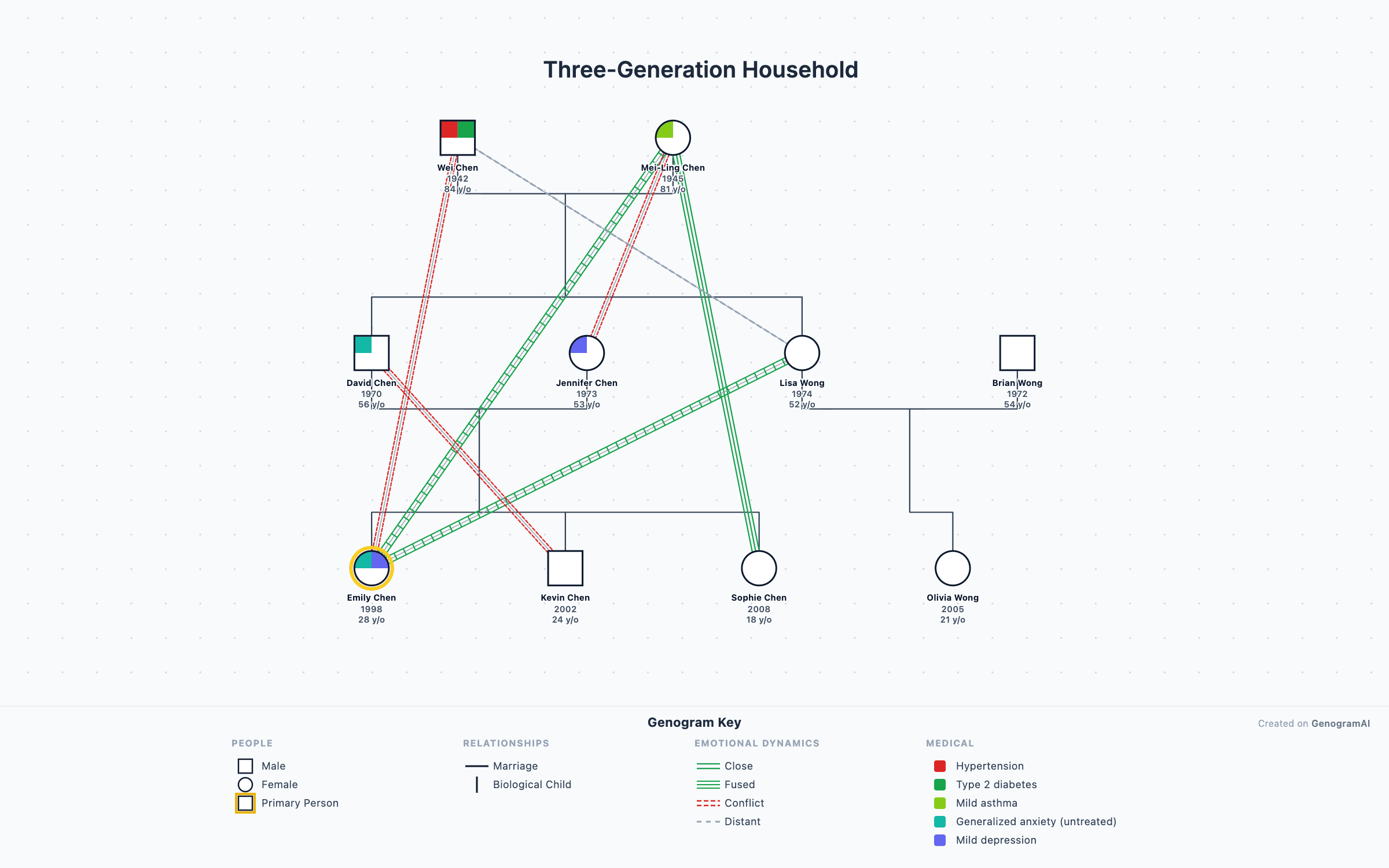
3-Generation Family Genogram
Classic three-generation genogram with marriage, children, and grandchildren — the standard layout used in family therapy assessment.
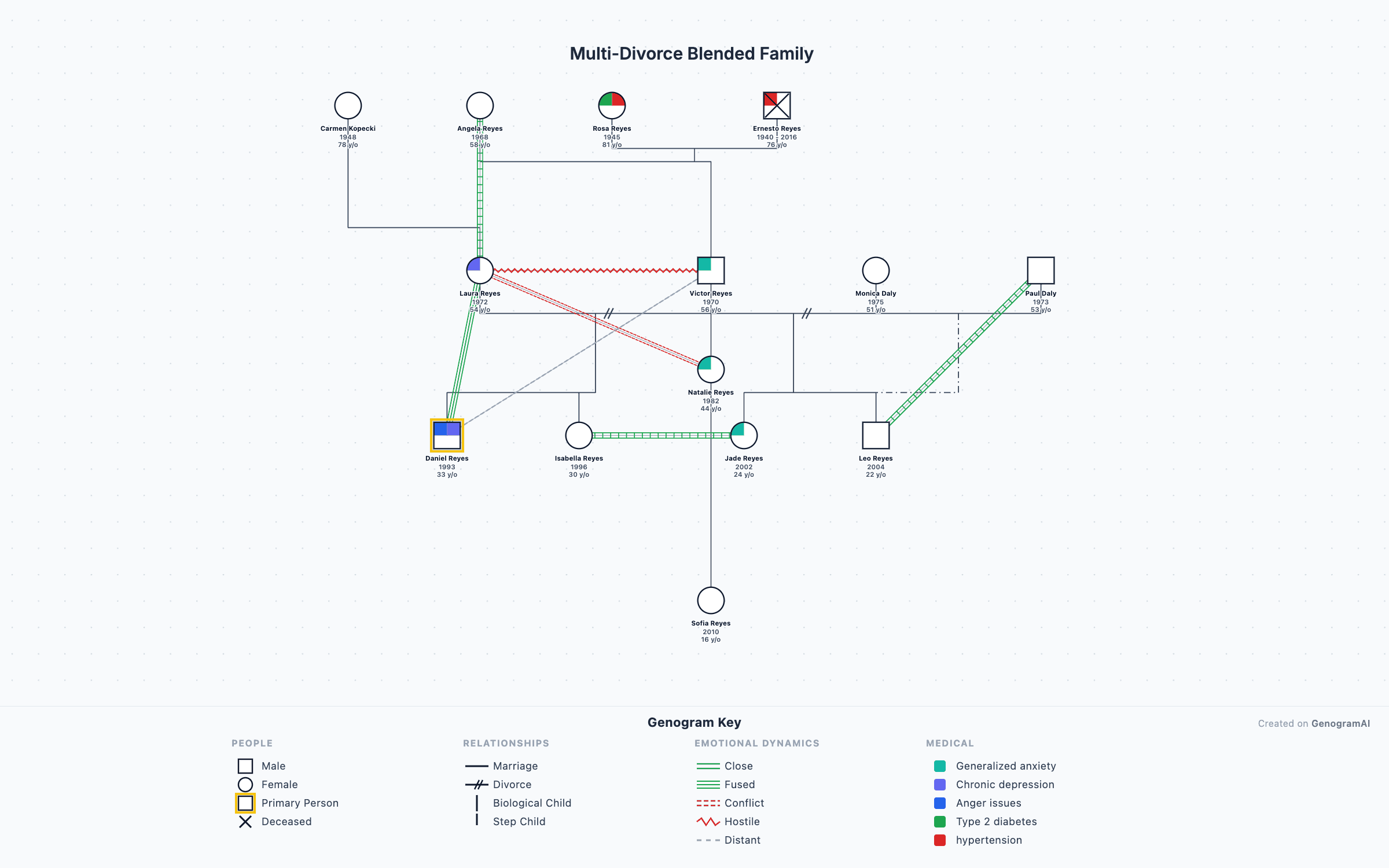
Blended Family Genogram
Step-parents, half-siblings, and multiple marriages mapped across generations using McGoldrick blended-family notation.
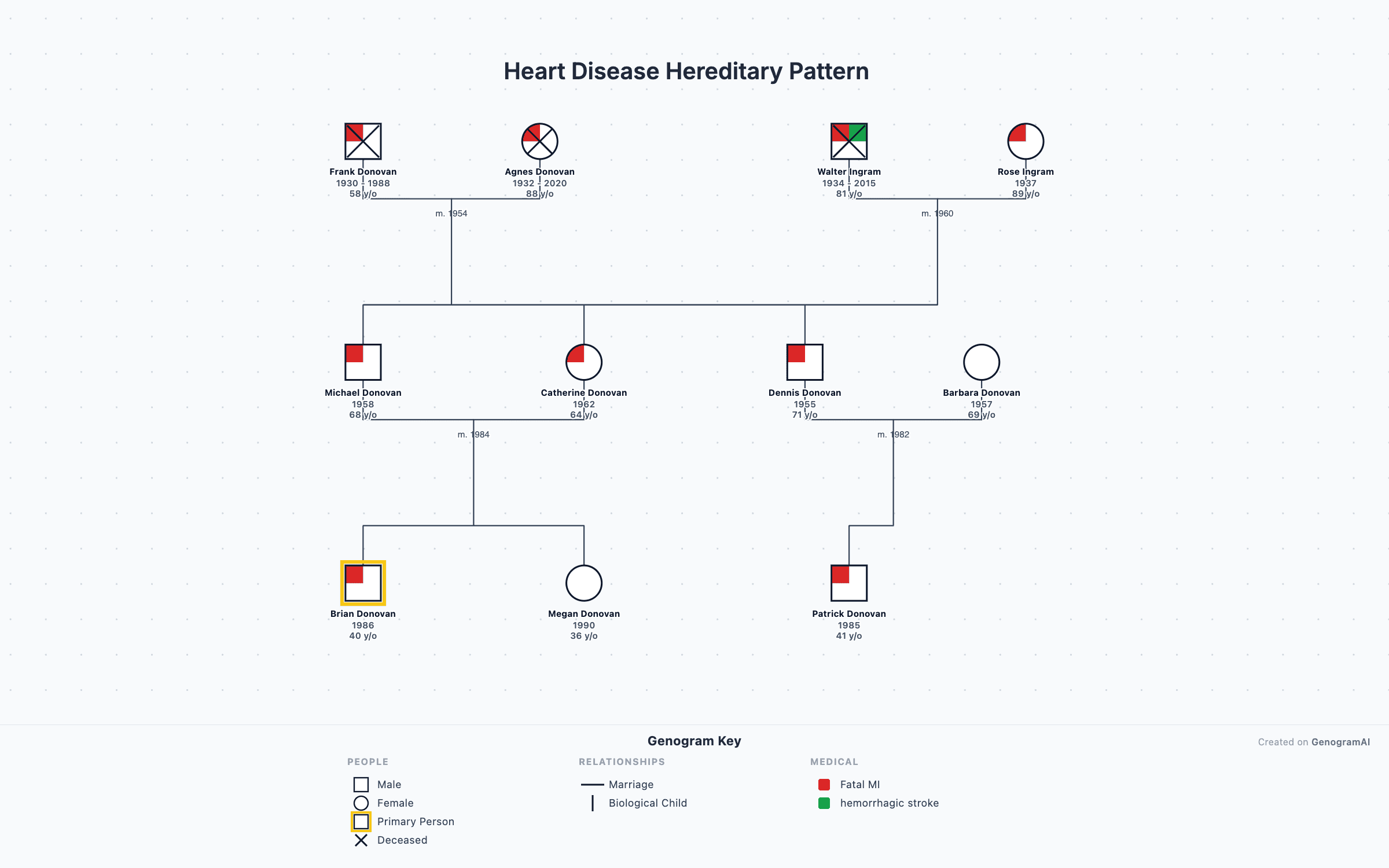
Medical Family History Genogram
Track hereditary conditions like heart disease, cancer, and diabetes with the four-quadrant medical notation system.
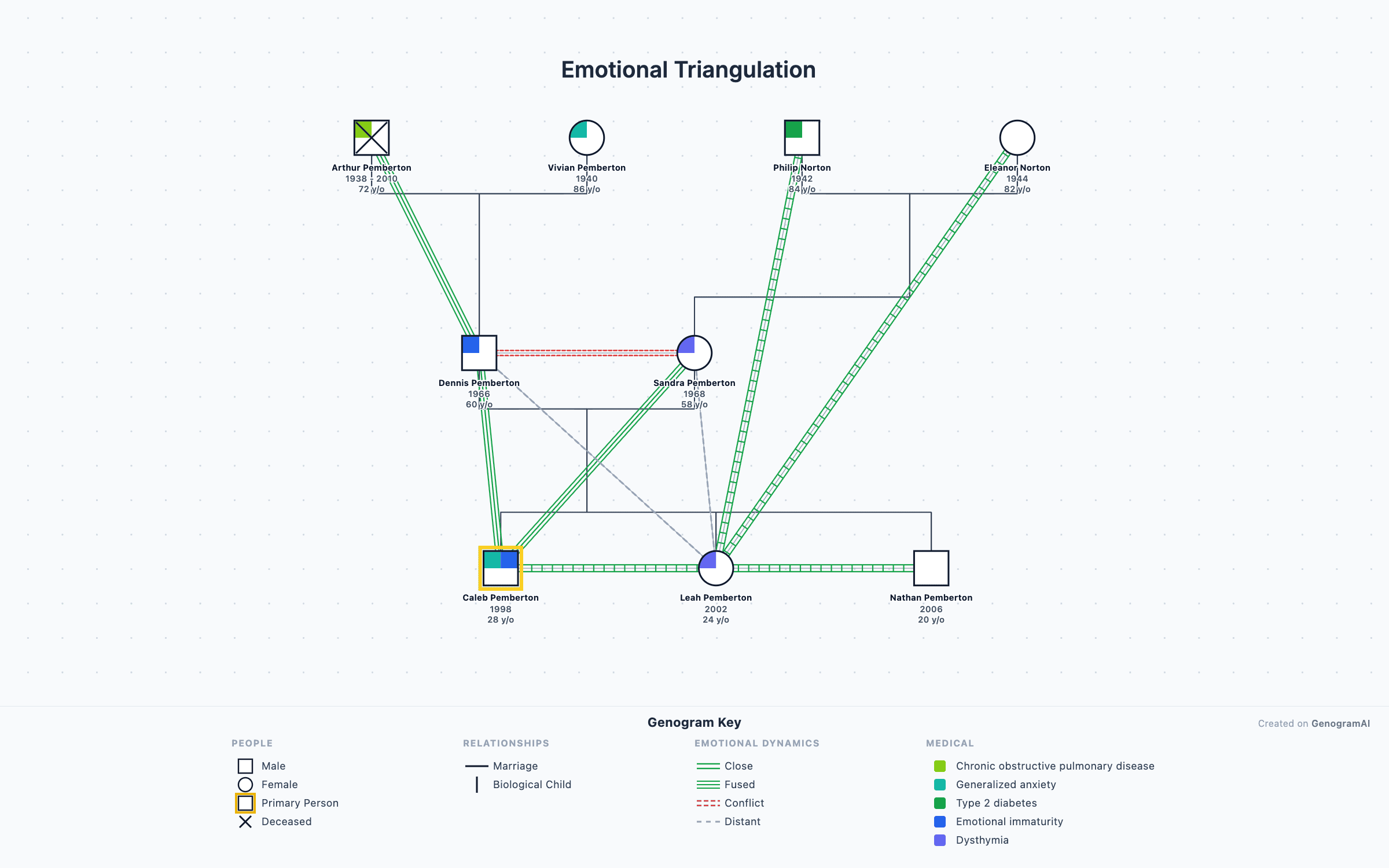
Emotional Patterns Genogram
Map conflict, enmeshment, cutoff, and closeness with 38 emotional relationship overlays from the McGoldrick standard.
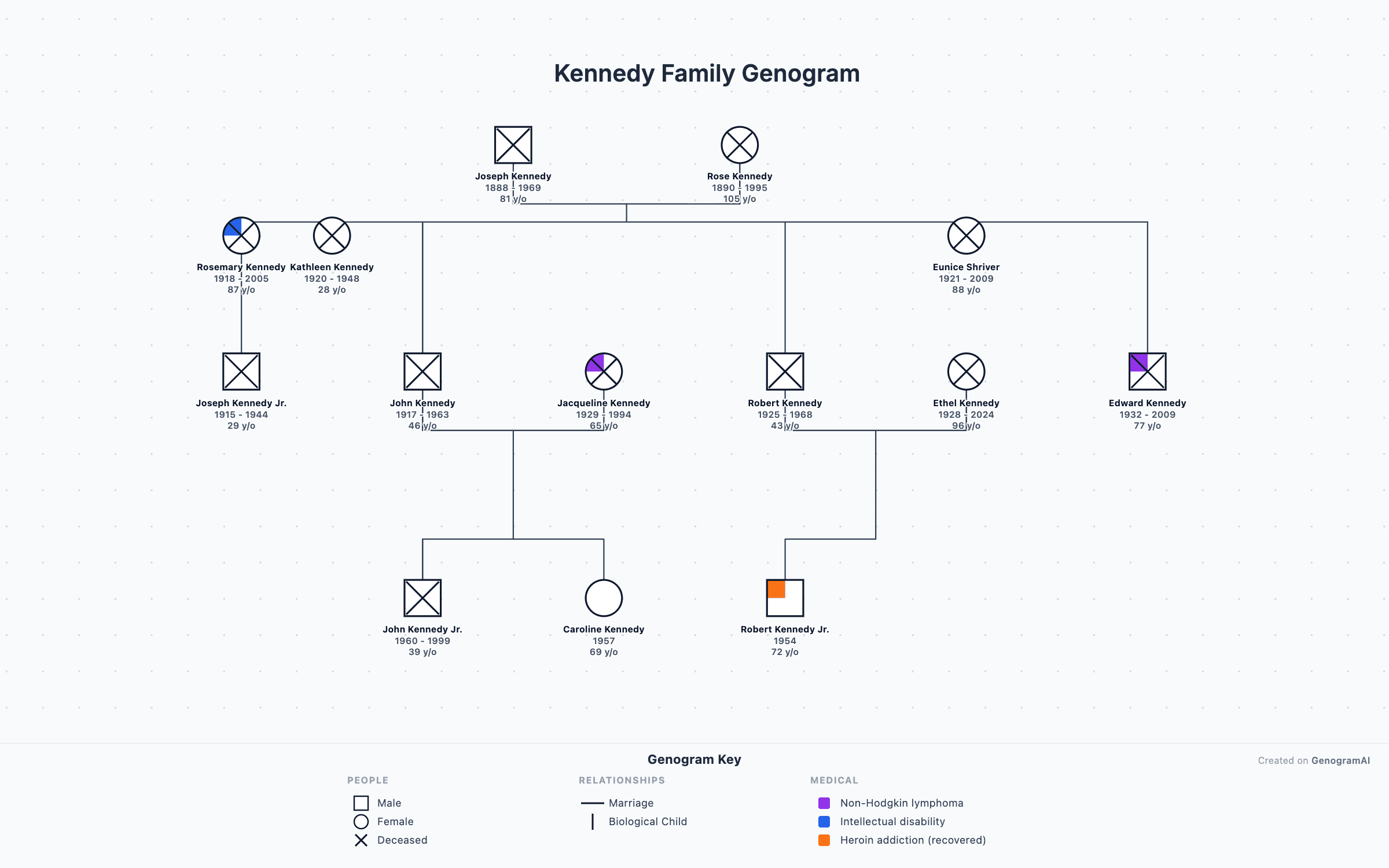
Kennedy Family Genogram
The Kennedy political dynasty mapped across four generations — a teaching example for genogram construction.
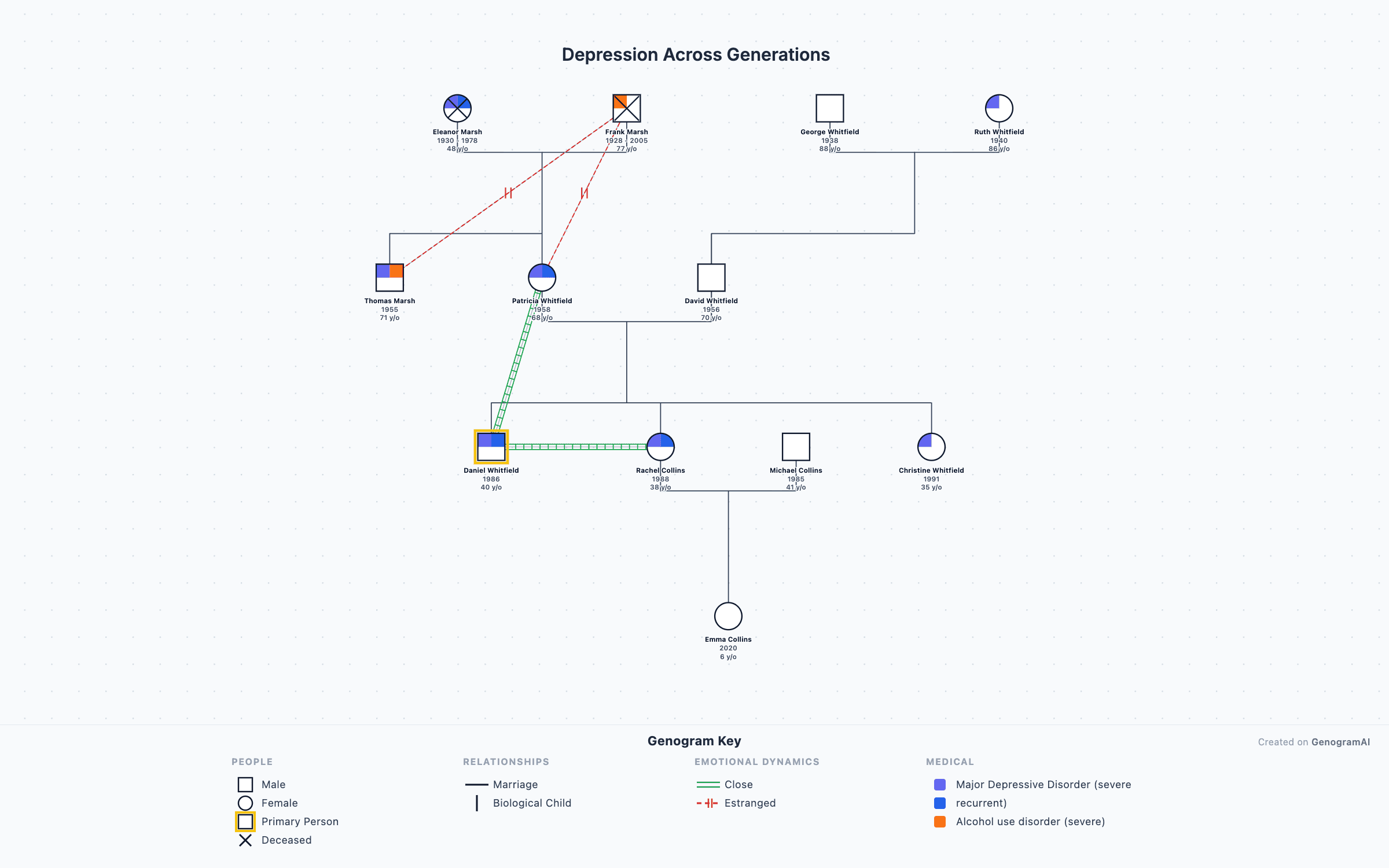
Depression Across Generations
Multigenerational transmission of depression and mood disorders visualized using clinical genogram symbols.
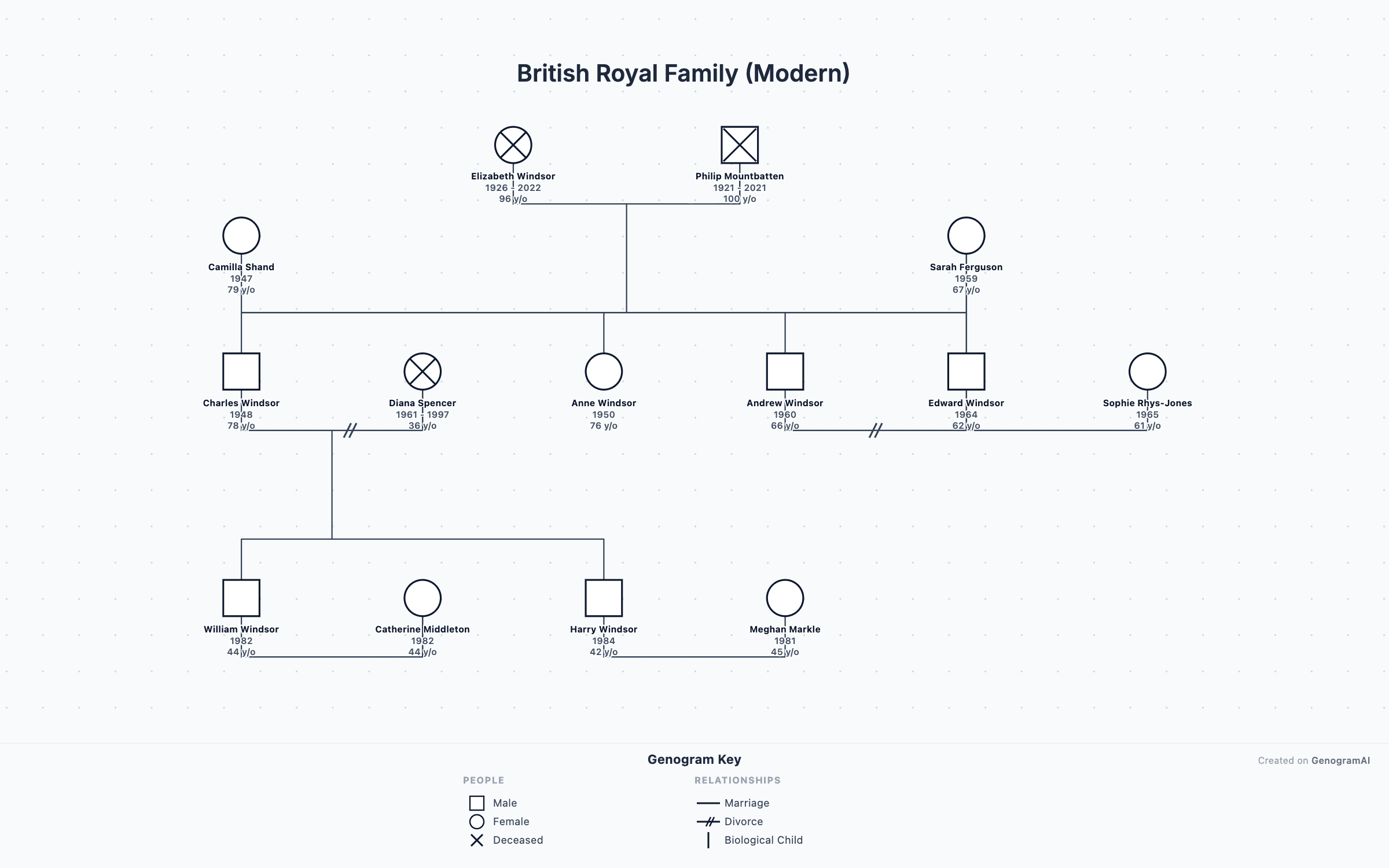
British Royal Family
The modern British royal family from Elizabeth II to present — useful as a template for complex multigenerational genograms.
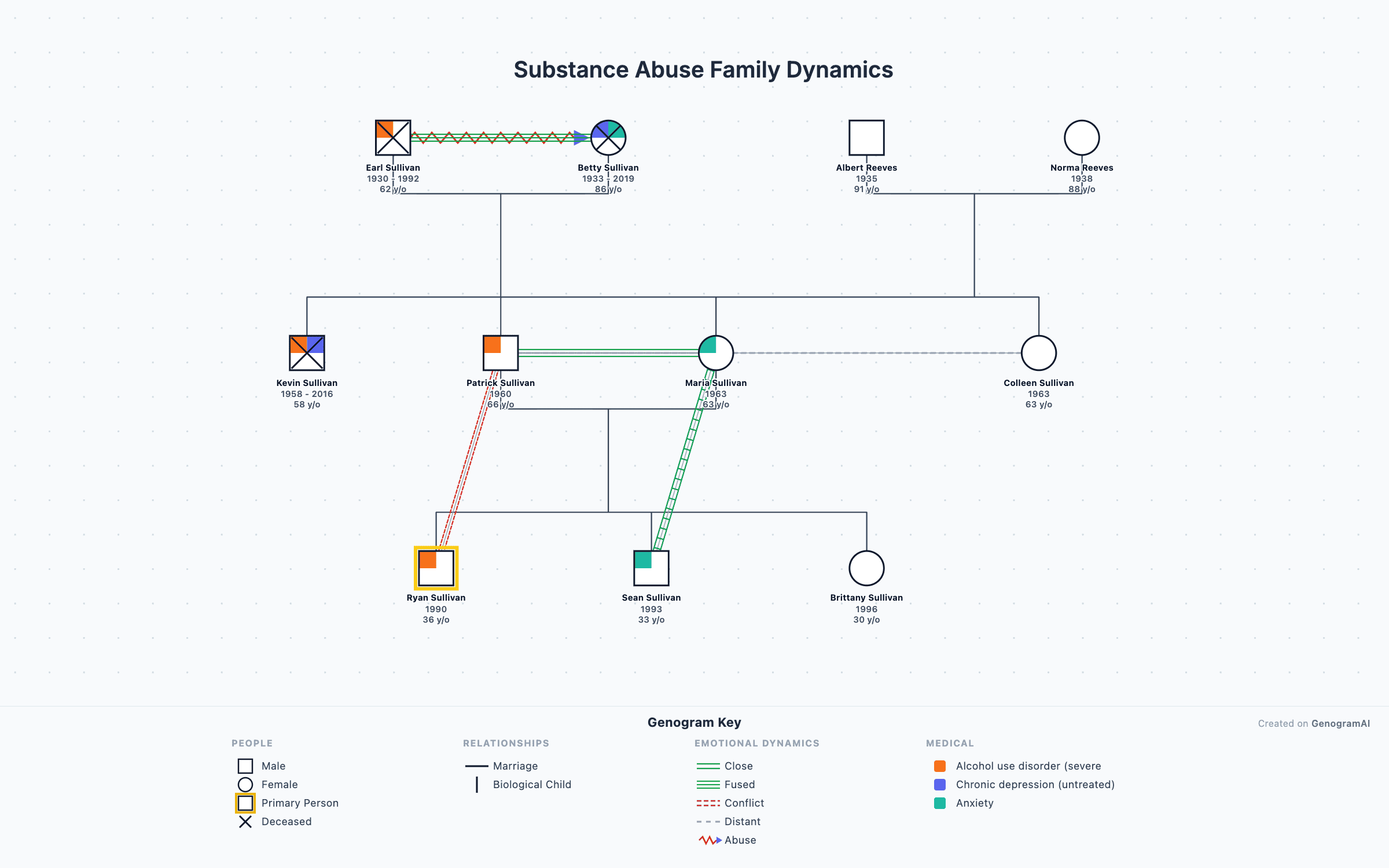
Substance Abuse Dynamics
Family patterns around addiction, codependency, and recovery — clinical genogram example for therapy training.