For MFT students and programs
Genogram tool for marriage and family therapy students
Quick answer
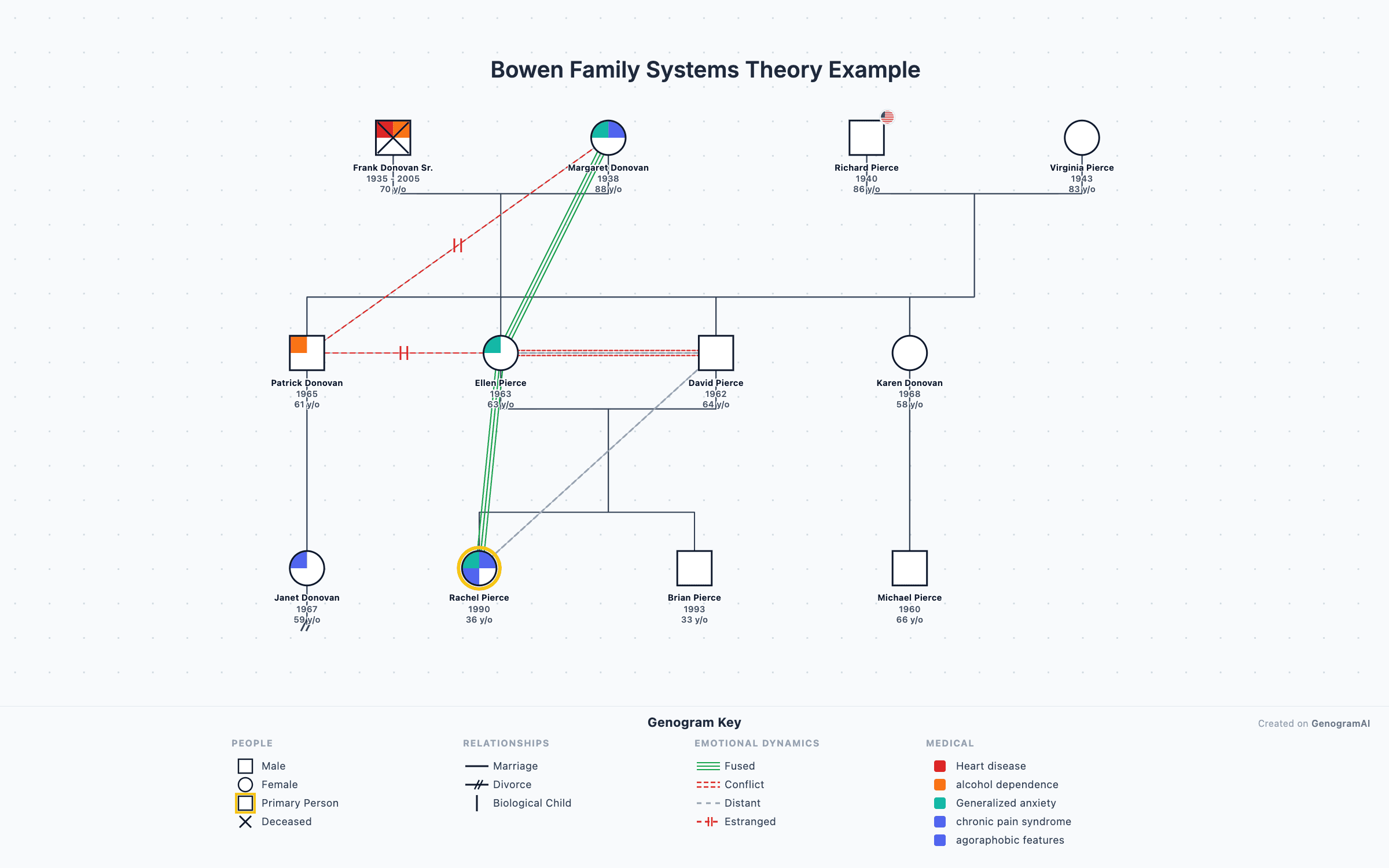
MFT programs are demanding
Bowen Theory Requires Proper Mapping
Your professor wants to see standard symbols and relationship dynamics mapped correctly. Generic diagramming platforms don't have these symbols.
MFT programs focus heavily on family systems theory. You need tools that speak the same clinical language as your coursework.
COAMFTE Standards Are Specific
Your accredited program has specific documentation requirements. Your genograms need to demonstrate clinical competency for supervision and case presentations.
COAMFTE-accredited programs have high standards. Your clinical work needs to reflect professional-level assessment skills.
Practicum Families Are Complex
Your first real clients have multigenerational trauma, multiple divorces, step-families, and emotional patterns you're just learning to identify.
The jump from textbook families to real clinical families is huge. You need tools that handle complexity while you're still learning.
Limited Time Between Classes and Practicum
Between coursework, practicum hours, and supervision meetings, you have maybe an hour to create a genogram for tomorrow's case presentation.
MFT programs are intensive. Every minute counts when you're balancing academic and clinical demands.
What do MFT students need in a genogram tool?
Emotional Relationship Overlays
Triangle Identification
Multigenerational Patterns
Professional Documentation
Use genograms across your MFT curriculum
| Course | How the genogram is used |
|---|---|
| Family Systems Theory | Create genograms demonstrating Bowen concepts: differentiation, triangles, nuclear family emotional process, multigenerational transmission. |
| Clinical Practicum | Develop genograms to map out context and identify relational patterns. Prepare case presentations for supervision. |
| Assessment | Use genograms to assess family structure, uncover generational medical and mental health history, identify social supports, and more! |
| Couples Therapy | Map both partners' family-of-origin patterns. Identify how inherited patterns affect the couple subsystem. |
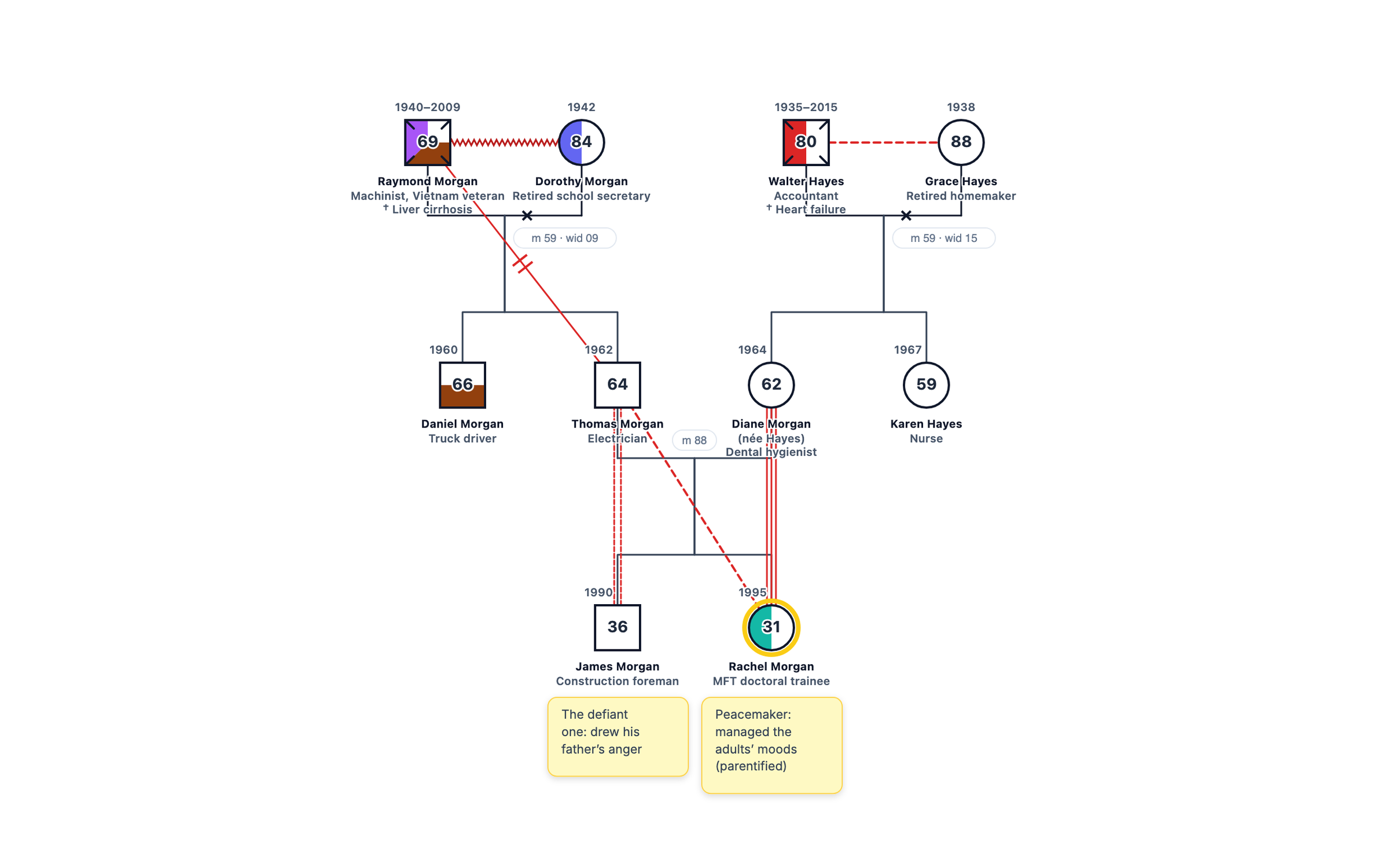
From family description to clinical genogram
- 1
Describe the family system
Type a description including emotional patterns: 'Mother is enmeshed with youngest child, father is emotionally cutoff from his family of origin...' - 2
AI generates the structure
GenogramAI creates the genogram with correct symbols for each relationship type and emotional overlay. - 3
Add clinical observations
Note triangles, differentiation levels, multigenerational patterns. Add medical/mental health history. - 4
Export for supervision
Download a high-resolution PNG for case presentations or supervision (PDF and SVG on paid plans).
What does the free plan cover?
| Free | Professional ($12/month) | |
|---|---|---|
| Genograms | 2 | Up to 25 projects |
| AI | 5 credits a month | Unlimited, plus AI Architect and Insights |
| Relationship types | All 64 | All 64 |
| Medical quadrants | Yes | Yes |
| Export | PNG | PNG, PDF, SVG, GEDCOM |
FAQs for MFT students
Does GenogramAI use standard clinical notation?
Yes. The genograms use standard McGoldrick-Gerson-Petry notation recognized in MFT education and practice. GenogramAI exports high-resolution PNG images suitable for case presentations and supervision.
Does it support Bowen family systems concepts?
Absolutely. GenogramAI includes emotional relationship overlays for mapping fusion, cutoffs, conflict, and distance—all central to Bowenian assessment. You can visualize triangles and multigenerational patterns.
Is there a free option for students?
Yes. There is no separate student plan, but the free plan covers most coursework: 2 genograms, 5 AI credits a month, all 64 relationship types, emotional overlays, medical quadrants, and PNG export. No credit card required. PDF, SVG and GEDCOM export and unlimited AI are on the Professional plan ($12/month).
Can I use AI to help create my genogram?
Yes. Describe the family system in plain English (e.g., 'The mother is fused with the oldest daughter, while the father is emotionally distant from all children') and AI creates the structure with appropriate symbols.