Clinical Supervision Countertransference
A therapy trainee's personal genogram created during clinical supervision to explore countertransference patterns.
Interactive Clinical Supervision Countertransference
Click and drag to explore. Zoom with scroll.
Can't see the genogram? View in the GenogramAI Gallery
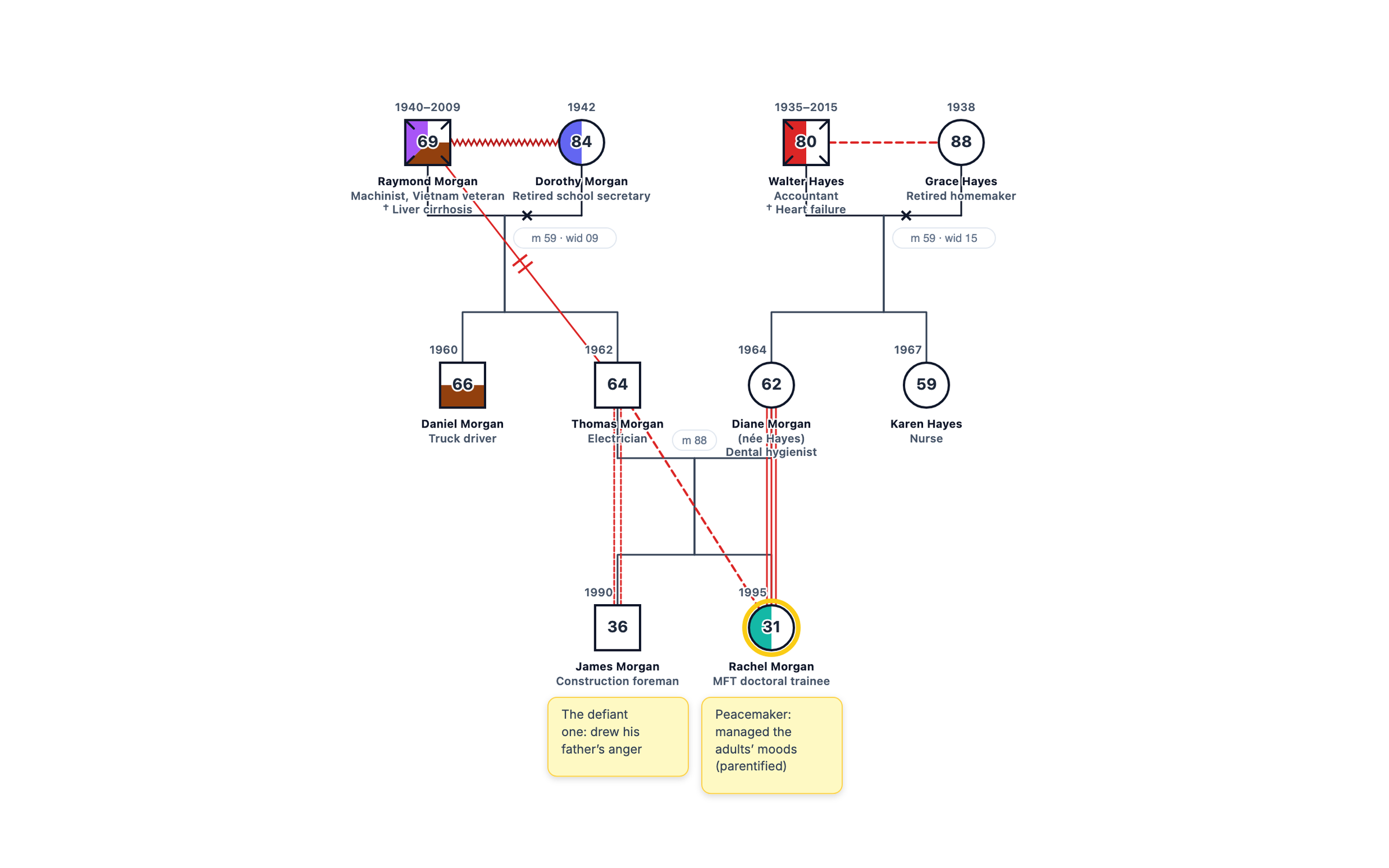
About This Genogram
A therapy trainee's personal genogram created during clinical supervision to explore countertransference patterns. Maps a 3-generation family where emotional suppression, parentification, and conflict avoidance in the trainee's family of origin create blind spots when working with clients who present similar dynamics.
How to Read This Genogram
In MSW and MFT training programs, students construct and interpret genograms as a core competency because the skill underpins much of what happens in family-based assessment. Early assignments ask students to diagram their own family of origin using standard notation, which develops both technical accuracy and reflective self-awareness about the systems that shaped them. Later assignments introduce constructed case examples like this one, where students practice reading an unfamiliar family's structure, identifying generational patterns, and forming evidence-based hypotheses about how the family system might influence the presenting concern.
The skills built through repeated genogram work include tracking information across multiple generations simultaneously, translating verbal family history into a visual format that a supervisor or treatment team can read quickly, and distinguishing structural facts from relational inferences. Students also learn to update a genogram as new information emerges during treatment, treating it as a living clinical document rather than a one-time intake tool. Familiarity with these skills before entering field placements allows students to spend their clinical hours on assessment and intervention rather than on learning the notation system from scratch under supervision.
Key Patterns in This Genogram
Symbol Reference
Standard genogram symbols and notation demonstrated in context.
Template Structure
Proper genogram layout and organization for academic assignments.
Learning Framework
A teaching tool for understanding family systems theory in practice.
Pattern Analysis
This genogram maps 10 members across 3 generations of the Morgan family, created by therapy trainee Rachel Morgan (b. 1995) during her second year of a marriage and family therapy doctoral program. The genogram was initiated after Rachel's clinical supervisor observed a recurring pattern: Rachel consistently avoided exploring anger in session, redirected clients away from family-of-origin material involving parental conflict, and showed a pronounced tendency to rescue child clients from uncomfortable emotional states. Rather than addressing these patterns as skill deficits, the supervisor recognized them as potential countertransference signals and initiated the self-of-the-therapist genogram exercise. What emerged was a family system organized around the management and suppression of one person's emotional volatility — Rachel's father, Thomas Morgan (b. 1962).
The Morgan family's emotional architecture was built around Thomas's unpredictable anger. A Vietnam veteran's son who witnessed domestic violence throughout his childhood, Thomas carried intergenerational trauma that expressed itself as periodic explosive rage followed by extended periods of withdrawal and guilt. Rachel's mother, Diane (b. 1964), developed a hyper-attuned emotional monitoring system — constantly scanning Thomas's mood and adjusting the household's emotional temperature accordingly. The children were recruited into this system early: Rachel's older brother James (b. 1990) became the defiant one who drew Thomas's anger toward himself, functioning as a lightning rod that protected the rest of the family, while Rachel became the peacemaker who smoothed over conflicts, anticipated needs, and ensured that no one's emotions escalated to a dangerous level. This parentified role — the child who manages the adults' emotional states — became Rachel's core relational identity.
The genogram reveals how Rachel's parentification transferred directly into her clinical work. In therapy sessions, Rachel unconsciously replicates her family role: she monitors the client's emotional state with hyper-vigilance, intervenes to reduce emotional intensity before it reaches a productive therapeutic level, and experiences a client's anger as a signal of imminent danger rather than a clinically useful emotion. When working with families where a child is parentified, Rachel over-identifies with the child and directs interventions at rescuing them from their role — which, while not clinically wrong, reflects her own unresolved wound rather than the client's stated treatment goals. The parallel process is striking: just as Rachel managed her father's emotions to keep the family safe, she manages her clients' emotions to keep the therapy room safe — safe for her, not necessarily for them.
The supervision genogram also revealed a conflict-avoidance pattern that spans three generations on the maternal side. Diane's mother, Grace (b. 1938), maintained a marriage to an emotionally unavailable man by 'not making waves' — a strategy she taught her daughters explicitly. Diane replicated this pattern with Thomas, and Rachel absorbed it as the family's operating system. In clinical practice, this manifests as Rachel's difficulty with therapeutic confrontation: she struggles to challenge client defenses, avoids pointing out contradictions in client narratives, and experiences supervisory feedback about these patterns as criticism rather than professional development. The genogram made visible that Rachel's clinical gentleness — which she had framed as empathic attunement — was partly a defense against her own anxiety about what happens when people are directly confronted with uncomfortable truths.
The therapeutic use of this genogram in supervision follows a specific protocol: first, the trainee creates the genogram with the supervisor's guidance; second, the trainee identifies the family patterns most likely to create countertransference; third, the supervisor and trainee collaboratively map those patterns onto specific clinical moments where the trainee's effectiveness was compromised; fourth, the trainee develops a monitoring plan — specific internal signals (body tension, thought patterns, emotional impulses) that indicate countertransference activation in session. For Rachel, the monitoring plan includes noticing when she feels the urge to comfort a client who is expressing anger (signal: her own anxiety, not the client's distress), when she avoids asking about a client's father (signal: projection of her own paternal relationship), and when she feels unusually protective of a child in family therapy (signal: identification with her own parentified role). This genogram does not eliminate countertransference — that is neither possible nor desirable — but it transforms it from an unconscious impediment into a conscious clinical data point.
Build a Similar Genogram
A practitioner documenting a family similar to this one would typically record three generations of household composition, significant life events such as births, deaths, marriages, and separations, any relevant medical or mental health history, and the quality of key relationships between members. That information comes from a combination of the client's verbal account, intake questionnaires, and, where available, collateral records. The completed diagram captures both the factual structure of the family and the practitioner's clinical observations about relational patterns, making it a reference that can be shared across disciplines or reviewed at future stages of treatment.
GenogramAI's AI genogram generator allows you to build a diagram like this one from a plain-language description of the family. You type or paste a narrative, such as the basic structure and any key relationships or health history you want to include, and the AI parses that text, places the correct symbols, draws the appropriate relationship lines, and arranges the layout automatically. The result is a fully editable diagram that you can refine, annotate, and export for clinical records or educational use. Try the AI genogram creator to generate your own genogram from a text description in seconds.
Genogram Symbols Used in This Example
The following standard genogram symbols appear in the Clinical Supervision Countertransference. Each symbol follows McGoldrick and Gerson clinical notation conventions.
Person Symbols
- Male (Square)
- A square represents a male family member in standard genogram notation.
- Female (Circle)
- A circle represents a female family member in standard genogram notation.
Status Markers
- Deceased (X)
- An X drawn through the symbol indicates the person is deceased.
- Index Patient (Arrow)
- An arrow pointing to a person identifies them as the index patient — the individual who is the focus of the clinical assessment.
Structural Relationships
- Marriage
- A solid horizontal line connecting two individuals represents a marriage or committed partnership.
- Parent-Child
- A vertical line descending from a couple line to a child symbol represents a parent-child relationship.
Emotional Relationships
- Close
- Two parallel lines between individuals represent an emotionally close relationship.
- Enmeshed
- Three parallel lines indicate a fused or enmeshed relationship with poor boundary differentiation.
- Distant
- A dotted line represents an emotionally distant or disengaged relationship.
- Conflict
- A zigzag line between individuals represents an openly conflictual relationship.
- Cutoff
- A line with a break or fence marks indicates a severed or estranged relationship.
Related Resources
- Learn how genograms in social work professionals use self-of-the-therapist genograms in clinical training.
- This example uses the enmeshed relationship symbol to indicate the parentified caretaking dynamic.
- The conflict relationship symbol marks the father's explosive anger pattern that shaped the family system.
- The distant relationship symbol indicates emotional withdrawal following conflict episodes.
Frequently Asked Questions
Why do clinical supervisors ask therapy trainees to create personal genograms?
How does countertransference manifest in the clinical patterns shown in this genogram?
What is the 'self of the therapist' concept illustrated in this genogram?
Can experienced therapists benefit from creating countertransference genograms, or is this only for trainees?
Related Genogram Examples
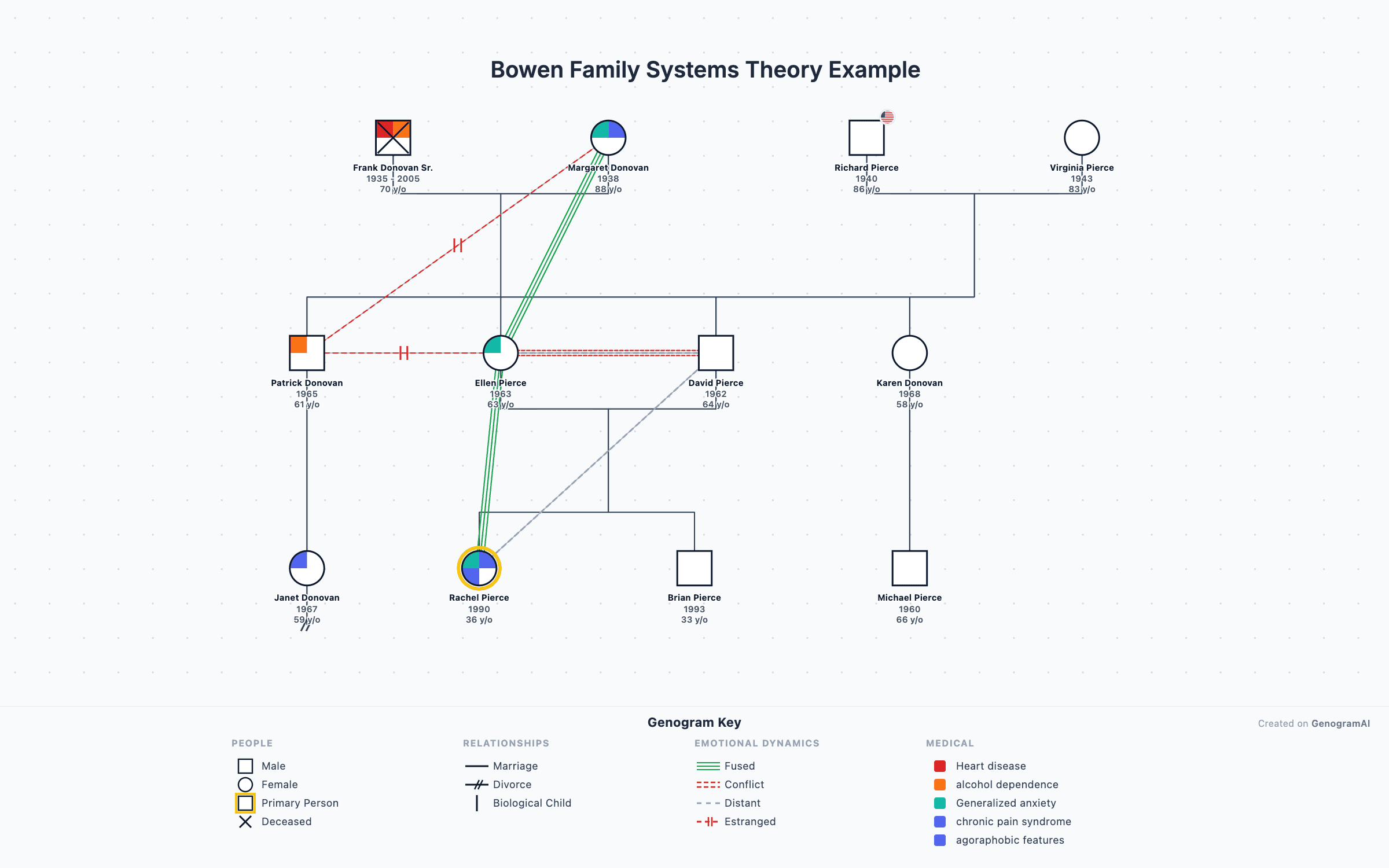
Bowen Family Systems Theory Example
A teaching genogram designed to illustrate Murray Bowen\'s eight interlocking concepts of family systems theory: differentiation of self, triangles.
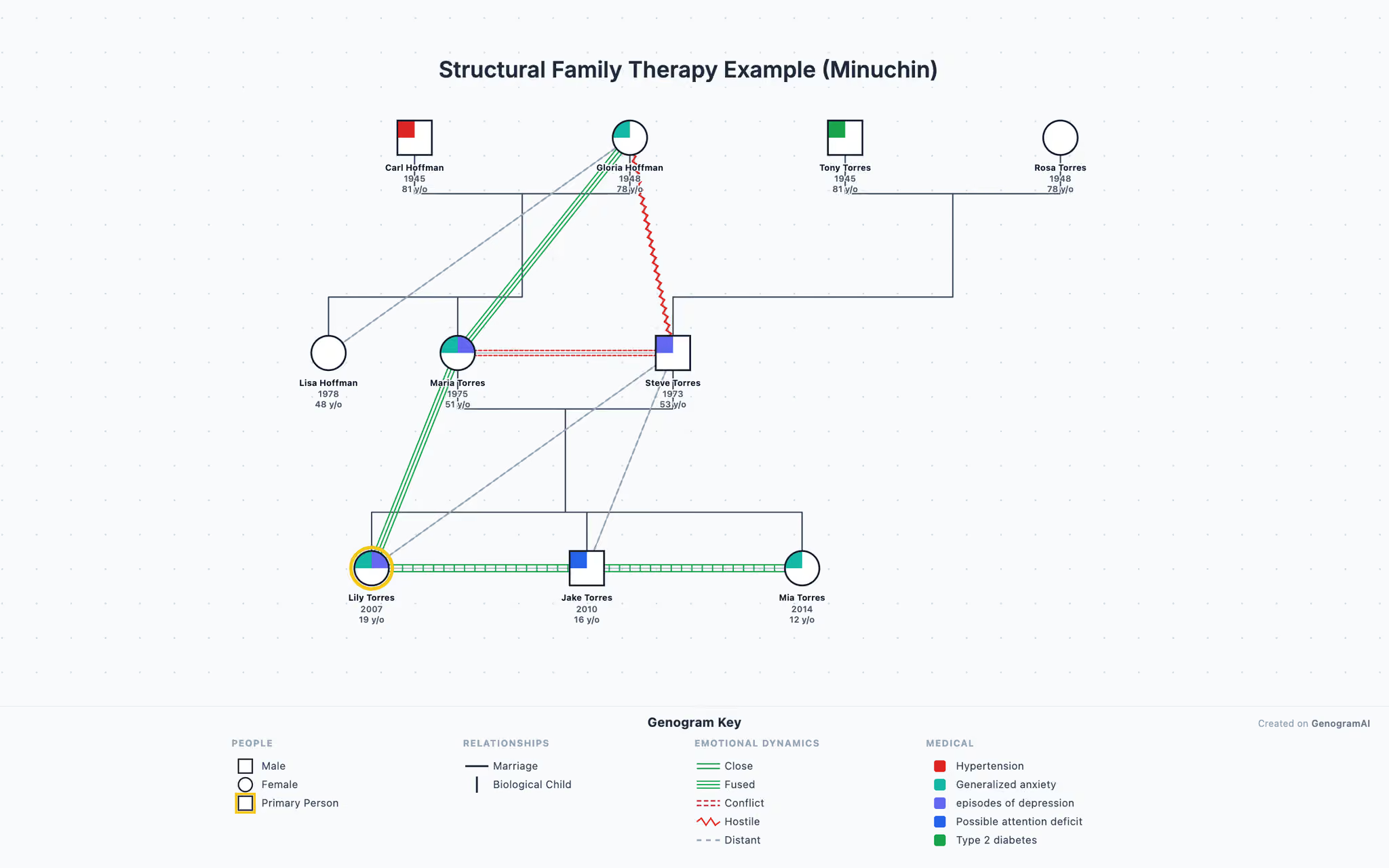
Structural Family Therapy Example (Minuchin)
A teaching genogram illustrating Salvador Minuchin\'s structural family therapy concepts: enmeshed and disengaged subsystems, cross-generational coalitions.
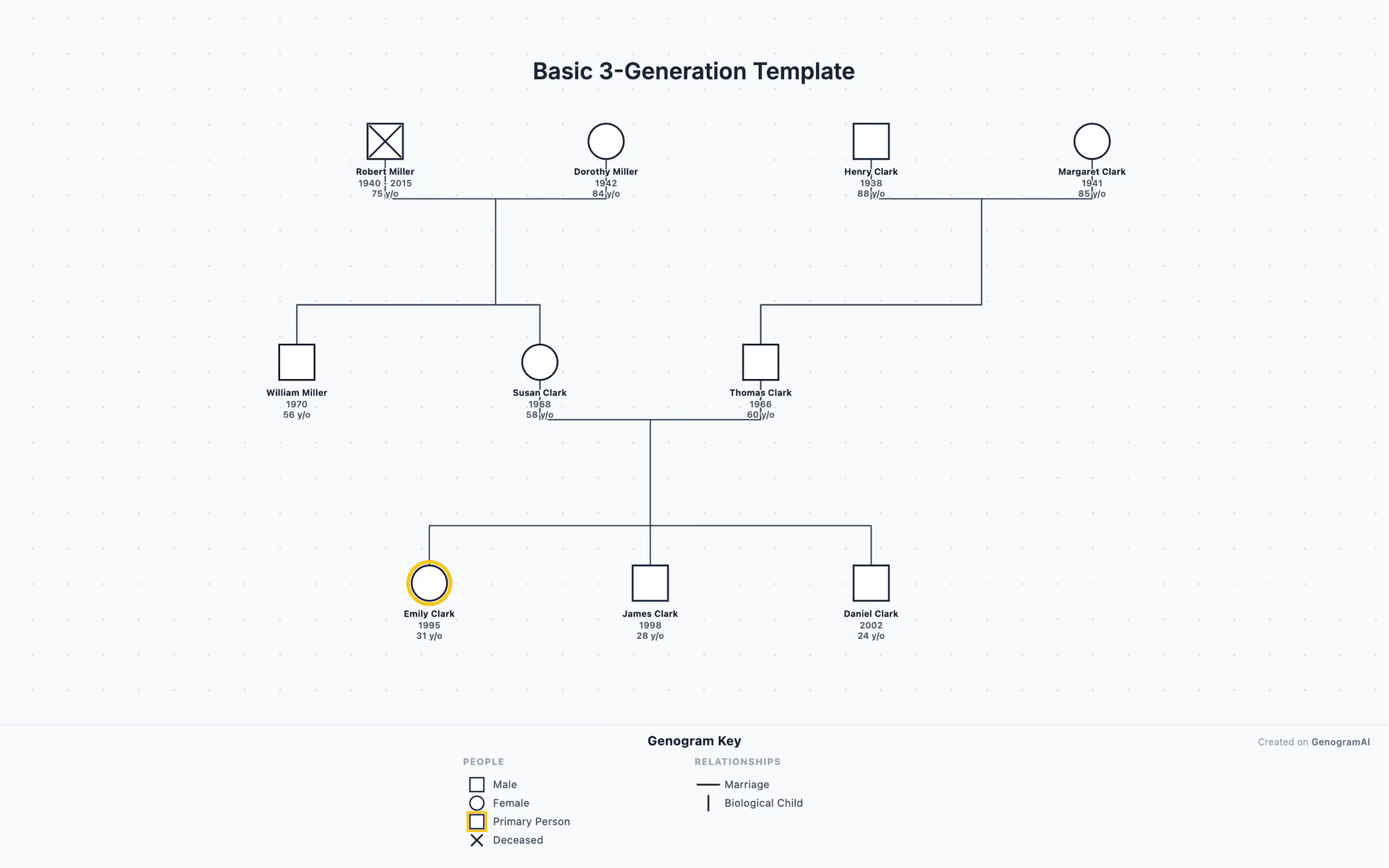
Basic 3-Generation Template
A clean, simple three-generation genogram template designed for teaching basic genogram construction.
Create Your Own Genogram
Use GenogramAI to build your own family genogram with AI assistance. Describe your family and let AI do the rest.
Educational disclaimer: This genogram example is an educational illustration of genogram notation and family systems concepts. Examples based on public figures use publicly available information. They are not clinical documents. All examples are intended for learning genogram symbols and patterns.