Genogram example · Academic & teaching
Structural Family Therapy Example (Minuchin)
Quick answer
At a glance
| This example | |
|---|---|
| Generations | 3 |
| Family members | 10 (4 male, 6 female) |
| Birth years | 1945 to 2014 |
| Index person | Lily Torres |
| Emotional relationships | Close, Distant, Conflict, Fused/Enmeshed and Hostile |
| Conditions marked | Anxiety Conditions, Depressive Disorders, Mental Health Conditions, Cardiovascular Conditions and Diabetes |
| Category | Academic & teaching |
| Tags | Academic, Clinical, Educational |
About this genogram
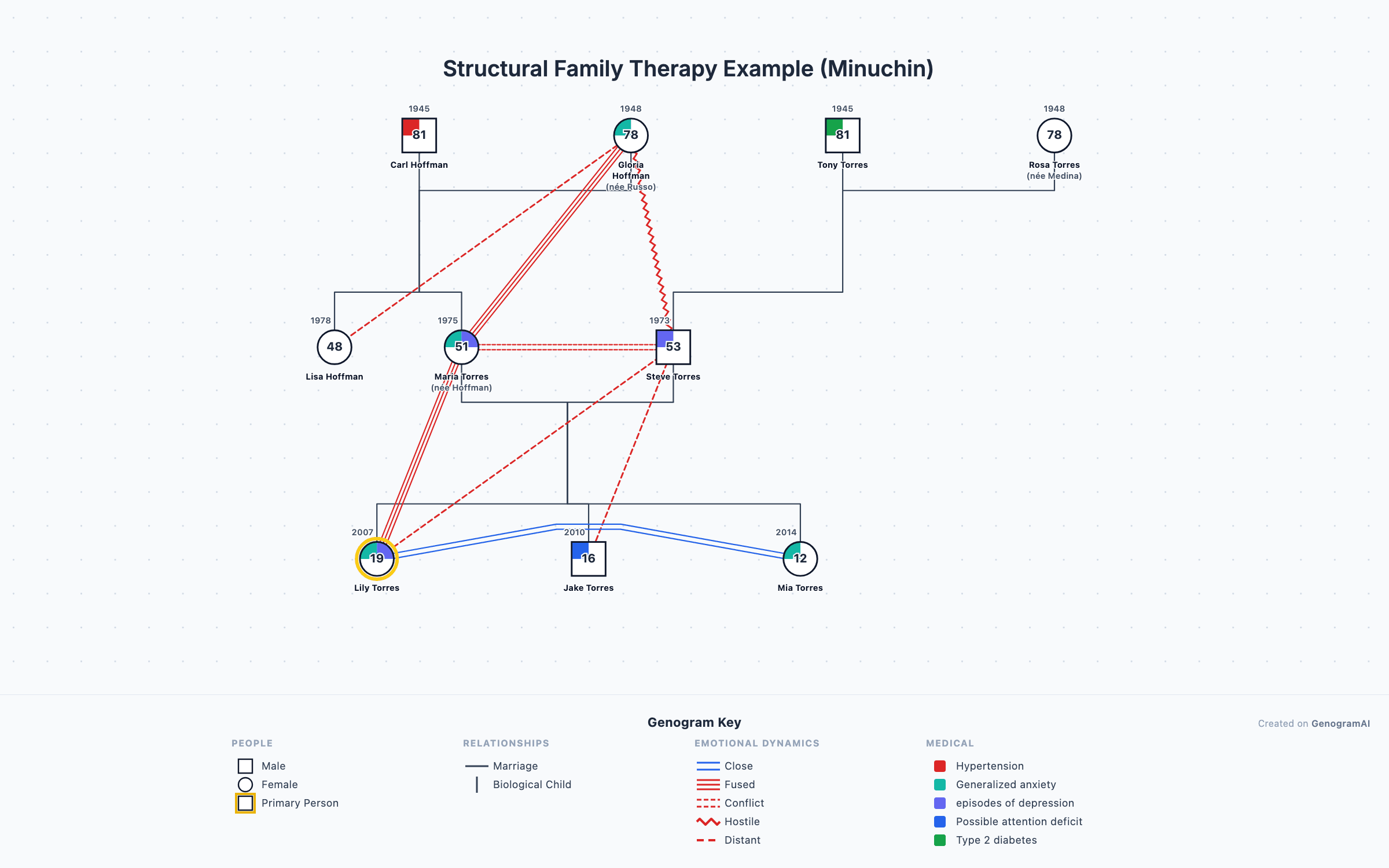
A teaching genogram illustrating Salvador Minuchin's structural family therapy concepts: enmeshed and disengaged subsystems, cross-generational coalitions, parentified child, boundary violations, and dysfunctional family hierarchy. Depicts a family presenting for therapy with a symptomatic adolescent, revealing how structural dysfunction maintains the symptom. Shows the before-therapy pattern that a structural therapist would seek to restructure.
Pattern analysis
Overview
This 3-generation genogram maps 10 family members with birth years spanning from 1945 to 2014, comprising 4 males and 6 females. The genogram tracks 5 medical/psychological condition categories and 5 emotional relationship types across 8 documented dyads. The index patient is Lily Torres (b. 2007), high school student.
Generation by generation
The family system encompasses 3 generations with distinct patterns at each level. The oldest generation includes Carl, Gloria, Tony and 1 other, with 3 presenting documented conditions. The middle generation includes Maria, Steve, Lisa, with 2 presenting documented conditions. The youngest generation includes Lily, Jake, Mia, with 3 presenting documented conditions.
Emotional relationships
Emotional relationship mapping reveals 2 fused/enmeshed relationships, 3 distant relationships, 1 conflictual relationship, 1 hostile relationship, 1 close relationship. Specific patterns include a fused/enmeshed relationship between Maria and Lily, a fused/enmeshed relationship between Gloria and Maria, a distant relationship between Steve and Lily. The co-occurrence of fused and conflictual relationships suggests a family system with poorly differentiated boundaries, where emotional intensity oscillates between enmeshment and discord.
Health conditions
Medical and psychological conditions are documented in 8 of 10 family members (80%). Anxiety-spectrum conditions appear in 4 members (Gloria, Maria, Lily...). Depressive disorders appear in 3 members (Maria, Steve, Lily), affecting 2 females and 1 male. Cardiovascular conditions appears in 1 member (Carl). Comorbidity is observed in 2 family members, with Maria presenting 2 concurrent condition categories. The multigenerational prevalence of anxiety-spectrum conditions suggests both genetic predisposition and possible environmental or behavioral transmission pathways.
Teaching use
As a teaching resource, this genogram demonstrates standard McGoldrick–Gerson notation in a realistic family context. Students can practice identifying key patterns: multigenerational transmission, family life cycle stages, and the interplay between structural relationships and emotional processes. The example integrates both medical and emotional overlays, making it suitable for advanced coursework in family therapy and family medicine.
How do you read the Structural Family Therapy Example (Minuchin) genogram?
- 1
Find each person and generation
Squares are males and circles are females, and each row is one generation, oldest at the top. This one has 4 males and 6 females across 3 generations. - 2
Check the status markers
Markers on a symbol add facts about that person: Index Patient (Arrow). The index person, the focus of the assessment, is Lily Torres. - 3
Follow the family lines
Horizontal lines join partners and vertical lines drop to their children, born left to right in birth order. This genogram uses Marriage and Parent-Child lines. - 4
Read the emotional lines
Lines drawn between two people show how they relate: Close, Distant, Conflict, Fused/Enmeshed and Hostile. Notice who has several lines converging on them, and which patterns repeat from one generation to the next. - 5
Read the shading
Shaded symbols mark health conditions: Anxiety Conditions, Depressive Disorders, Mental Health Conditions, Cardiovascular Conditions and Diabetes. Trace each line of descent to see where a condition recurs and where it stops.
Genogram symbols used in this example
| Symbol | Type | What it means |
|---|---|---|
| Male (Square) | Person Symbols | A square represents a male family member in standard genogram notation. |
| Female (Circle) | Person Symbols | A circle represents a female family member in standard genogram notation. |
| Index Patient (Arrow) | Status Markers | An arrow pointing to a person identifies them as the index patient — the individual who is the focus of the clinical assessment. |
| Marriage | Structural Relationships | A solid horizontal line connecting two individuals represents a marriage or committed partnership. |
| Parent-Child | Structural Relationships | A vertical line descending from a couple line to a child symbol represents a parent-child relationship. |
| Close | Emotional Relationships | Two parallel lines between individuals represent an emotionally close relationship. |
| Distant | Emotional Relationships | A dotted line represents an emotionally distant or disengaged relationship. |
| Conflict | Emotional Relationships | A zigzag line between individuals represents an openly conflictual relationship. |
| Fused/Enmeshed | Emotional Relationships | Three parallel lines with a zigzag overlay represent a fused relationship — emotionally intense with poor boundaries. |
| Hostile | Emotional Relationships | A zigzag line with an arrow indicates a hostile, one-directional aggressive dynamic. |
| Anxiety Conditions | Medical Conditions | Shading in the genogram symbol indicates anxiety-spectrum diagnoses (GAD, panic disorder, phobias, OCD). |
| Depressive Disorders | Medical Conditions | Shading indicates depressive conditions (major depression, dysthymia, bipolar disorder). |
| Mental Health Conditions | Medical Conditions | Shading indicates psychological or psychiatric conditions beyond anxiety and depression. |
| Cardiovascular Conditions | Medical Conditions | Shading indicates heart disease, hypertension, stroke, or other cardiovascular conditions. |
| Diabetes | Medical Conditions | Shading indicates Type 1 or Type 2 diabetes. |
Build a genogram like this one
Example prompt
- 1
Start from the dashboard
Sign in to GenogramAI and choose Create with AI (paid plans), or open a blank genogram and use Ask AI (any plan). To start from this exact chart instead, use Open as template. - 2
Describe your family
Paste a description like the one above, with your own names, dates, relationships and health history. - 3
Check and adjust
Edit people and lines by hand, or ask the AI for one change at a time. - 4
Export
Download a PNG on the free plan. PDF and SVG export are on paid plans.
The free plan includes 2 genograms and 5 AI credits a month. See the AI genogram creator for what else it can do.
Related resources
- Use this example as a reference for genogram assignments in family therapy courses.
- Our guide for genograms for psychology students explains the notation used in this example.
- Start with simple genogram examples if you are new to genogram notation.
- The fused relationship symbol indicates enmeshed boundaries in this family system.
- The distant relationship symbol in this genogram indicates emotional disengagement.
Frequently asked questions
What clinical patterns does the Structural Family Therapy Example (Minuchin) genogram reveal?
The Structural Family Therapy Example (Minuchin) genogram maps multigenerational transmission of psychological patterns, emotional dynamics, and relationship structures. Clinicians use it to identify recurring cycles of behavior, attachment styles, and communication patterns that may inform diagnosis and treatment planning in family therapy.
How can students use the Structural Family Therapy Example (Minuchin) genogram?
Students can use the Structural Family Therapy Example (Minuchin) genogram as a reference for learning genogram symbols, notation, and interpretation. It serves as a teaching template for family therapy courses, social work programs, and psychology classes.
What genogram symbols are used in the Structural Family Therapy Example (Minuchin) example?
This genogram uses Male (Square), Female (Circle), Index Patient (Arrow), Marriage, Parent-Child, Close, Distant, Conflict, Fused/Enmeshed, Hostile, Anxiety Conditions, Depressive Disorders and 3 more. All of them follow standard genogram notation, so the chart reads the same way in any genogram program or textbook.
Can I build a genogram like the Structural Family Therapy Example (Minuchin) example?
Yes. Open GenogramAI, choose Create with AI on the dashboard (paid plans) or open a blank genogram and use Ask AI in the editor (any plan), and describe the family in plain words: who is in it, how they are related, key dates and the relationships or health conditions you want to show. The AI draws the symbols and lines, and you can then edit by hand or ask for one change at a time. A family of 10 people like this one takes a short paragraph to describe. The free plan includes 2 genograms and 5 AI credits a month, with PNG export.
About this example