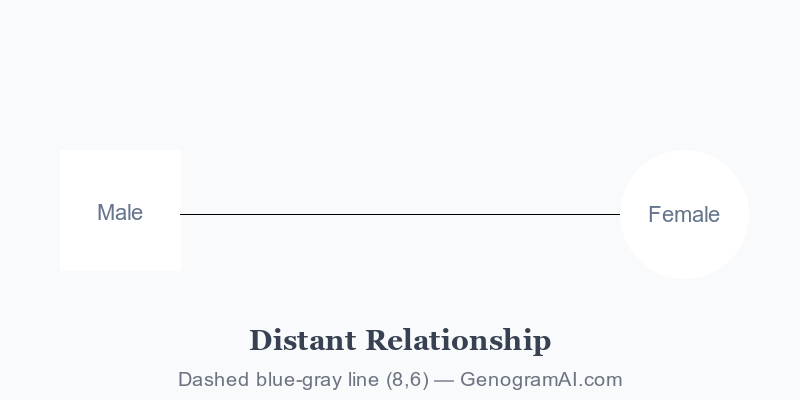
The distant relationship symbol—a dotted or dashed line—represents emotional disconnection between family members. Despite being structurally connected (related), individuals with distant relationships lack emotional intimacy, regular communication, or meaningful engagement with each other.
Male
Female
Distant Relationship: Dashed red line
What is a Distant Relationship in Genogram Notation?
A distant relationship in genogram terminology refers to an emotional pattern where family members have limited or superficial connection despite their biological or legal relationship. According to McGoldrick, Gerson, and Petry (2020), "A dotted line indicates a distant relationship."
Distance in family relationships exists on a spectrum. It may range from mild emotional reserve to significant avoidance, though it differs from cutoffin that some contact typically remains. The relationship exists structurally but lacks emotional depth or intimacy.
Clinical Definition
Distant relationships are characterized by emotional unavailability, limited communication, and absence of meaningful connection. Unlike cutoff, contact may occur but remains superficial—family members may see each other at gatherings but never discuss anything personal.
Characteristics of Distant Relationships
Distant relationships manifest through specific patterns that clinicians should recognize when conducting genogram interviews and assessments.
Limited Communication
Infrequent contact, conversations that stay on surface topics, and avoidance of personal or emotional discussions.
Emotional Unavailability
Little to no emotional support, inability to discuss feelings, and absence of warmth in interactions.
Physical or Emotional Space
May manifest through geographical distance or emotional walls even when physically proximate.
Infrequent Interaction
Contact limited to obligatory occasions (holidays, funerals) with little initiation of voluntary connection.
Clinical Significance
Distance in family relationships often serves a protective function. According to Bowen family systems theory, emotional distance is one of the primary mechanisms families use to manage anxiety. Understanding when and why distance developed is crucial for effective therapy.
Protective vs. Problematic Distance
Distance is not inherently pathological. It may represent:
Healthy differentiation: Appropriate autonomy between family members
Cultural norms: Some cultures value emotional reserve
Self-protection: Distance from harmful or toxic family members
Geographic reality: Families spread across different locations
However, distance becomes clinically significant when it:
Prevents necessary support during crisis
Reflects unresolved conflict or avoidance
Causes distress to family members who desire closeness
Represents a pattern repeated across generations
Assessment Tip
When documenting distant relationships, explore the history: Was the relationship always distant? Did distance develop after a specific event? Is the distance mutual or does one party desire more closeness? These details inform treatment.
Common Patterns of Distance
Father-Child Distance
One of the most commonly documented patterns in genograms. Research consistently shows that fathers, particularly in previous generations, often had more distant relationships with their children compared to mothers. This pattern may relate to traditional gender roles, work demands, or intergenerational transmission of emotional patterns.
Sibling Distance After Life Transitions
Siblings who were close in childhood may become distant after marriage, having children, or geographic moves. This can be a natural evolution or may reflect unresolved conflicts, competition, or different life trajectories.
Distance Following Divorce
Children of divorce often develop distant relationships with one parent, typically the non-custodial parent. This pattern may persist into adulthood and affect subsequent relationships.
Intergenerational Distance Patterns
Distance often repeats across generations. A man who had a distant relationship with his father may unconsciously create similar distance with his own children, perpetuating the pattern unless consciously addressed.
Distance vs. Cutoff: Understanding the Spectrum
Distant
Cutoff
Some contact remains
No contact at all
May attend family events
Avoids all contact
Superficial communication possible
Communication completely severed
May be gradual development
Often follows specific event
Dotted/dashed line symbol
Line with two slashes symbol
How to Use This Symbol in GenogramAI
Steps to Add a Distant Relationship:
1Press E to activate the Emotional Relationship tool
2Click on the first family member
3Drag to the second family member
4Select "Distant" from the relationship type menu
5Note when distance developed and contributing factors
Case Example
The Thompson Family: David (48) describes a distant relationship with his father Robert (75). They live 30 minutes apart but see each other only at holidays. Conversations stay on safe topics—weather, sports, work—never touching on feelings or personal matters. David cannot recall ever hearing his father say "I love you."
Mapping the genogram reveals Robert also had a distant relationship with his own father, who was a "provider but not emotionally present." The pattern has repeated across three generations. David recognizes he's at risk of creating similar distance with his teenage son and seeks therapy to break the cycle.
Therapeutic Considerations
Working with Distance
Explore function: What purpose does the distance serve?
Understand history: How and when did it develop?
Assess desire: Do parties want more closeness?
Identify barriers: What prevents greater connection?
Small steps: Change comes through gradual efforts, not dramatic confrontations
No. Healthy independence involves the ability to function autonomously while still being capable of intimacy. Distance often involves difficulty with emotional connection, not just appropriate autonomy.
Can distant relationships become close?
Yes, with intentional effort from both parties. This typically requires addressing underlying issues, developing new communication patterns, and gradual increase in emotional sharing. Change is possible but requires sustained commitment.
How do I distinguish distant from introverted?
An introverted person may have fewer relationships but can be emotionally intimate within them. Distance is about the quality of connection within a specific relationship, not personality style. Ask about emotional depth, not just contact frequency.