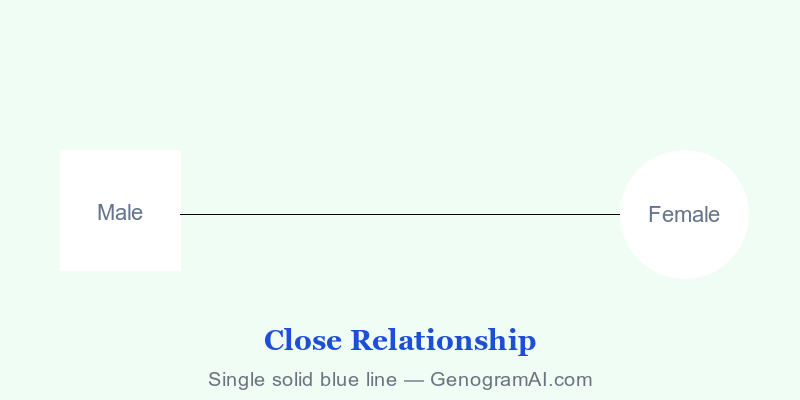
The close relationship symbol represents warm, supportive bonds between family members. Depicted as two parallel blue lines connecting individuals, this symbol indicates emotional intimacy, mutual support, and healthy attachment in family systems.
Male
Female
Close Relationship: Two parallel blue lines
What is a Close Relationship in Genogram Notation?
In genogram terminology, a close relationship refers to an emotional bond characterized by warmth, mutual support, open communication, and positive regard between family members. Relationship lines indicate the quality of connections between individuals, with close relationships shown through a distinctive blue line.
GenogramAI Notation
In GenogramAI, a close relationship is displayed as two parallel blue lines — distinct from the plain "connected" line by its blue color, which signals emotional warmth and intentional closeness. This symbol is recognized across therapeutic modalities and clinical settings worldwide.
McGoldrick Standard
The McGoldrick, Gerson & Petry (2020) standard uses two parallel lines to indicate a close relationship, and GenogramAI draws it the same way: two parallel blue lines between the two people. Three parallel lines mean something different — fusion or enmeshment.
Characteristics of Close Relationships
Close relationships in family systems are marked by several key characteristics that differentiate them from other emotional patterns. Understanding these traits helps therapists accurately identify and document healthy bonds.
Emotional Availability
Family members are emotionally present and responsive to each other's needs, creating a secure base for attachment.
Mutual Support
Both parties provide support during challenging times while celebrating successes and milestones together.
Healthy Boundaries
Despite emotional closeness, individuals maintain appropriate boundaries and respect each other's autonomy.
Open Communication
The ability to discuss difficult topics, express emotions, and resolve conflicts constructively.
Clinical Significance
Close relationships serve as protective factors in family systems. Research in family therapy consistently shows that secure, close bonds between family members contribute to psychological resilience, better mental health outcomes, and improved coping mechanisms during stress.
When mapping genograms, therapists look for patterns of closeness across generations. These patterns can reveal:
Strengths in the family system that can be leveraged therapeutically
Healthy relationship models that younger generations can emulate
Support networks available during crisis situations
Potential resources for family-based interventions
Close vs. Fused Relationships: An Important Distinction
One of the most critical distinctions in genogram notation is between closeand fused (enmeshed) relationships. While both involve strong emotional bonds, they represent fundamentally different dynamics:
Key Difference
Close relationships maintain individual identity and healthy boundaries. Fused relationships (shown with three lines) indicate enmeshment where boundaries become blurred and individual autonomy is compromised.
Close (two parallel blue lines): Healthy intimacy + individual identity
Fused (three lines): Enmeshment + loss of boundaries
How to Use This Symbol in GenogramAI
Creating close relationship indicators in GenogramAI is straightforward. The platform automatically applies standardized notation while giving you flexibility in documenting family dynamics.
Steps to Add a Close Relationship:
1Press E to activate the Emotional Relationship tool
2Click on the first family member
3Drag to the second family member
4Select "Close" from the relationship type menu
5Add optional notes about the nature of the closeness
Case Examples
Example 1: Mother-Daughter Bond
Maria (45) and her daughter Sofia (22) share a close relationship characterized by regular communication, mutual respect, and emotional support. They discuss important life decisions together while Sofia maintains her independence as a young adult. This would be documented with two parallel blue lines between their symbols.
Example 2: Sibling Connection
Brothers James (38) and Michael (35) have maintained a close bond despite living in different cities. They speak weekly, support each other through career challenges, and coordinate care for their aging parents. Their relationship demonstrates how closeness can persist across physical distance.
Therapeutic Applications
Understanding close relationships in a family system helps therapists:
Identify resources: Close relationships represent potential support systems that can be activated during therapy
Recognize patterns: Mapping closeness across generations reveals family strengths that can be reinforced
Plan interventions: Understanding who is close to whom helps in strategic intervention planning
A "connected" relationship (plain line) indicates a basic relationship exists without specifying quality. A "close" relationship (solid blue line) indicates warmth and emotional intimacy — the blue color signals intentional closeness beyond a neutral connection.
Can close relationships exist between non-family members?
Yes. Genograms often include significant non-biological relationships. Close friendships, mentoring relationships, or other meaningful bonds can be documented using the same notation.
How do I know if a relationship is "close" or "fused"?
Ask about boundaries. In close relationships, individuals maintain separate identities and can make independent decisions. In fused relationships, there's often guilt about separation, difficulty with independent choices, and over-involvement in each other's lives.
Use GenogramAI to map close relationships and other emotional patterns in your family system. Start with our free genogram creator - no download required.