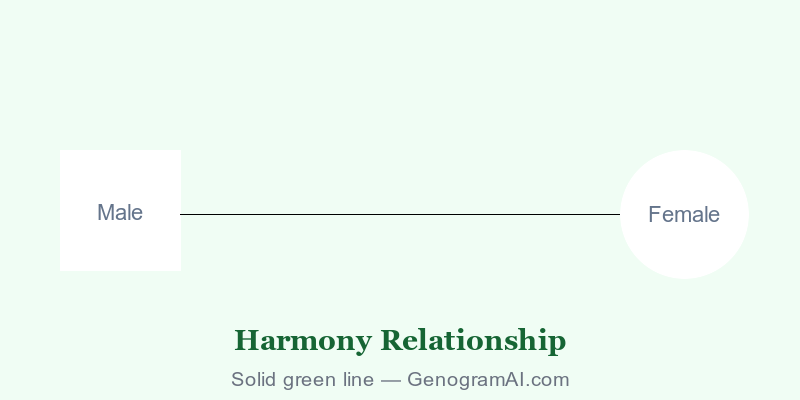
The harmony relationship symbol — a single green or positive-colored line — represents balanced, peaceful relationships characterized by mutual respect, effective communication, and absence of significant conflict. This symbol indicates relationships that function smoothly without the intensity of close bonds or the friction of hostile ones.
Male
Female
Harmony Relationship: Single solid green line
What is a Harmony Relationship?
A harmony relationship describes a balanced, peaceful connection between family members. Unlike the intensity of close or fused relationships, harmony represents equilibrium — people getting along well without the deep emotional interdependence that characterizes more intense bonds.
In clinical practice, harmony is often the baseline against which other relationship qualities are measured. When a therapist maps a family genogram, harmonious relationships provide context — they show where the family system is functioning well, which helps identify where disruptions or difficulties may be more significant.
Balance and Equilibrium
Harmony relationships are characterized by give-and-take, mutual accommodation, and the ability to navigate differences without escalation. They represent the "goldilocks zone" of family relationships — neither too hot (enmeshed/hostile) nor too cold (distant).
Characteristics of Harmonious Relationships
Mutual Respect
Both parties respect boundaries and individual differences without needing to change the other.
Low Conflict
Disagreements are handled constructively without escalation to hostility or lasting resentment.
Appropriate Boundaries
Family members maintain healthy individuation while staying connected — neither enmeshed nor cut off.
Effective Communication
Open dialogue where both parties feel heard. Able to discuss difficult topics without the conversation breaking down.
Movement along this spectrum over time can indicate important family transitions — for example, a once-close relationship shifting to harmony after healthy differentiation, or harmony deteriorating to distance after a family conflict.
Clinical Significance
Harmonious relationships often represent family strengths that can be leveraged in therapy. They indicate that family members have developed effective patterns for managing their relationship — skills that might be transferable to more troubled relationships within the system.
When reviewing a genogram, the distribution of harmonious relationships is clinically informative:
Harmony concentrated in one generation but absent in another may indicate a transmission disruption
Harmony between extended family but conflict in the nuclear family suggests the primary system is under stress
A family member who has harmonious relationships with everyone may be a potential bridge person in therapeutic interventions
Absence of any harmonious relationships is a significant clinical finding warranting exploration
When Harmony Masks Issues
Sometimes apparent harmony may mask underlying issues. "Pseudo-harmony" can occur when:
Family members avoid conflict rather than resolving it
One person consistently accommodates to keep the peace
Important issues remain undiscussed to maintain surface calm
Cultural expectations suppress natural emotional expression
A family member is conflict-avoidant due to past trauma
Red Flags for Pseudo-Harmony
If a family presents as universally harmonious but one or more members show signs of anxiety, depression, or somatic symptoms, the clinician should explore whether apparent harmony is genuine or masking avoidance. Pseudo-harmony often collapses under stress, revealing underlying tensions that were never addressed.
Research on Harmonious Family Relationships
Family systems research consistently finds that genuinely harmonious relationships are associated with better outcomes across multiple domains. Families with higher proportions of harmonious relationships show lower rates of anxiety and depression among members, better physical health outcomes, and more effective problem-solving during crises.
McGoldrick and colleagues emphasize that mapping both positive and negative relationship patterns is essential — clinicians who focus only on pathology miss the strengths that can anchor therapeutic change. Harmonious relationships in a genogram represent existing resources within the family system. See our Bowen family systems theory example for a clinical illustration.
How to Use in GenogramAI
1Press E for Emotional Relationship tool
2Click first person, drag to second person
3Select "Harmony" from the relationship menu
4A single green line appears between the two people
Frequently Asked Questions
What does harmony mean in a genogram?
In genogram notation, a harmony relationship represents a balanced, peaceful connection between family members. It's shown as a single green or positive-colored line. Unlike close relationships (which involve deeper emotional intimacy), harmony indicates that family members get along well with mutual respect and effective communication, without intense emotional interdependence.
How is harmony different from a close relationship in a genogram?
Harmony represents balanced, functional relationships with mutual respect and low conflict — think of pleasant, stable interactions. Close relationships involve deeper emotional intimacy, warmth, and personal sharing. Harmony is the 'goldilocks zone' — neither the intensity of closeness/enmeshment nor the disconnection of distance.
Can a harmony relationship be problematic?
Yes. 'Pseudo-harmony' occurs when family members avoid conflict rather than resolving it, when one person consistently accommodates to keep the peace, or when cultural expectations suppress natural emotional expression. A clinician should explore whether apparent harmony masks underlying issues that go unaddressed.
How do I create a harmony line in GenogramAI?
Press 'E' to activate the Emotional Relationship tool, click and drag between two people, then select 'Harmony' from the relationship type menu. A single green line will appear between them.
Is harmony common in families?
Research suggests most families have a mix of relationship qualities. Pure harmony across all relationships is uncommon — most family systems contain some harmonious, some close, some distant, and some conflictual relationships. The pattern of where harmony exists (and doesn't) is clinically informative.