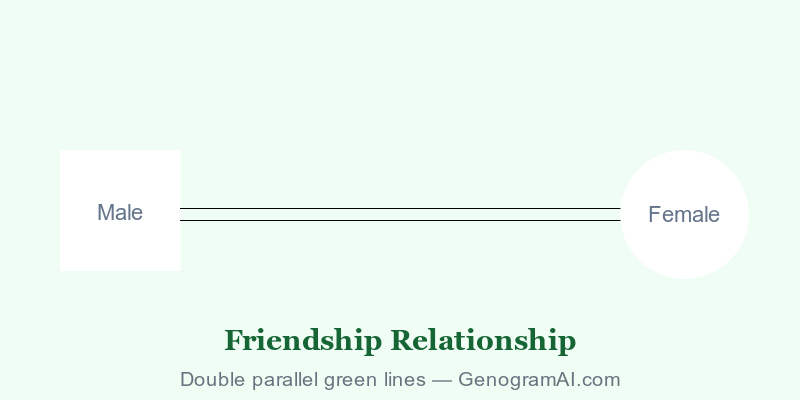
The friendship symbol—typically two parallel green lines—represents platonic supportive bonds that may exist between family members or between family members and significant non-relatives. This symbol distinguishes warm, supportive relationships that lack romantic or obligatory family elements.
Person A
Person B
Friendship: Teal line with circles indicating platonic bond
What is a Friendship Relationship in Genograms?
While genograms primarily map family relationships, significant friendships can profoundly impact family systems. The friendship symbol documents:
Close platonic bonds between family members (siblings who are also "best friends")
Significant non-relatives who function as family ("chosen family")
Mentors, godparents, or community members with significant roles
Relationships that provide support outside the biological family
Chosen Family
In many communities, particularly LGBTQ+ communities, chosen family relationships carry the emotional weight and significance of biological family. Documenting these as friendships on genograms acknowledges their importance to the family system.
Clinical Significance
Friendship relationships on genograms help therapists identify:
External support systems that may be therapeutic resources
Relationships that may compete with or supplement family bonds
Sources of influence on family members
Potential triangulation involving non-family members
Friendship vs. Close Relationship
Key Distinction
Friendship: Platonic, voluntary, often peer-based Close: Intimate family bond with role expectations Two siblings might be both "close" (familial intimacy) AND "friends" (also enjoy each other's company platonically)
Clinical Examples
The following scenarios illustrate how friendship notations on a genogram carry clinical weight beyond simple social connection.
1. Parent-Child "Best Friends" Dynamic
A 28-year-old woman describes her mother as her "best friend." They talk daily, share all personal details, and the daughter consults her mother before every major decision. On the genogram, this friendship line between parent and child signals a potential boundary issue. The therapist explores whether the friendship label masks enmeshment — whether the mother treats the daughter as a peer confidante rather than maintaining a parental role, and whether the daughter has difficulty forming independent adult relationships as a result.
2. Sibling Friendship Across a Family Cutoff
Two adult brothers maintain a close friendship despite their parents being in complete cutoff following a bitter divorce. On the genogram, the friendship line between the siblings stands in contrast to the cutoff line between the parents. Clinically, this friendship represents a resilience factor — the brothers have preserved their bond independently of the parental conflict. However, the therapist also explores whether maintaining this friendship creates loyalty binds, as each brother may feel pressure to "choose sides" or avoid discussing the other parent.
3. Surrogate Parental Friendship With a Non-Family Member
A teenage client identifies a neighbor — a retired teacher — as the most important adult in their life. The genogram shows friendship between the client and this non-relative, while the lines to both biological parents show distance and conflict. This friendship serves a compensatory function: the neighbor provides the emotional stability and mentorship absent from the family system. The therapist considers how this relationship both supports the client and potentially delays addressing the dysfunction within the biological family.
Friendship vs. Close Relationship: A Detailed Comparison
These two positive relationship types overlap in practice but differ in meaningful clinical ways.
Dimension
Friendship
Close Relationship
Nature
Mutual, platonic, voluntary
Any strong bond, including obligatory family ties
Choice
Actively chosen by both parties
May arise from family structure rather than choice
Obligation
No role-based obligation
Often carries role expectations (parent-child, spouse)
When a friendship line appears on a genogram, therapists should explore several dimensions to understand its role within the family system.
Is the Friendship a Protective Factor?
Friendships — especially with non-family members — can serve as critical protective factors. A client with a dysfunctional family of origin but a strong friendship network may have better outcomes in therapy. The friendship line on the genogram helps the therapist identify these external resources and consider how to leverage them during treatment.
Does the Friendship Compensate for Missing Family Bonds?
When a client describes a friend as "like a mother to me" or "the brother I never had," the friendship may be filling a structural gap in the family system. While this is often healthy, the therapist should explore whether the client has fully grieved the absence of the original family bond or whether the friendship serves as an avoidance mechanism that prevents deeper processing.
Could the Friendship Mask Enmeshment?
The label "friendship" between family members — particularly across generational lines — sometimes conceals problematic dynamics. A parent who insists on being their child's "friend" may be abdicating parental authority. Siblings who frame their enmeshment as friendship may resist healthy individuation. The therapist should assess whether the friendship label accurately describes the relationship or whether it softens a dynamic that warrants closer examination.
How Does the Friendship Interact With Family Loyalties?
External friendships can create tension within the family system if family members perceive the friend as a rival for loyalty or influence. Conversely, intra-family friendships can create alliances that exclude other members. Mapping these dynamics on the genogram reveals triangulation patterns and coalition structures that might otherwise go unnoticed.
Frequently Asked Questions
Should I include non-family friends on a genogram?
Yes, when the friendship is clinically significant. Not every casual friendship belongs on a genogram, but when a non-relative plays a meaningful role in the client's emotional life — acting as a confidante, surrogate family member, or primary support figure — including them provides a more accurate picture of the client's relational world. Many clinicians add these figures to the outer edges of the genogram with a friendship line connecting them to the relevant family member.
Can friendship exist alongside other relationship types on a genogram?
Absolutely. Two siblings might have both a close family bond and a friendship. A former spouse might maintain a friendship after divorce. In GenogramAI, you can layer multiple relationship lines between the same two people to capture this complexity. The combination of lines tells a richer clinical story than any single line alone.
How do I distinguish friendship from harmony on a genogram?
Friendship denotes a specific relational quality — platonic, chosen, mutual enjoyment of each other's company. Harmony describes the overall tone of any relationship — peaceful, balanced, free of conflict. A parent and child might have a harmonious relationship without being friends in the peer-like sense. The friendship symbol is best reserved for relationships where both parties would use the word "friend" to describe the bond.
What if one person considers the relationship a friendship but the other does not?
Asymmetric perceptions are clinically important. If a client views a relationship as friendship but the other person views it as obligatory or transactional, the mismatch itself is worth exploring. You can document this by adding a note to the friendship line indicating directionality, or by using different relationship types on each side if the genogram tool supports it.