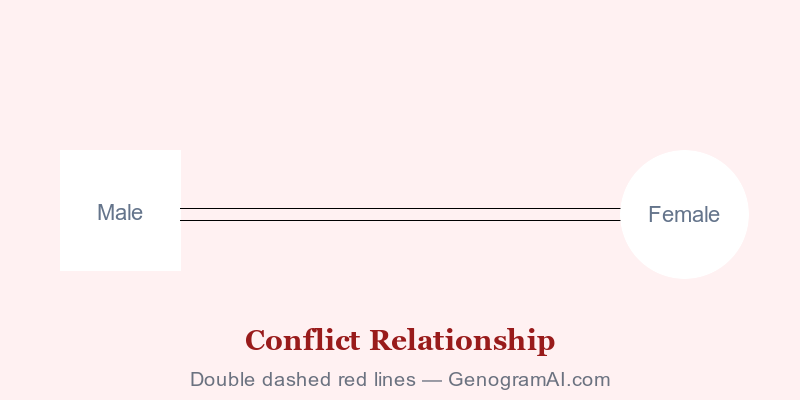
The conflict symbol — two dashed red lines — represents ongoing tension, disagreement, or discord between family members. This pattern indicates persistent friction that may or may not be expressed openly but creates underlying stress in the family system.
Male
Female
Conflict Relationship: Two dashed red lines (typically red)
What Is a Conflict Relationship in Genogram Notation?
In genogram terminology, a conflict relationship refers to an emotional pattern characterized by ongoing tension, disagreement, competing interests, or unresolved issues between family members. According to Monica McGoldrick in Genograms: Assessment and Treatment (2020), conflict lines document relationships where friction is a defining feature.
Standard Notation
The conflict symbol is drawn as two dashed red lines between two individuals. This is one of the most commonly documented emotional patterns in clinical genograms, as family conflict is frequently the presenting issue that brings clients to therapy.
Conflict vs. Hostile: An Important Distinction
One of the most common questions in genogram notation is the difference between conflict and hostile relationships. While both involve negative emotional dynamics, they represent different intensities:
Key Difference
While many clinicians use these terms interchangeably, a useful clinical distinction is:
Conflict (two dashed red lines): Ongoing tension, disagreement, simmering friction
Hostile (red zigzag): Active antagonism, expressed hostility, open warfare
Common Sources of Family Conflict
Understanding the common sources of conflict helps clinicians document patterns more accurately. Research in family therapy identifies several recurring triggers:
Value Differences
Competing values, religious differences, lifestyle choices, or political disagreements that create ongoing friction.
Communication Failures
Misunderstandings, passive-aggressive patterns, or inability to discuss difficult topics constructively.
Role Disputes
Disagreements about parenting approaches, financial decisions, inheritance, or caregiving responsibilities.
Unresolved History
Past grievances, perceived betrayals, or old wounds that have never been addressed or resolved.
Clinical Significance
Conflict patterns are clinically significant for several reasons. Research in family therapy consistently shows that unresolved conflict affects not just the individuals involved but the entire family system.
Triangulation risk: Conflict between two people often pulls in a third party (a child, in-law, or sibling), creating triangles that stabilize the conflict but harm the triangulated person
Escalation potential: Unaddressed conflict may escalate to hostile or violent dynamics over time
Multigenerational transmission: Children who grow up witnessing persistent conflict often replicate these patterns in their own adult relationships
Hidden closeness: Paradoxically, high-conflict relationships sometimes mask underlying attachment or closeness — the conflict is a way of maintaining engagement
Conflict Triangles in Family Systems
Murray Bowen identified triangulation as a core process in family systems. When two people are in conflict, they frequently draw in a third person to reduce anxiety. In genograms, these patterns show up as conflict lines between two people with a close or fused line to a third.
Common Triangle Pattern
A classic example: parents in conflict who triangulate a child. The child becomes the focus of attention (either as a go-between or as the "problem"), which temporarily reduces parental tension but harms the child's development. Genograms make these triangles visible.
Case Examples
Example 1: In-Law Conflict
Rosa (62) and her daughter-in-law Mei (34) have been in conflict since Mei married Rosa's son Carlos (36). The tension centers on parenting differences — Rosa believes in strict discipline while Mei favors a more permissive approach. Carlos is triangulated, feeling pulled between his mother and wife. The genogram shows a conflict line between Rosa and Mei, with close lines from both to Carlos.
Example 2: Sibling Financial Dispute
After their father's death, siblings David (48) and Karen (45) entered into prolonged conflict over the estate. David believed Karen had influenced their father to change his will. Three years later, the conflict persists and has spread — David's wife and Karen's husband are now also involved, with the conflict line extending across both nuclear families.
Therapeutic Approaches to Conflict
When conflict patterns appear in genograms, therapists can use several approaches:
Identify the triangle: Map who is being triangulated and work to detriangulate them
Track the pattern: Look for similar conflicts in previous generations — the current conflict may echo an older unresolved issue
Assess differentiation: Help each person develop their own position without requiring the other to change
Explore the function: Understand what the conflict achieves in the system — it may be maintaining distance, preserving a coalition, or expressing unspoken grief
How to Use This Symbol in GenogramAI
Steps to Add a Conflict Relationship:
1Press E to activate the Emotional Relationship tool
2Click on the first family member involved in the conflict
3Drag to the second family member
4Select "Conflict" from the relationship type menu
5Add optional notes about the nature and source of the conflict
What does the conflict symbol look like in a genogram?
The conflict symbol in a genogram is two dashed red lines drawn between two individuals. In GenogramAI the jagged zigzag is reserved for Hostile, the next step up in intensity. The dashes distinguish it from the solid lines used for closeness and from the zigzag used for hostility. According to McGoldrick, Gerson, and Petry (2020), this symbol represents ongoing tension, discord, or disagreement between family members.
What is the difference between conflict and hostile in a genogram?
Conflict and hostile relationships are closely related but differ in intensity. Conflict (two dashed red lines) represents ongoing tension, disagreement, and friction that may simmer beneath the surface. Hostile relationships indicate more active, expressed antagonism and open warfare. In practice, many clinicians use these terms interchangeably, though some reserve 'hostile' for more severe or violent dynamics.
Can conflict relationships be healthy?
Some degree of conflict is normal and even healthy in families. Constructive conflict — where family members can disagree, express different viewpoints, and work through differences — is a sign of differentiation. The conflict symbol in genograms typically represents persistent, unresolved conflict that causes ongoing distress, not occasional healthy disagreements.
How do I draw a conflict relationship in GenogramAI?
Press 'E' to activate the Emotional Relationship tool, click on the first person, drag to the second person, then select 'Conflict' from the relationship type menu. A red two dashed red lines will appear between the two individuals.
What causes conflict patterns to repeat across generations?
Multigenerational conflict patterns often repeat because family members learn conflict management styles from their parents. According to Bowen family systems theory, unresolved conflict in one generation increases anxiety in the next, often leading to similar conflict patterns. Children who witness persistent parental conflict may replicate those dynamics in their own adult relationships.