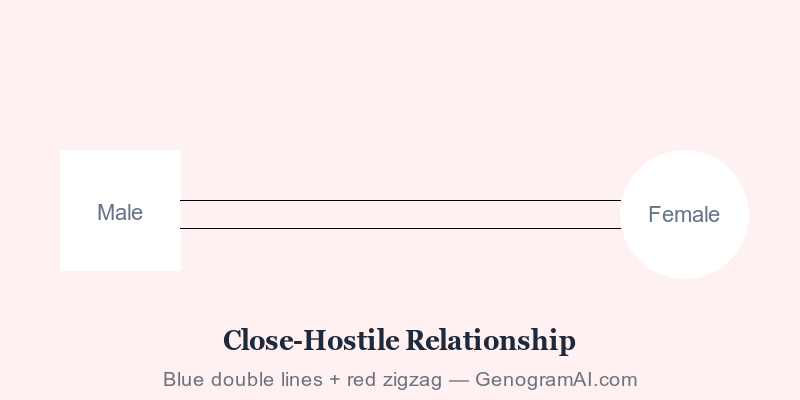
The close-hostile symbol—combining parallel lines with a zigzag—represents relationships that oscillate between intense intimacy and conflict. These volatile connections feature both deep emotional involvement and recurring hostility, creating a pattern of connection and clash.
Male
Female
Close-Hostile: Two parallel lines (closeness) + zigzag line (conflict)
What is a Close-Hostile Relationship?
A close-hostile relationship combines elements of both intimacy and conflict. According to McGoldrick, Gerson, and Petry, "A zigzag line with 2 straight lines indicates a close-hostile relationship." This symbol captures relationships where strong emotional bonds coexist with frequent conflict.
These relationships are characterized by intensity in both directions—family members may love each other deeply while also fighting regularly. The connection is real and significant, but so is the friction. It's the classic "can't live with them, can't live without them" dynamic.
Clinical Note
The close-hostile pattern suggests that any conflictual relationship implies underlying connection. By definition, you can only have intense conflict with someone you care about—pure indifference produces distance, not hostility. The closeness and hostility are intertwined.
Characteristics of Close-Hostile Relationships
Cyclical Pattern
The relationship cycles between periods of closeness and periods of conflict. Reconciliations may be intense, followed by new blowups.
Strong Attachment
Despite conflict, the emotional bond is strong. Neither party can simply walk away—they're invested in the relationship.
High Reactivity
Small triggers can escalate quickly. The emotional temperature can shift from warm to hostile rapidly.
Interdependence
Often involves high levels of mutual dependence—practical, emotional, or both—that keeps parties connected despite friction.
Common Examples
Parent-Adult Child Relationships
Perhaps the most common setting for close-hostile dynamics. An adult child may deeply love their parent while frequently arguing about life choices, boundaries, or old grievances. The parent may criticize constantly yet remain deeply involved in the child's life.
Sibling Relationships
Siblings who grew up close may develop patterns of both connection and competition that persist into adulthood. They may be each other's biggest supporters and harshest critics simultaneously.
Long-Term Marriages
Couples married for decades sometimes develop close-hostile patterns—they can't imagine life without each other but argue frequently about established patterns that neither has been willing to change.
Don't try to eliminate conflict without addressing closeness needs
Don't try to increase distance without helping with conflict skills
Work on differentiation—maintaining self while staying connected
Help clients tolerate differences without cutting off or attacking
Differentiation and Close-Hostile Dynamics
From a Bowen theory perspective, close-hostile relationships often reflect moderate differentiation. The individuals are differentiated enough to have their own positions (hence conflict) but not differentiated enough to hold those positions without emotional reactivity.
Higher differentiation would allow:
Maintaining closeness despite disagreement
Expressing different views without escalation
Tolerating the other's differences without trying to change them
Managing own anxiety without projecting onto the relationship
Close-Hostile vs. Other Patterns
Pattern
Closeness
Conflict
Close
High
Low
Hostile
Variable
High
Close-Hostile
High
High
Distant-Hostile
Low
High (when contact occurs)
Distant
Low
Low
Triangulation in Close-Hostile Relationships
Close-hostile dyads frequently triangulate others to manage their intensity:
Children: Parents in close-hostile marriages may pull children in as allies, confidants, or distractors
Extended family: Siblings may draw in parents when their own conflicts escalate
Therapists: Each party may try to get the therapist to take their side
Issues: External concerns (money, health, work) may become stand-ins for relationship issues
How to Use This Symbol in GenogramAI
Steps to Add a Close-Hostile Relationship:
1Press E to activate the Emotional Relationship tool
2Click on the first family member
3Drag to the second family member
4Select "Close-Hostile" from the relationship type menu
5Note typical triggers, cycle patterns, and how conflict typically resolves
Case Example
The Rodriguez Family: Elena (55) and her mother Carmen (78) have a close-hostile relationship. They speak daily, Carmen is deeply involved in Elena's life and her grandchildren's activities, and Elena describes her mother as her "best friend and worst critic."
Their pattern: Carmen offers unsolicited advice about Elena's parenting, Elena feels criticized and snaps back, Carmen feels hurt and attacks Elena's "oversensitivity," they don't speak for a day, then Carmen calls as if nothing happened. This cycle repeats weekly.
The genogram reveals Carmen had a similar relationship with her own mother. Therapy focuses on helping Elena differentiate—maintaining connection while setting boundaries—without expecting Carmen to change.
Not necessarily. Some families and cultures accept more open expression of conflict as part of intimate relationships. The clinical concern is when the pattern causes distress, prevents growth, or negatively impacts other family members (especially children).
Can close-hostile become just close?
Yes, through increased differentiation. When both parties can maintain their own positions without needing the other to agree, and when they develop skills to discuss differences without escalation, the hostile element can decrease while closeness remains.
How is close-hostile different from normal arguing?
Close-hostile is a persistent pattern, not occasional disagreement. If conflicts follow predictable cycles, involve the same unresolved issues, and are a defining feature of the relationship, it qualifies as close-hostile. Occasional arguments in an otherwise close relationship wouldn't warrant this symbol.