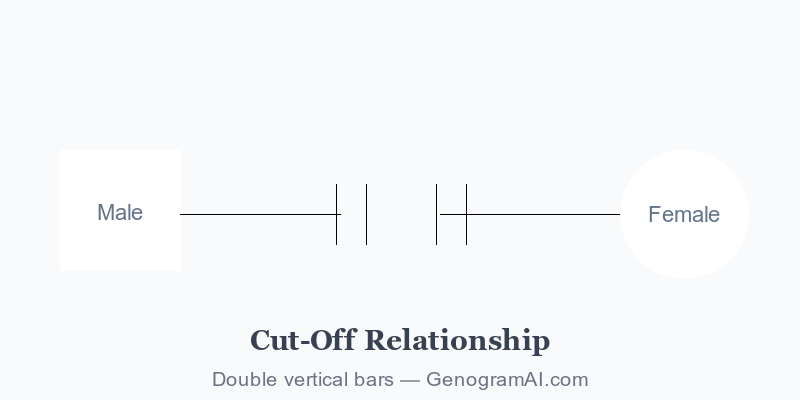
The cutoff symbol—a line with two slashes—represents complete emotional disconnection between family members. Cutoffs are among the most clinically significant patterns in family systems, indicating relationships where contact has been severed entirely, often following unresolved conflict or trauma.
Male
Female
Cutoff Relationship: Single line with two slashes (indicating severed connection)
What is a Cutoff Relationship?
A cutoff in family systems terminology refers to the complete severing of emotional contact between family members. According to Monica McGoldrick and colleagues, "A single line with two slashes through it indicates a cutoff." Murray Bowen considered cutoffs one of the most significant variables affecting family system prognosis.
Unlike distance (which involves limited contact), cutoff means no contact at all— family members may not speak, see each other, or acknowledge each other's existence. Cutoffs can last years or even generations, profoundly impacting family functioning.
Clinical Significance
Murray Bowen stated that cutoffs are among the most significant family variables influencing prognosis. Cutoffs don't eliminate the emotional intensity of relationships—they simply redirect it. The emotional energy invested in maintaining a cutoff often equals or exceeds what maintaining the relationship would require.
Characteristics of Cutoffs
Complete Severing
No contact whatsoever—no calls, visits, messages, or acknowledgment. The person may be treated as if they don't exist.
Sustained Duration
Cutoffs typically persist for extended periods—years or decades. They may last until death without reconciliation.
Ripple Effects
Cutoffs affect the entire family system, forcing others to take sides or navigate around the disconnection.
Unresolved Intensity
Despite no contact, strong emotions remain—anger, grief, longing. The relationship continues to exert influence.
Common Causes of Cutoffs
Cutoffs rarely develop spontaneously. They typically follow specific triggering events or accumulation of unresolved issues:
Unresolved conflict: Long-standing disputes about money, inheritance, or perceived injustices
Disapproval of life choices: Partner selection, sexual orientation, religious changes, career decisions
Family secrets revealed: Discovery of affairs, hidden children, or other betrayals
Abuse or trauma: Physical, emotional, or sexual abuse requiring self-protection
Mental illness: Untreated mental health issues making relationship impossible
Substance abuse: Addiction-related behaviors driving family apart
Third-party interference: Spouse, in-laws, or others creating division
From the Research
McGoldrick notes: "Cutoffs can also involve great conflict or silent distancing." Some cutoffs follow explosive confrontation; others develop gradually through increasing avoidance until contact simply stops. Both patterns lead to the same symbol on the genogram but may have different clinical implications.
The Bowen Perspective on Cutoffs
Murray Bowen's family systems theory provides a framework for understanding cutoffs as a manifestation of low differentiation. Key concepts include:
Cutoff as Pseudo-Solution
Cutoff feels like a solution—eliminating the source of pain. However, Bowen argued that cutoff doesn't resolve the underlying emotional intensity; it merely relocates it. The anxiety that drove the cutoff often resurfaces in other relationships or gets transmitted to the next generation.
Undifferentiation and Reactivity
Cutoffs reflect difficulty managing emotional reactivity. When individuals cannot tolerate the anxiety of remaining connected while maintaining their own position, cutoff becomes the default. Higher differentiation would allow maintaining connection despite disagreement.
Multigenerational Transmission
Families with cutoffs often show the pattern across generations. Children who witness parents cutting off relatives learn this as a template for managing relationship difficulties. The pattern then repeats in their own adult relationships.
Impact on the Family System
System-Wide Effects
Triangulation pressure: Other family members forced to manage relationships with both parties
Lost resources: Support, knowledge, and connection permanently lost
Secrets and silence: Children may not know extended family or family history
Anniversary reactions: Holidays, deaths, and milestones trigger painful reminders
Deathbed regrets: Reconciliation often attempted too late
When Cutoff May Be Appropriate
While Bowen theory generally views cutoffs as problematic, there are situations where limiting or ending contact may be necessary:
Ongoing physical or sexual abuse
Active addiction with harmful behaviors
Untreated severe mental illness with dangerous behavior
Persistent emotional abuse despite attempts at boundary-setting
In these cases, the clinical focus shifts to processing the decision, maintaining the client's mental health, and preventing transmission of trauma to the next generation—not necessarily to reconciliation.
How to Document Cutoffs in GenogramAI
Steps to Add a Cutoff:
1Press E to activate the Emotional Relationship tool
2Click on the first family member
3Drag to the second family member
4Select "Cutoff" from the relationship type menu
5Document: start date, precipitating events, who initiated, and current status
Important: McGoldrick emphasizes noting the start and end dates of any cutoffs, "since it is likely to ripple out into other patterns of illness or other dysfunction."
Case Example
The Chen Family: Linda (52) has been cut off from her father Wei (78) for 20 years, since she married a man he disapproved of. The genogram reveals Wei had cut off his own brother 30 years earlier over a business dispute. Linda's children have never met their grandfather.
Wei's recent cancer diagnosis has prompted Linda to seek therapy to process her feelings about potential reconciliation. The therapist helps her explore:
Her own contribution to maintaining the cutoff
What reconciliation would look like (full contact vs. limited bridge-building)
How to approach contact without sacrificing her own position
Processing potential outcomes including continued rejection
Cutoff Repaired: The Healing Symbol
When cutoffs are resolved, genograms can document this through the "cutoff repaired" symbol—a line with slashes and a circle between them, indicating that the severed connection has been restored. This represents clinical progress and system change.
Yes, these terms are often used interchangeably. "Cutoff" is the clinical/Bowen theory term; "no contact" or "NC" is more commonly used in popular discourse. Both refer to complete cessation of relationship.
How is cutoff different from healthy boundaries?
Healthy boundaries involve limiting specific behaviors while maintaining connection. Cutoff eliminates the relationship entirely. Boundaries are about what behaviors you'll accept; cutoff is about cutting off the person.
Can cutoffs be healthy?
In cases of ongoing abuse or danger, limiting contact may be necessary for safety. However, even necessary cutoffs have systemic effects that should be processed therapeutically. The goal is conscious choice rather than reactive fleeing.