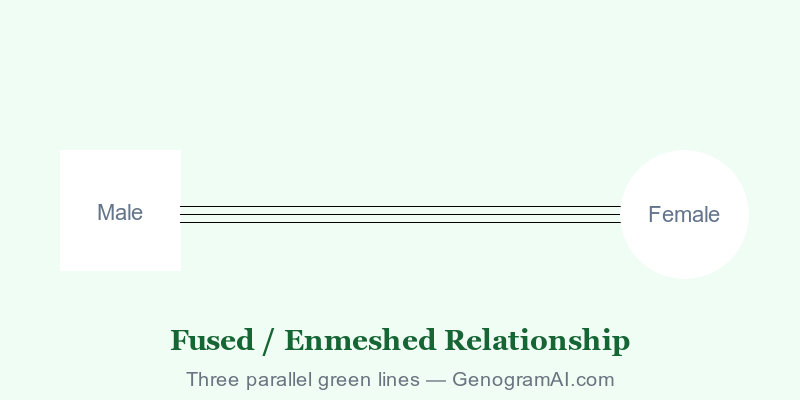
The fused relationship symbol (three parallel lines) represents enmeshment—an over-involved connection where individual boundaries become blurred. This pattern indicates highly interdependent relationships that may inhibit personal autonomy and individual development.
Male
Female
Fused/Enmeshed Relationship: Three parallel lines (red)
What is a Fused/Enmeshed Relationship?
In family systems theory, fusion or enmeshment describes relationships characterized by extreme emotional closeness where individual boundaries dissolve. According to Monica McGoldrick and colleagues, "Three straight lines indicates they are fused, that is, that their relationship is highly interdependent."
The concept of enmeshment was originally developed by Salvador Minuchin in his structural family therapy approach. Minuchin described enmeshed families as having diffuse boundaries where members are overly connected, often at the expense of individual autonomy and development.
Clinical Definition
Enmeshment refers to a family pattern where personal boundaries are porous and unclear. Members are overinvolved in each other's lives, making it difficult to distinguish between individual needs, feelings, and responsibilities.
Characteristics of Fused Relationships
Fused relationships exhibit distinct patterns that differentiate them from healthy closeness. Recognizing these characteristics is essential for accurate genogram documentation and therapeutic intervention.
Blurred Boundaries
Difficulty distinguishing where one person ends and another begins. Members may speak for each other or assume they know each other's thoughts.
Over-Involvement
Excessive concern with each other's affairs, decisions, and emotional states. One member's mood affects the entire system intensely.
Guilt About Separation
Strong feelings of guilt, anxiety, or disloyalty when attempting to individuate or spend time apart.
Identity Confusion
Difficulty developing individual identity separate from the relationship. Self-worth depends heavily on the other person.
Clinical Significance
Murray Bowen's family systems theory places great emphasis on the concept ofdifferentiation of self—the ability to maintain one's identity while remaining connected to others. Fused relationships represent low differentiation, where emotional reactivity is high and autonomy is compromised.
Clinical Concerns
Anxiety transmission: Anxiety spreads rapidly through enmeshed systems
Developmental delays: Children in enmeshed families may struggle with age-appropriate independence
Relationship patterns: Enmeshment often repeats across generations
Mental health impact: Associated with anxiety, depression, and eating disorders
Fused vs. Close: Understanding the Difference
One of the most important clinical distinctions is between healthy closeness and pathological enmeshment. Both involve strong emotional bonds, but they operate very differently:
Close Relationship
Fused/Enmeshed Relationship
Individual identities maintained
Identities become merged
Can disagree without crisis
Disagreement feels threatening
Independent decision-making
Difficulty making decisions alone
Comfortable spending time apart
Anxiety when separated
2 parallel lines symbol
3 parallel lines symbol
Common Enmeshment Patterns
Parent-Child Enmeshment
Often seen between a parent and one child (frequently opposite-sex parent-child pairs). The child may become a "parentified child" taking on adult emotional responsibilities, or may remain dependent well into adulthood. This pattern commonly develops after divorce, death of a spouse, or in families where the marital relationship is distant.
Mother-Daughter Enmeshment
One of the most commonly documented forms of enmeshment. The mother may live vicariously through the daughter, be unable to tolerate the daughter's independence, or use the daughter as a confidant for adult issues.
Sibling Enmeshment
Can develop when siblings band together against parental conflict or dysfunction. While protective initially, it can prevent individual development and create difficulties in adult relationships outside the sibling bond.
Therapeutic Approach
Treatment for enmeshment focuses on building differentiation—helping individuals develop their own thoughts, feelings, and identity while maintaining appropriate connection. This process is gradual and requires careful attention to the anxiety it may provoke in the family system.
How to Use This Symbol in GenogramAI
Steps to Add a Fused Relationship:
1Press E to activate the Emotional Relationship tool
2Click on the first family member
3Drag to the second family member
4Select "Fused" from the relationship type menu
5Document specific enmeshment patterns in the notes field
Case Example
The Martinez Family: Rosa (52) and her daughter Carmen (28) present with an enmeshed relationship. Carmen still lives at home, consults her mother on all decisions (including what to wear), and experiences panic attacks when separated from her mother for more than a few hours. Rosa speaks for Carmen in sessions and becomes visibly distressed when Carmen expresses any opinion different from her own.
The genogram reveals this pattern existed in the previous generation—Rosa had a similar relationship with her own mother, who lived with the family until her death. Treatment focuses on gradual differentiation while honoring the cultural value placed on family closeness.
Multigenerational Patterns
Enmeshment rarely appears in isolation. When documenting fused relationships on genograms, look for:
Similar patterns in previous generations
Compensatory distance in other family relationships
Triangulation patterns involving the enmeshed dyad
Cutoffs that may have resulted from failed individuation attempts
Enmeshment becomes problematic when it prevents individual development, creates anxiety about separation, or interferes with forming healthy outside relationships. Some degree of closeness that might look like enmeshment can be culturally normative— context matters in assessment.
Can enmeshment be fixed?
Yes, through a therapeutic process focused on differentiation. This involves gradually building individual identity while maintaining connection. Progress is typically slow and may provoke anxiety in the family system.
How is enmeshment related to triangulation?
Enmeshed dyads often triangulate third parties to manage anxiety. For example, an enmeshed mother-daughter pair might unite against the father, or an enmeshed parent might confide in a child about marital problems.