Family of Origin Genogram: Graduate Student Assignment Example
Four-generation family of origin genogram for MSW, MFT and counseling assignments: triangles, sibling position, migration and health patterns.
Interactive Family of Origin Genogram: Graduate Student Assignment Example
Click and drag to explore. Zoom with scroll.
Can't see the genogram? View in the GenogramAI Gallery
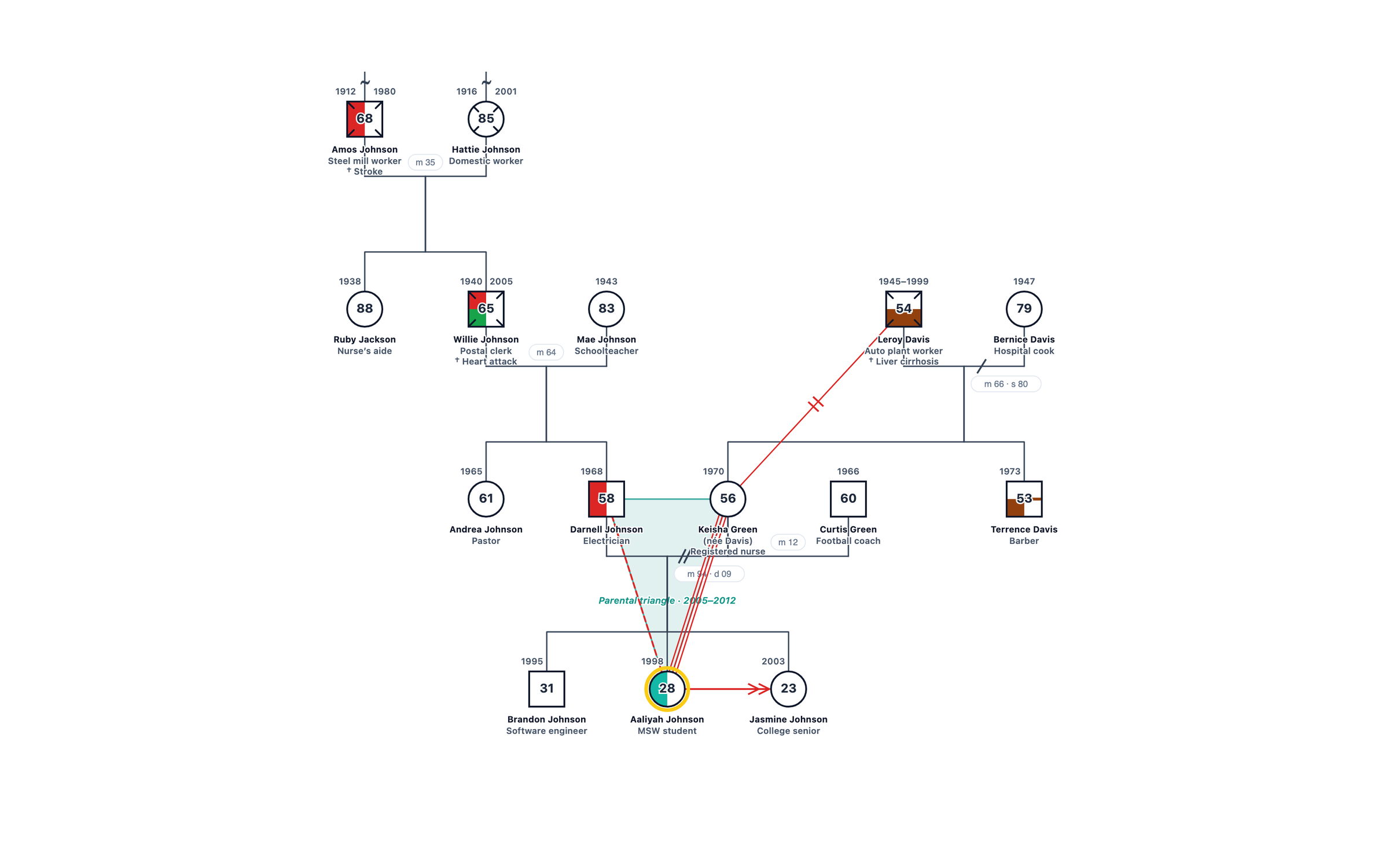
About This Genogram
A four-generation family-of-origin genogram of the kind graduate students draw for MSW, MFT and counseling courses, for a fictional African-American family whose great-grandparents moved from Mississippi to Chicago in the Great Migration. It shows sibling position, a parental triangle, divorce and remarriage, a separation, alcohol and heart disease patterns, education levels and a dated chronology.
How to Read This Genogram
In MSW and MFT training programs, students construct and interpret genograms as a core competency because the skill underpins much of what happens in family-based assessment. Early assignments ask students to diagram their own family of origin using standard notation, which develops both technical accuracy and reflective self-awareness about the systems that shaped them. Later assignments introduce constructed case examples like this one, where students practice reading an unfamiliar family's structure, identifying generational patterns, and forming evidence-based hypotheses about how the family system might influence the presenting concern.
The skills built through repeated genogram work include tracking information across multiple generations simultaneously, translating verbal family history into a visual format that a supervisor or treatment team can read quickly, and distinguishing structural facts from relational inferences. Students also learn to update a genogram as new information emerges during treatment, treating it as a living clinical document rather than a one-time intake tool. Familiarity with these skills before entering field placements allows students to spend their clinical hours on assessment and intervention rather than on learning the notation system from scratch under supervision.
Key Patterns in This Genogram
Symbol Reference
Standard genogram symbols and notation demonstrated in context.
Template Structure
Proper genogram layout and organization for academic assignments.
Learning Framework
A teaching tool for understanding family systems theory in practice.
Pattern Analysis
Aaliyah Johnson (28) drew this genogram for a family-systems course in her MSW program. Her great-grandparents, Amos and Hattie Johnson, left Greenwood, Mississippi, for Chicago in 1946 during the Great Migration; Amos worked in a steel mill and Hattie was a domestic worker and church deaconess. The single wavy mark on their lines records the move between two cultures within one country.
Patterns repeat across generations. Heart disease and hypertension run through the paternal line (Amos, Willie, Darnell). Alcohol use runs through the maternal line: Aaliyah’s grandfather Leroy died of liver disease in 1999, her mother Keisha was estranged from him and did not attend his funeral, and her uncle Terrence is in recovery. Education rises across generations, from domestic and factory work to nursing, a master’s degree and Aaliyah’s graduate study.
In the nuclear family, Aaliyah is the middle of three. Her parents divorced in 2009 when she was 11; the shaded parental triangle (2005–2012) marks how she was drawn into their conflict, fused with her mother and distant from her father. After the divorce she became a second parent to Jasmine. Her reflection paper can connect these positions to her choice of social work and to her own anxiety.
Build a Similar Genogram
A practitioner documenting a family similar to this one would typically record three generations of household composition, significant life events such as births, deaths, marriages, and separations, any relevant medical or mental health history, and the quality of key relationships between members. That information comes from a combination of the client's verbal account, intake questionnaires, and, where available, collateral records. The completed diagram captures both the factual structure of the family and the practitioner's clinical observations about relational patterns, making it a reference that can be shared across disciplines or reviewed at future stages of treatment.
GenogramAI's AI genogram generator allows you to build a diagram like this one from a plain-language description of the family. You type or paste a narrative, such as the basic structure and any key relationships or health history you want to include, and the AI parses that text, places the correct symbols, draws the appropriate relationship lines, and arranges the layout automatically. The result is a fully editable diagram that you can refine, annotate, and export for clinical records or educational use. Try the AI genogram creator to generate your own genogram from a text description in seconds.
Genogram Symbols Used in This Example
The following standard genogram symbols appear in the Family of Origin Genogram: Graduate Student Assignment Example. Each symbol follows McGoldrick and Gerson clinical notation conventions.
Person Symbols
- Male (Square)
- A square represents a male family member.
- Female (Circle)
- A circle represents a female family member.
- Index person (highlighted outline)
- The person at the centre of the assessment is drawn with a highlighted outline.
- Deceased (X)
- An X through the symbol marks a person who has died; birth and death years are written above it.
- Age inside the symbol
- The current age (or age at death) is written inside each symbol, with years above it.
Couples
- Marriage
- A solid line between partners; the marriage year is written on the line (m 90 = married 1990).
- Divorce
- Two slashes across the couple line mark a divorce, with the year (d 02).
- Separation
- One slash across the couple line marks a separation (s 80).
- Immigration marker
- A double wavy mark on a person’s line records immigration; a single wavy mark records living across two cultures.
Family Process
- Emotional triangle
- A shaded triangle joining three people, labelled with its years, marks a triangle in the family system.
- Fused
- Three parallel lines mark an over-close, fused relationship.
- Distant
- A dashed line marks emotional distance.
- Cutoff
- A line broken by two short bars marks an emotional cutoff.
- Caretaking
- An arrow from the caregiver to the person cared for marks a caretaking role.
Medical
- Medical shading
- The left half of a symbol is shaded for a physical or mental illness and the bottom half for alcohol or drug use; each condition has its own colour, listed in the key. Hatching means suspected, a partial fill means in recovery.
Related Resources
- Read our genogram assignment guide.
- Learn what goes into a family of origin genogram.
- See our tips on genograms for social work students.
- Triangles and sibling position come from Bowen family systems genogram theory.
Frequently Asked Questions
What should a family of origin genogram include?
How do I show a triangle?
What is sibling position and why does it matter?
Can I use this example for my assignment?
Related Genogram Examples
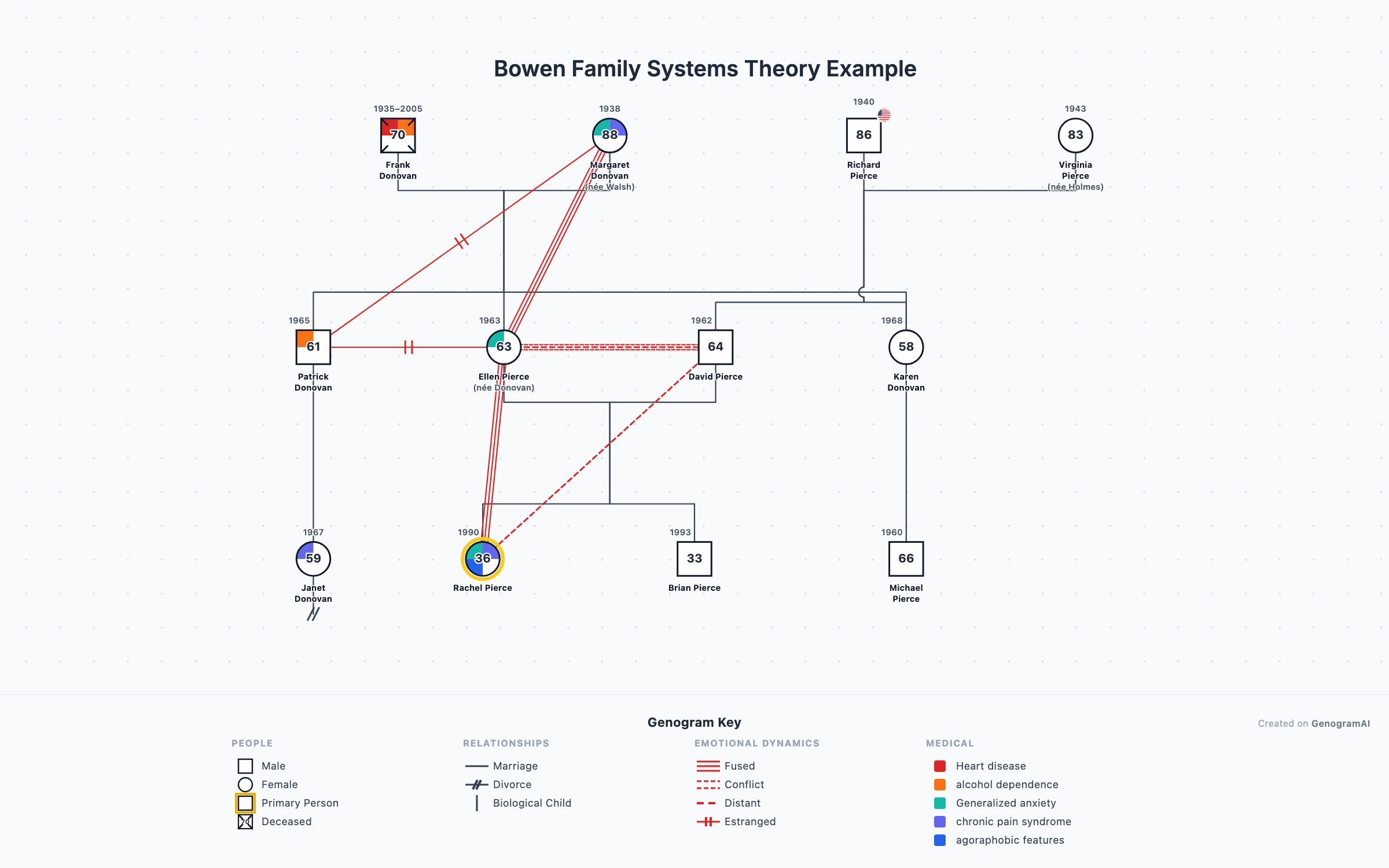
Bowen Family Systems Theory Example
A teaching genogram designed to illustrate Murray Bowen\'s eight interlocking concepts of family systems theory: differentiation of self, triangles.
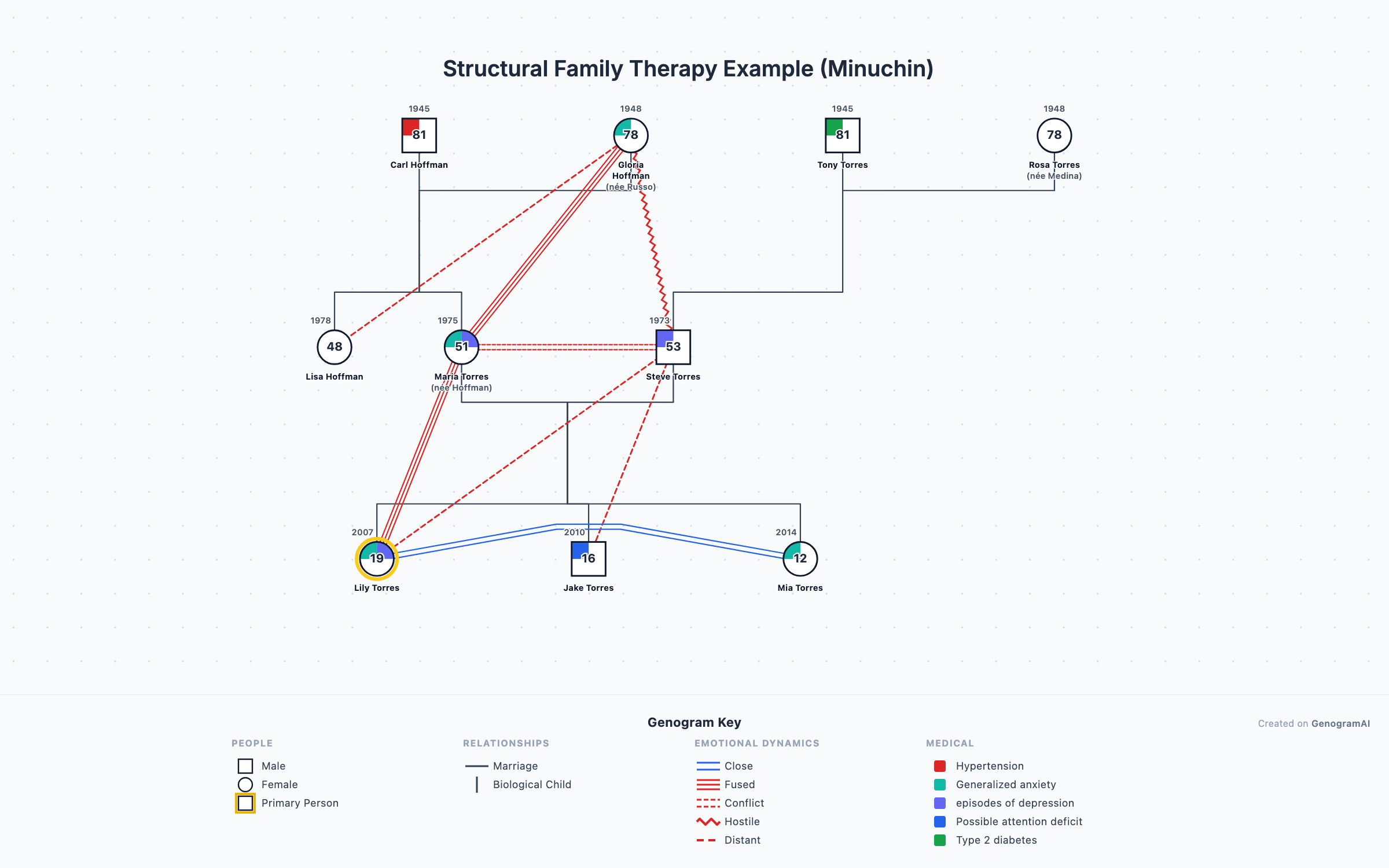
Structural Family Therapy Example (Minuchin)
A teaching genogram illustrating Salvador Minuchin\'s structural family therapy concepts: enmeshed and disengaged subsystems, cross-generational coalitions.
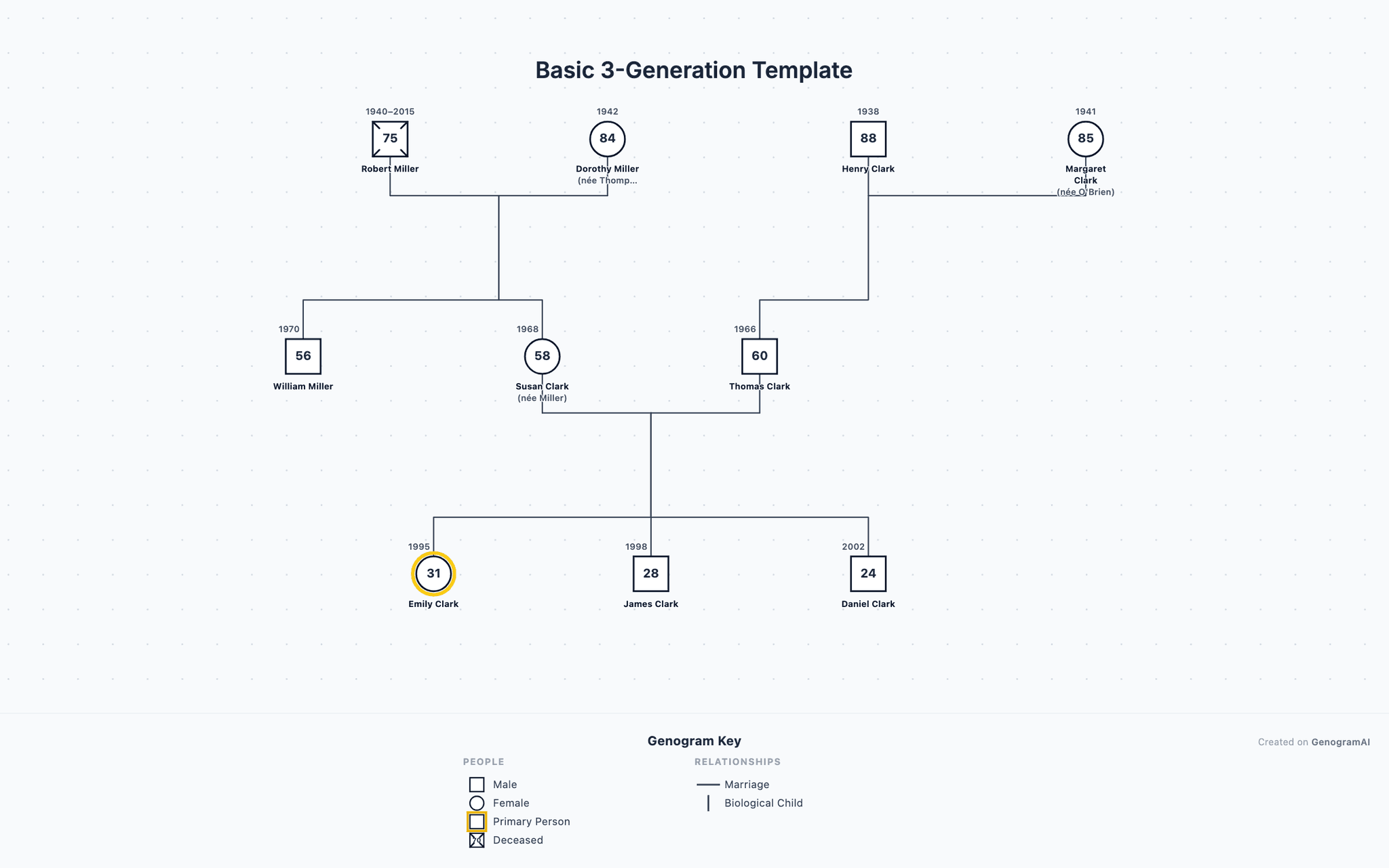
Basic 3-Generation Template
A clean, simple three-generation genogram template designed for teaching basic genogram construction.
Create Your Own Genogram
Use GenogramAI to build your own family genogram with AI assistance. Describe your family and let AI do the rest.
Educational disclaimer: This genogram example is an educational illustration of genogram notation and family systems concepts. Examples based on public figures use publicly available information. They are not clinical documents. All examples are intended for learning genogram symbols and patterns.