For MSW and BSW students
Genograms for social work students, without the frustration
Quick answer
The social work student struggle
Field Placement Wants It Yesterday
"Your field supervisor asked for a genogram of your client's family system. They want it before tomorrow's supervision meeting. You've never made one outside of a textbook example."
Field placements throw you into real clinical work fast. There's no time to learn new software when you're also writing process recordings and attending seminars.
Complex Families Don't Fit Simple Tools
"Your client has a blended family with three marriages, step-siblings, half-siblings, an estranged parent, and two incarcerated relatives. PowerPoint crashes just thinking about it."
Social work deals with complex family structures. The families we serve don't fit neat templates; they need tools that handle real-world complexity.
HBSE Course Shows Examples, Doesn't Teach Tools
"Human Behavior and Social Environment covered genograms in one lecture. The professor showed beautiful examples from the textbook. Then moved on. Now you have to create one."
MSW programs pack in so much content that practical tool training gets skipped. You're expected to figure it out on your own time.
MSW Debt Is Already Crushing
"You're taking out loans for tuition. Buying $200 textbooks. Doing unpaid field hours. The idea of paying for software you'll use twice feels impossible."
Social work salaries rarely keep pace with graduate tuition. Every dollar matters.
Built for real social work
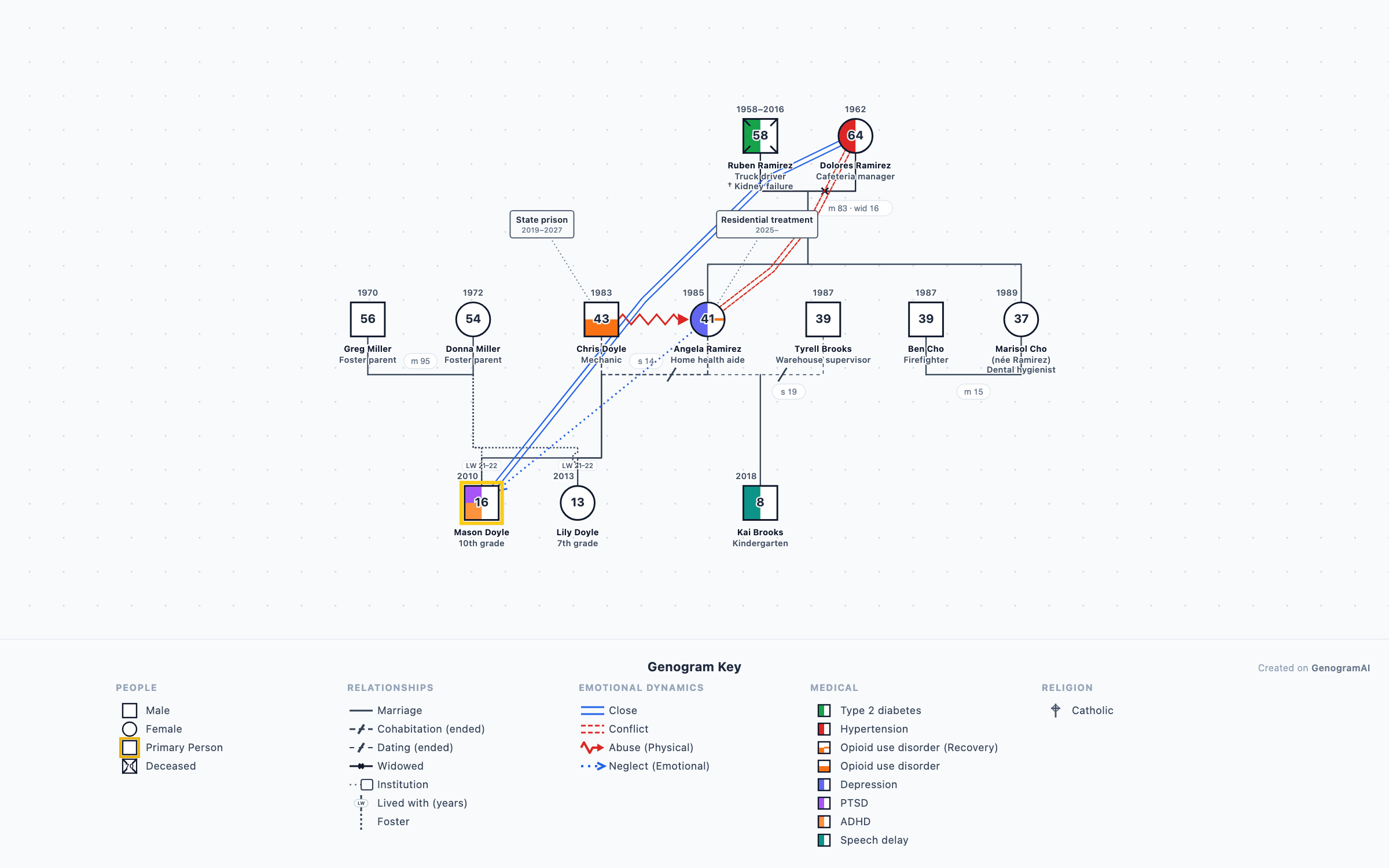
Complex Family Structures
Emotional Relationship Mapping
Trauma & Loss Indicators
Systems Perspective
How are genograms used in field placements?
| Placement setting | How you use a genogram |
|---|---|
| Child Welfare | Map family systems for case documentation. Show placement history, relative resources, risk factors. |
| Healthcare Social Work | Document family medical history. Identify caregivers. Plan discharge with family resources in view. |
| Mental Health | Assessment tool for family therapy. Show multigenerational patterns. Document for treatment planning. |
| School Social Work | Understand student's home environment. Identify family strengths and challenges. Collaborate with families. |
From intake notes to a supervision-ready genogram
- 1
Pull the facts from intake
Household members, three generations, dates of births, deaths, marriages, separations and placements. - 2
Build the structure
Describe the family to the AI or add people one by one. Check birth order and every couple line. - 3
Add the assessment layer
Emotional relationships, trauma and loss, substance use, caregiving and placement history. - 4
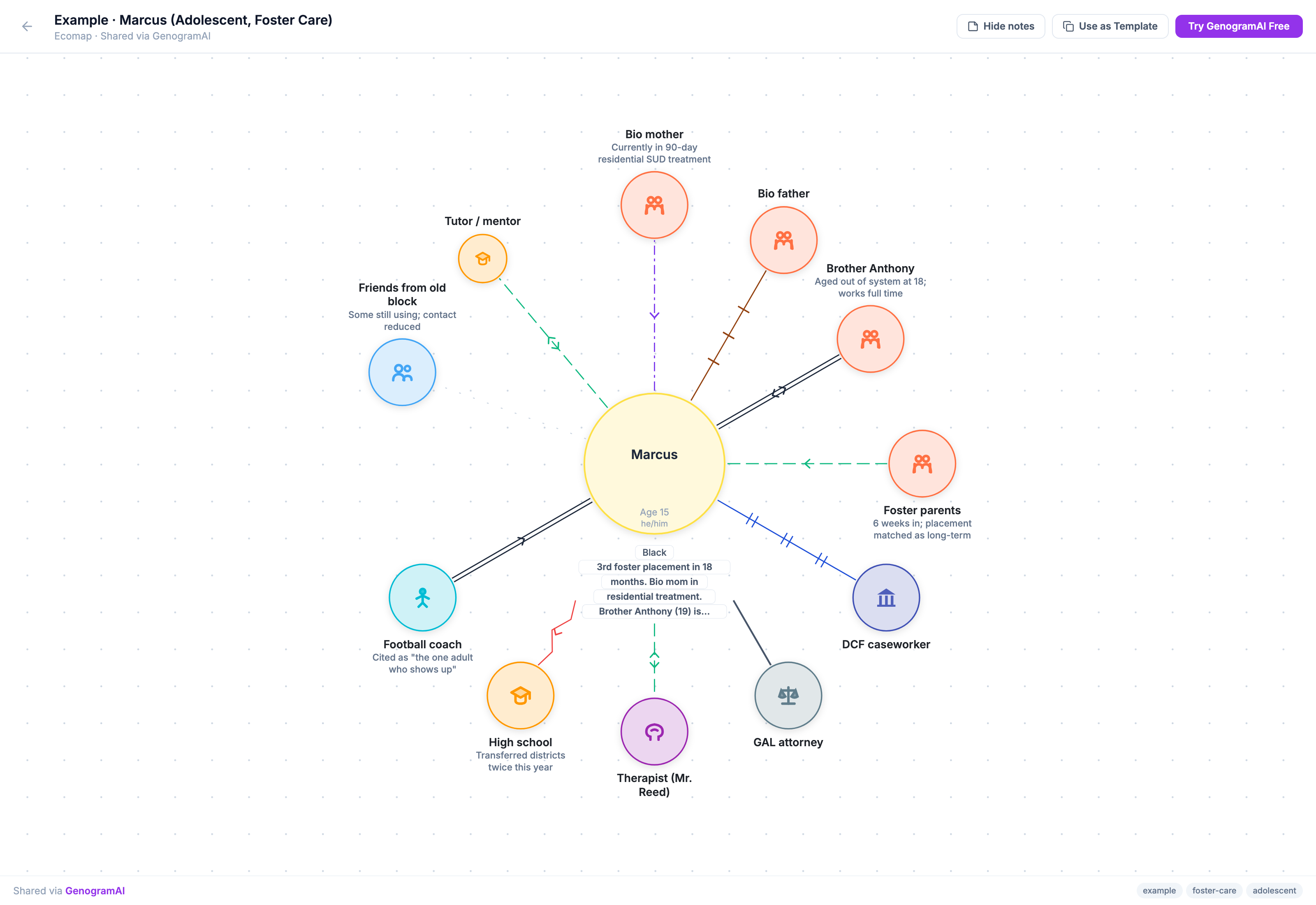
Map the supports
Draw an eco-map of current services and supports so your supervisor sees the whole system. - 5
Export for supervision
Download a PNG for your case presentation, with names changed if it leaves the agency.
Look competent in supervision
Documentation Ready
Client Collaboration
Proper Notation
Do you need a genogram or an eco-map?
You have enough on your plate
Free plan includes:
- 2 genograms (enough for most field placements)
- Complex family structures supported
- AI generation from description (5 AI credits a month)
- PNG export for documentation (PDF on paid plans)
- No credit card needed
Ready before your next supervision meeting.
Social work student genograms: questions
How do I make a genogram for my MSW field placement?
Start from your intake notes: list everyone in the household and three generations of family, with births, marriages, separations and deaths. Draw the structure first, then add emotional relationships, placement history and risk or protective factors. In GenogramAI you can describe the family in plain text and edit the result before supervision.
What should a social work genogram include?
At minimum: three generations, standard symbols for gender, deaths, marriages and divorces, the client or index person marked, and the relationships that matter for your assessment, such as cutoffs, conflict or caregiving. Child welfare placements usually also want foster, adoptive and kinship placements shown with dates.
Should I make an eco-map too?
Often, yes. A genogram shows the family across generations; an eco-map shows the client's current connections to school, work, health care, courts, faith communities and other supports. Many field placements ask for both. GenogramAI makes eco-maps too, using the same AI credits.
Is GenogramAI free for social work students?
The free plan includes 2 genograms, 5 AI credits a month (shared with eco-maps), all 64 relationship types and PNG export, with no card. PDF and SVG export and unlimited AI are on the Professional plan ($12/month).
Can I put real client details into a genogram tool?
Follow your agency's and program's privacy rules. For coursework, change names or use initials. For identifiable client data, GenogramAI's Clinical plan adds zero-knowledge AES-256-GCM encryption and secure offline storage in the macOS app.