Emotional relationship · Directional
Focused on negatively symbol in genograms
Quick answer
Understanding negative focus in genograms
| Manifestation | What it looks like |
|---|---|
| Scapegoating | Blaming one person for family problems |
| Chronic criticism | Constant fault-finding and disapproval |
| Unfavorable comparisons | "Why can't you be more like..." |
| Projection | Attributing one's own faults to another |
| Identified patient | Seeing one person as "the problem" |
The scapegoat dynamic
- Diverts attention from family dysfunction onto one person
- Creates an outlet for family stress and anxiety
- Often targets the most sensitive or different family member
- May rotate between family members or remain fixed
- The scapegoat often becomes the truth-teller or change agent
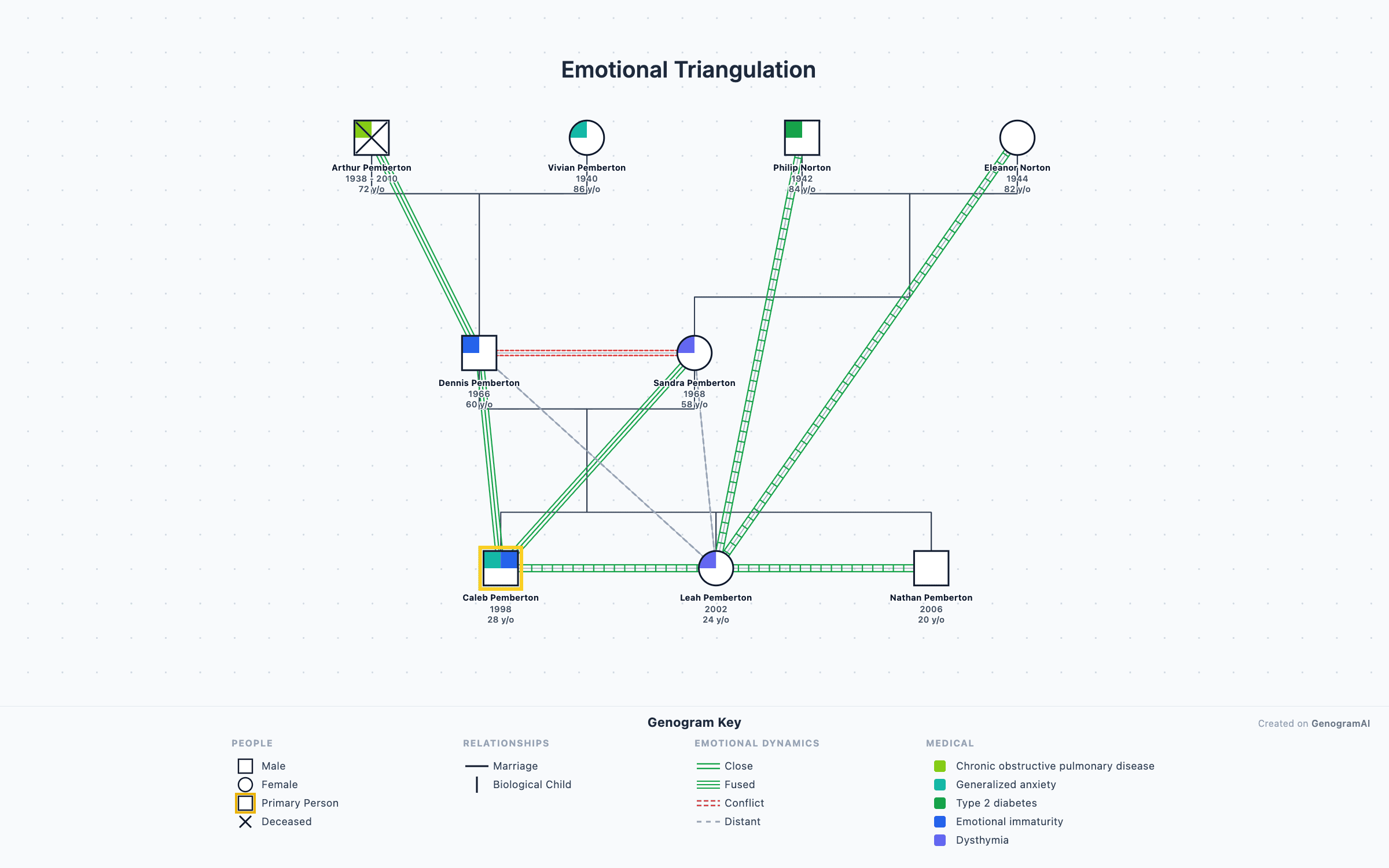
Effects on the target and generational patterns
Effects on the target
- Internalized shame and self-criticism
- Difficulty trusting positive feedback
- May develop people-pleasing or rebellious responses
- Increased risk of anxiety and depression
- Challenges with self-worth and identity
Generational patterns
- A parent who was scapegoated may scapegoat their child
- Or may overprotect their child from any criticism
- The role may transfer to a spouse or partner
- Breaking the pattern requires awareness and intervention
When to use this symbol
- Parental scapegoating of one child: A family where one child consistently receives disproportionate blame, criticism, and negative attention while siblings are favored or overlooked. The parent may fixate on this child's perceived flaws while ignoring similar behavior in other children.
- In-law targeting: A mother-in-law who directs persistent disapproval toward one specific daughter-in-law (criticizing her parenting, housekeeping, career choices, or appearance) while accepting other in-laws. The negative focus is habitual rather than situational.
- Supervisor or authority figure fixation: In family business contexts, a patriarch or matriarch who singles out one family member for chronic criticism in the workplace, undermining their confidence and authority while praising others. This pattern often mirrors earlier parent-child dynamics.
How is it different from focused on?
| Dimension | Focused on | Focused on negatively |
|---|---|---|
| How it looks | Straight red line, filled arrowhead | Red zigzag, large arrowhead |
| Emotional valence | Neutral or positive: concentrated attention that may be protective, admiring, or anxiously caring | Specifically critical, blaming, or disapproving in nature |
| Impact on the target | Can be supportive (though excessive focus can feel smothering) | Consistently damages self-worth, creates anxiety, and may lead to internalized shame or rebellious acting out |
| Family function | Often serves a bonding or protective function | Typically serves a displacement function: the critic channels their own anxiety, disappointment, or unresolved issues onto the target |
How to add a focused on negatively line in GenogramAI
- 1
Start from the person directing the criticism
Select the person directing the criticism first and click the red heart (emotional line) button, then click the target of the negative focus. The arrow points from the first person to the second. - 2
Choose Focused On Negatively
With the new line selected, pick Focused On Negatively from the relationship types in the panel on the right. The line redraws in the focused on negatively style straight away. - 3
Add context
Add a clinical note describing the nature of the negative focus (e.g., "chronic criticism of career choices" or "scapegoated for family problems") to provide therapeutic context. - 4
Or ask the AI
In the AI chat, type a request such as "Add focused on negatively from the father to Jake" and the line is added for you.
Frequently asked questions
Is focused-on-negatively the same as hostility?
No. Hostility is mutual antagonism between two people. Focused-on-negatively is one-directional: one person directs critical attention toward another. The target may respond with withdrawal, people-pleasing, or rebellion, but the core dynamic is asymmetric. Think of it as a spotlight of criticism rather than a two-way battle.
Can the target of negative focus change over time?
Yes. In some families, the scapegoat role rotates. When one family member leaves the system (moves away, gets married, cuts off), the negative focus may shift to another member. Tracking this rotation on the genogram across time reveals that the problem is systemic, not about any one individual.
What drives a parent to focus negatively on one specific child?
Common drivers include: the child resembles someone the parent has unresolved conflict with (an ex-spouse, a disliked relative), the child was born during a difficult period, the child's temperament clashes with the parent's expectations, or the child unconsciously carries projected traits the parent dislikes in themselves. Understanding the origin helps guide intervention.
How do I document negative focus when the critic does not see it as negative?
Many parents who focus negatively on a child frame it as "concern" or "high standards." The genogram documents the experienced impact, not the stated intent. If the target experiences the attention as critical and damaging, and the pattern is consistent, the focused-on-negatively symbol is appropriate regardless of how the critic describes their behavior.