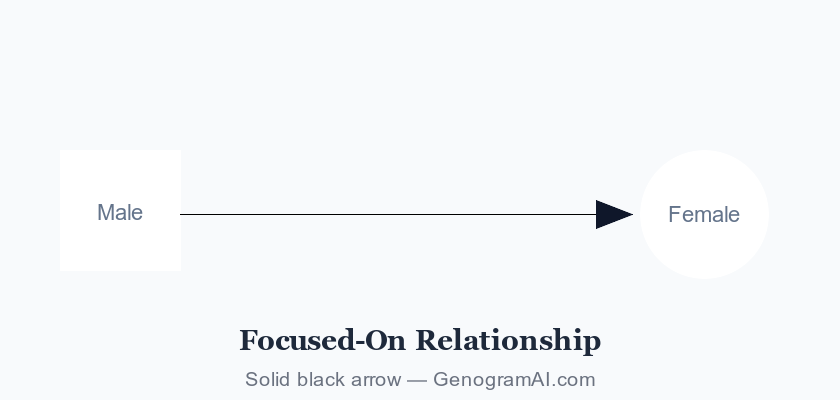
The focused on symbol — a red arrow pointing toward another person — represents relationships where one individual directs significant attention, energy, or concern toward another. This documents patterns of heightened attention that may be positive (care, mentorship) or neutral, but distinctly asymmetrical.
Focused
Object
Focused On: Teal arrow line pointing toward the object of attention
Understanding Focused Attention in Genograms
Focused on represents asymmetrical attention — one person directing significant energy toward another. This differs from close or fused relationships because:
The focus is primarily one-directional
The object of focus may or may not reciprocate
The intensity may exceed what is typical for the relationship type
It can be positive, neutral, or become problematic depending on context
In Bowen family systems theory, focused attention patterns are closely related to the concept of differentiation. Individuals with lower differentiation are more likely to become overly focused on others — either through anxious attention or by organizing their emotional life around another person. Recognizing these patterns in a genogram helps clinicians identify where family members may benefit from developing greater emotional autonomy.
Types of Focused Attention
Several patterns may warrant the "focused on" notation in clinical practice:
Parental over-focus: Excessive attention to one child over siblings, often the eldest, youngest, or a child with health concerns
Caretaking focus: Preoccupation with a family member's physical or emotional needs
Worry focus: Persistent anxiety about someone's wellbeing, safety, or life choices
Mentorship focus: Deep investment in another's professional or personal development
Idealization: Placing someone on a pedestal, viewing them through an unrealistically positive lens
Surveillance: Monitoring or tracking another's behavior, often rooted in anxiety
Clinical Significance
Focused attention patterns reveal important family dynamics that clinicians should explore:
May indicate parentification of a child who receives excessive focus
Can signal enmeshment beginning to develop between family members
Often precedes fused or caretaker relationship patterns
May create sibling rivalry when one child receives disproportionate focus
Can be healthy (mentorship, attentive parenting) or problematic (obsession, control)
The object of focus may feel pressured, smothered, or responsible for the other's emotional state
Impact on the Focused-On Person
Being the object of sustained focus can create its own challenges. The focused-on person may develop a sense of responsibility for the other's emotional state, feel unable to set boundaries, or experience guilt when pursuing independence. In therapy, it is important to explore experiences from both sides of this dynamic.
Multigenerational Patterns
Focused attention patterns frequently repeat across generations. A parent who was the object of intense focus may unconsciously replicate the pattern with their own child, or swing to the opposite extreme of emotional distance. Common multigenerational chains include:
An anxious grandmother focused on her daughter, who then over-focuses on her own son
A family culture of "designated worrier" — one person in each generation takes on the role of monitoring everyone else
Alternating patterns where focused-on children become emotionally distant parents
Mapping these patterns across three or more generations in a genogram makes them visible and provides therapeutic leverage for change. See our enmeshed family system example for a clinical illustration.
Focused On vs. Caretaker vs. Enmeshed
Distinguishing Similar Patterns
Focused On: Attention and energy directed toward someone — may be positive or neutral
Caretaker: Specifically taking active responsibility for another's needs
Enmeshed/Fused: Mutual over-involvement where boundaries dissolve — both parties are deeply intertwined
All caretakers are focused on, but not all focus involves caretaking. Enmeshment is typically mutual, while focused on is one-directional.
How to Use in GenogramAI
1Press E for Emotional Relationship tool
2Click on the person doing the focusing
3Drag to the person receiving the attention
4Select "Focused On" from the relationship menu
5The red arrow appears pointing toward the object of attention
Frequently Asked Questions
What does 'focused on' mean in a genogram?
In genogram notation, 'focused on' represents a relationship where one person directs disproportionate attention, energy, or concern toward another. It's shown as a red arrow line pointing from the person doing the focusing to the person receiving the attention. The pattern is one-directional — the object of focus may or may not reciprocate the intensity.
How is 'focused on' different from 'caretaker' in a genogram?
While both symbols indicate asymmetrical attention, 'focused on' is broader — it can include worry, admiration, idealization, or concern. 'Caretaker' specifically involves taking active responsibility for someone's physical or emotional needs. All caretaker relationships involve focus, but not all focus involves caretaking.
Is being focused on someone always negative?
No. Focused attention can be healthy (a mentor invested in a student's growth, a parent attentive to a child's development needs) or problematic (obsessive worry, parentification of a child, idealization that creates unrealistic expectations). The clinical significance depends on the context, intensity, and impact on both parties.
How do I draw the focused on symbol in GenogramAI?
Press 'E' to activate the Emotional Relationship tool, click and drag from the person doing the focusing to the target person, then select 'Focused On' from the relationship menu. The red arrow will point in the direction of attention.
Can focused on relationships repeat across generations?
Yes. Multigenerational patterns of focused attention are common in family systems. For example, a parent who was overly focused on by their own parent may either replicate the pattern with their child or swing to the opposite extreme of emotional distance. Genograms are particularly useful for identifying these repeating patterns.