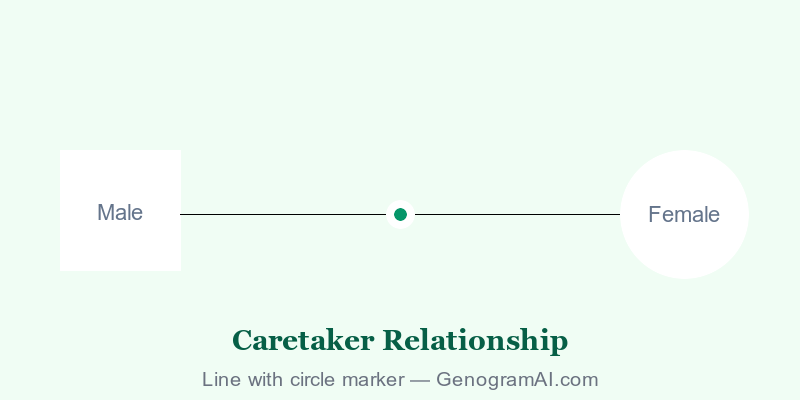
The caretaker symbol—a line with a double arrow—represents relationships where one person provides significant care or support to another. This directional symbol documents caregiving dynamics in family systems, from healthy nurturing to potentially problematic parentification.
Caretaker
Recipient
Caretaker Relationship: Line with double arrow pointing toward care recipient
What is a Caretaker Relationship?
In genogram notation, a caretaker relationship documents when one family member provides significant care, support, or nurturing to another. According to McGoldrick, Gerson, and Petry (2020), "A line with a double arrow indicates that one person is the caretaker of the other."
This symbol captures an important family dynamic that goes beyond normal reciprocal support. The caretaker role involves consistent, significant responsibility for another's wellbeing—whether physical, emotional, or both.
Key Feature: Directionality
Unlike bidirectional relationship symbols, the caretaker arrow points from the person providing care toward the person receiving it. This documents the asymmetrical nature of caregiving relationships.
Types of Caretaking
Physical Caretaking
Providing for daily needs: feeding, bathing, medical care, transportation, housing—typically for elderly, ill, or disabled family members.
Emotional Caretaking
Providing emotional support, comfort, and stability. May include managing another's emotional states or providing ongoing reassurance.
Financial Caretaking
Providing financial support or managing another's finances—common with elderly parents or adult children with difficulties.
Supervisory Caretaking
Overseeing and managing someone's life activities—particularly relevant for those with mental health or cognitive challenges.
Clinical Significance
Caretaking dynamics are crucial to assess in family therapy because they reveal:
Family role structures and expectations
Distribution of emotional and practical labor
Potential burnout or caregiver stress
Intergenerational patterns of who cares for whom
Power dynamics within the family
Healthy vs. Problematic Caretaking
Healthy Caretaking
Age and developmentally appropriate
Reciprocity exists in other forms
Caretaker's own needs are also met
Shared among family members when possible
Boundaries are maintained
Problematic Caretaking
Parentification: Children taking care of parents
Caregiver burnout: All burden on one person
Enabling: Caretaking that prevents growth
Control disguised as care: Using care to maintain power
Enmeshed caretaking: Loss of boundaries
Parentification: Children as Caretakers
One of the most clinically significant caretaking patterns involves children taking on adult caretaking responsibilities—termed parentification. This may include:
Children caring for physically or mentally ill parents
Children managing household responsibilities beyond their years
Children providing emotional support to parents (emotional parentification)
Children caring for younger siblings in place of parents
Parentification can have lasting effects, including difficulty with boundaries in adult relationships, struggles with self-care, and patterns of over-responsibility or, conversely, avoidance of any caregiving roles.
The Sandwich Generation
A common contemporary pattern involves middle-aged adults simultaneously caring for aging parents and dependent children—the "sandwich generation." Genograms often show multiple caretaker arrows emanating from the same person, highlighting the stress of multiple caregiving responsibilities.
Cultural Considerations
Cultural Context Matters
Expectations about caregiving vary significantly across cultures. In many cultures, adult children caring for elderly parents is not just expected but honored. What might look like "burden" from one cultural lens may be "sacred duty" from another. Always assess caretaking within cultural context.
Multigenerational Caretaking Patterns
When mapping genograms, look for patterns across generations:
Who typically provides care in this family?
Are there gender patterns (e.g., daughters always caretaking)?
Has the same person been caretaker for multiple family members?
What happens to caretakers when their role ends?
How is the caretaking role acknowledged or rewarded?
How to Use This Symbol in GenogramAI
Steps to Add a Caretaker Relationship:
1Press E to activate the Emotional Relationship tool
2Click on the caretaker (person providing care)
3Drag to the care recipient
4Select "Caretaker" from the relationship type menu
5Document type of care, duration, and any concerns
Case Example
The Patel Family: Maya (42) presents with anxiety and exhaustion. The genogram reveals she is caretaker for her mother Anita (72) who has early dementia, while also supporting her son Raj (19) through college struggles and providing financial help to her brother Vikram (38) who struggles with employment.
The mapping shows three caretaker arrows from Maya to other family members—and notably, no arrows pointing toward her. Therapy explores how this pattern developed, its connection to her role as eldest daughter, and strategies for either sharing the burden or establishing boundaries.
Therapeutic Considerations
Assess burnout: Caretakers often neglect their own needs
Explore resentment: Unacknowledged resentment may underlie caretaking
Examine reciprocity: What does the caretaker receive in return?
Consider alternatives: Can care be shared or supplemented?
Honor the role: Caretaking often provides meaning and purpose
No. The symbol simply documents that caretaking exists—it's neutral. Whether the dynamic is healthy or problematic requires clinical assessment of context, balance, and impact on both parties.
How is caretaker different from "close"?
Close relationships involve mutual emotional investment. Caretaker relationships are specifically about one person providing care to another—there's inherent asymmetry. A caretaker relationship can also be close, but the symbols document different aspects.
Can caretaking be mutual?
While some aspects of any relationship involve mutual care, the caretaker symbol documents significant asymmetrical caregiving. If care flows both directions equally, you might use "close" instead, or use two caretaker arrows if both parties are significant caretakers in different domains.