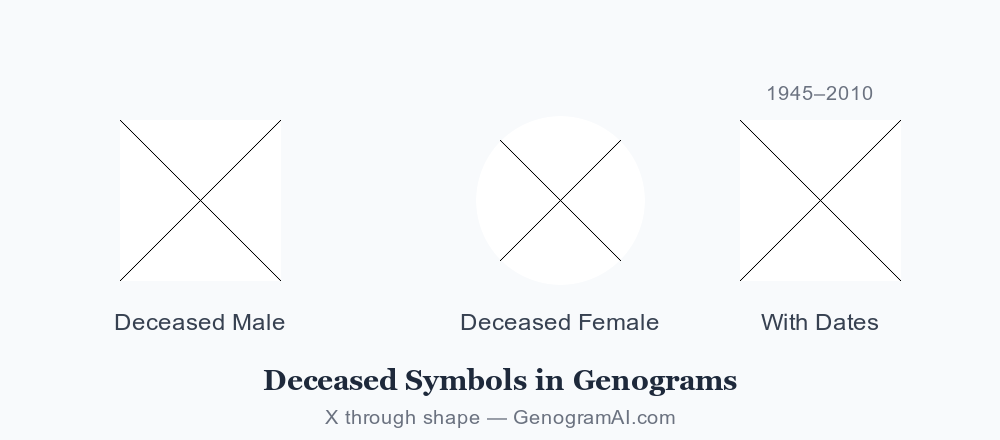
The deceased symbol in genograms is indicated by drawing an X through the person's shape. This universal notation instantly identifies family members who have passed away, allowing therapists to map mortality patterns, understand grief dynamics, and identify losses that may affect current family functioning.
Deceased Male
Square with X
Deceased Female
Circle with X
1945-2020
With Dates
Deceased: X drawn through the person symbol
How to Show Death in a Genogram
In standard genogram notation, a deceased family member is indicated by drawing an X through their symbol. The X typically extends slightly beyond the edges of the shape, making it clearly visible. The underlying shape (square for male, circle for female) remains intact to preserve gender identification.
Standard Notation
In standard genogram notation, an X drawn through a person's symbol shows that the person has died. The X should be drawn through the center of the shape, with lines extending from corner to corner (for squares) or at 45-degree angles (for circles).
Including Death Information
Beyond the X symbol, genograms typically include additional death-related information:
Birth and Death Years
Written below the symbol: "1945-2020" indicates birth in 1945 and death in 2020. This provides age context at a glance.
75
Age at Death
Some practitioners write the age inside the symbol or nearby. "75" indicates the person died at age 75.
CA
Cause of Death
Abbreviations or notes can indicate cause: "CA" (cancer), "MI" (heart attack), "MVA" (motor vehicle accident), "suicide," etc.
Historical Deaths
For deaths that occurred before living memory, some use a lighter X or dotted lines to indicate less certain information.
Clinical Significance
Mapping deceased family members serves several therapeutic purposes:
Mortality patterns: Early deaths, particularly from specific causes, may indicate genetic risk factors
Grief assessment: Recent deaths may explain current family distress or individual depression
Unresolved loss: Deaths that were never properly mourned can affect multiple generations
Anniversary reactions: Symptoms may cluster around death anniversaries
Replacement children: Children born after a sibling's death may carry special significance
Family structure changes: Deaths reshape roles, responsibilities, and power dynamics
The Importance of Death Dates in Genograms
Including precise death dates transforms a genogram from a simple family tree into a powerful analytical tool. Death dates reveal temporal patterns that would otherwise remain hidden:
Cluster deaths: Multiple family deaths within a short period can create compounded grief and trauma
Generational echoes: A client presenting with depression at age 45 may be the same age their parent died
Life stage losses: Deaths during childhood, adolescence, or young adulthood have different impacts than later losses
Historical context: Deaths during wars, pandemics, or economic crises carry cultural trauma dimensions
Research on Death and Family Systems
Murray Bowen's foundational family systems research identified death—particularly untimely or traumatic death—as one of the most significant stressors affecting family functioning across generations. His concept of the "emotional shock wave" describes how a death can trigger symptoms in family members years later, sometimes in members who seemed least affected at the time.
Monica McGoldrick's extensive research on loss and the family life cycle demonstrates that families who can openly acknowledge and process death generally adapt more successfully than families where death becomes a taboo topic. The genogram serves as a tool for making death visible and speakable.
More recent research in epigenetics suggests that trauma—including traumatic loss—may have biological effects that transmit across generations. This provides a scientific framework for understanding why patterns of early death or traumatic loss may have ongoing effects on descendants who never directly experienced the original event.
Pattern Recognition
When mapping deaths, look for patterns: Do males in the family tend to die young? Are there clusters of deaths at certain ages? Do deaths correlate with life transitions (e.g., shortly after retirement, after children leave home)? These patterns can be clinically significant and warrant discussion.
How to Mark Deceased in GenogramAI
Steps to Indicate Deceased Status:
1Click on the person to select them
2Open the person's details panel
3Set Status to "Deceased"
4Enter death year (and optionally death month)
5The X automatically appears through the symbol
Special Cases
Stillbirth vs. Death After Birth
For stillbirths (death at or before birth), use the full-size symbol with an X. For miscarriages, use the smaller filled circle. The distinction matters for understanding family dynamics and grief patterns.
Suicide
Deaths by suicide are typically noted with a cause annotation. Some practitioners use additional notation (like a specific color or mark) given the hereditary and psychological significance of suicide in family systems.
Recent Deaths
When a death is recent (within the past year or two), note the recency. This contextualizes current family distress and suggests active grief processes.
Traditionally, yes—the X extends slightly beyond the edges of the symbol for visibility. However, in digital tools like GenogramAI, the X may be contained within the shape for cleaner rendering while remaining clearly visible.
What if I don't know when someone died?
Mark them as deceased with the X. Add "d. unknown" or "d. ?" to indicate the death date is unknown. Include whatever information you have (approximate decade, "before 1990", etc.).
How do I show someone who disappeared?
For missing persons whose status is unknown, use a question mark inside the symbol or note "missing" nearby. If presumed dead, some practitioners use a dotted X.
Should I include pets that have died?
Some practitioners include significant pets, especially in family therapy contexts where pet loss has been traumatic. Use a small symbol with a note. This is particularly relevant for families where a pet death was the first major loss a child experienced.
How do I show multiple deaths at the same time (accident, disaster)?
Mark each individual as deceased and add a note linking them (e.g., "died together in MVA 2015"). Some practitioners draw a dotted box around simultaneous deaths to visually connect them. This is particularly important for understanding trauma responses in survivors.
What if the cause of death is sensitive or unknown to some family members?
This is clinically significant information. Note what the client knows vs. what is suspected. Family secrets around death (suicide, AIDS, overdose) often create intergenerational patterns of shame, anxiety, or confusion that affect current functioning.
How do I indicate someone died before I was born?
Use the standard X through the symbol. Add birth and death dates to show the timeline. These "ghosts" in the family system often have significant influence despite never being known directly—especially if the person was a sibling who died before the client's birth.