Interview guide
114 genogram questions to ask
Quick answer
The art of genogram interviewing
A good genogram interview does more than collect facts: it opens therapeutic conversations, builds rapport, and helps clients see their family from new perspectives. The questions you ask shape what emerges.
This guide provides questions across multiple domains. You won't use all of them in every session: select based on your clinical goals, time available, and client readiness. Start with structure and gradually move to more sensitive territory.
Clinical tip
Working with a client in therapy?
Core question categories
Family Structure (10 questions)
Basic composition and demographic information
- Who is in your immediate family?
- Tell me about your parents—are they living? Together?
- Do you have siblings? What are their names and ages?
- Are your parents' parents (your grandparents) living?
- Has anyone in your family been married more than once?
- Are there children from previous relationships?
- Has anyone been adopted or fostered?
- Who lives in your household currently?
- Are there step-parents or step-siblings?
- Has anyone in your family had twins or multiple births?
Relationships (10 questions)
Quality and nature of family connections
- How would you describe your relationship with your mother?
- How would you describe your relationship with your father?
- Which family members are you closest to?
- Are there any strained or conflictual relationships?
- Is anyone in the family not speaking to each other?
- How do your parents/siblings get along with each other?
- Who do you turn to when you need support?
- Are there any family members you've lost touch with?
- How would you describe your parents' marriage/relationship?
- Who in the family tends to mediate conflicts?
Medical & Mental Health (10 questions)
Physical and psychological health patterns
- Are there any health conditions that run in your family?
- Has anyone had heart disease, diabetes, or cancer?
- Is there a history of mental health conditions?
- Has anyone struggled with depression or anxiety?
- Is there substance use or addiction in your family?
- Have there been any suicides or suicide attempts?
- Has anyone been hospitalized for psychiatric reasons?
- Are there any genetic conditions in your family?
- What did family members die from?
- At what ages did family members develop health issues?
Significant Events (10 questions)
Major life events and transitions
- Have there been any deaths in your family? When?
- Were there any traumatic events that affected the family?
- Have there been any major moves or relocations?
- Were there periods of financial hardship?
- Has anyone been incarcerated?
- Were there any major illnesses or accidents?
- How did the family handle major losses?
- Were there any secrets that later came to light?
- What major events shaped your family?
- Are there anniversary dates that are significant?
Patterns & Roles (10 questions)
Multigenerational patterns and family roles
- What patterns do you see repeating in your family?
- Who was/is the caretaker in your family?
- Who was the "black sheep" or problem child?
- Who was seen as the successful one?
- How was conflict handled in your family?
- What were you told about emotions growing up?
- Who made the decisions in your family?
- Were there expectations based on birth order or gender?
- What roles did you play in your family growing up?
- Are there family "rules" that everyone knows but doesn't discuss?
Culture & Context (10 questions)
Cultural background and social context
- What is your family's ethnic/cultural background?
- What country did your family originate from?
- When did your family come to this country? Why?
- What role does religion play in your family?
- Are there cultural traditions that are important?
- How did your family's background shape their values?
- Were there experiences of discrimination or hardship?
- How does your family view help-seeking or therapy?
- What languages are spoken in your family?
- How does culture influence family relationships?
Substance Use & Addiction (8 questions)
Patterns of substance use across generations
- Is there alcohol or drug use in your family?
- Has anyone been to treatment or rehab?
- How is drinking or drug use viewed in your family?
- Are there patterns of addiction across generations?
- Has substance use contributed to relationship problems?
- Were there family members who were "functional" users?
- How has substance use affected children in the family?
- Are there gambling or other behavioral addictions?
Financial Patterns (8 questions)
Money, work, and economic dynamics
- What is the financial background of your family?
- Were there periods of significant financial stress?
- How was money discussed (or not discussed) growing up?
- Are there patterns of financial dependence or independence?
- Did money ever cause conflict in your family?
- What were the attitudes toward work and career?
- Were there family businesses or shared financial ventures?
- How did economic changes affect family relationships?
Strengths & Resources (8 questions)
Family resilience, coping, and positive patterns
- What are your family's greatest strengths?
- How has your family overcome hardship in the past?
- Who in your family do you admire most, and why?
- What positive traditions has your family maintained?
- Where does your family find support outside the home?
- What coping strategies have worked for your family?
- What values has your family passed down that you cherish?
- What would you most want to carry forward to the next generation?
Advanced and specialized questions
Attachment & Early Experiences
- What was it like growing up in your family?
- Who comforted you when you were upset as a child?
- How did your parents respond to your emotions?
- Were there any separations from caregivers early in life?
- How would you describe your childhood overall?
Triangles & Alliances
- When your parents fought, who got involved?
- Were there alliances between certain family members?
- Did you ever feel caught in the middle of others' conflicts?
- Who was the peacemaker in your family?
- Were there insiders and outsiders in family groupings?
Loss & Grief
- How did your family handle death and grief?
- Was it okay to talk about people who died?
- Were there losses that the family didn't acknowledge?
- How do different family members grieve?
- Are there unresolved losses in your family?
Strengths & Resilience
- What are your family's strengths?
- How has your family overcome challenges?
- Who in your family do you admire? Why?
- What positive qualities run in your family?
- What would you want to pass on to the next generation?
Boundaries & Autonomy
- How were boundaries handled in your family?
- Was privacy respected, or were boundaries often crossed?
- How did your family respond when someone set a boundary?
- Were there differences in boundaries for different family members?
- How has your understanding of boundaries changed over time?
Education & Achievement
- What were the expectations around education in your family?
- Were there first-generation college students?
- How was academic success or failure handled?
- Were there different expectations for different children?
- How did educational attainment affect family dynamics?
What each answer adds to the genogram
| Question category | What it fills in on the genogram |
|---|---|
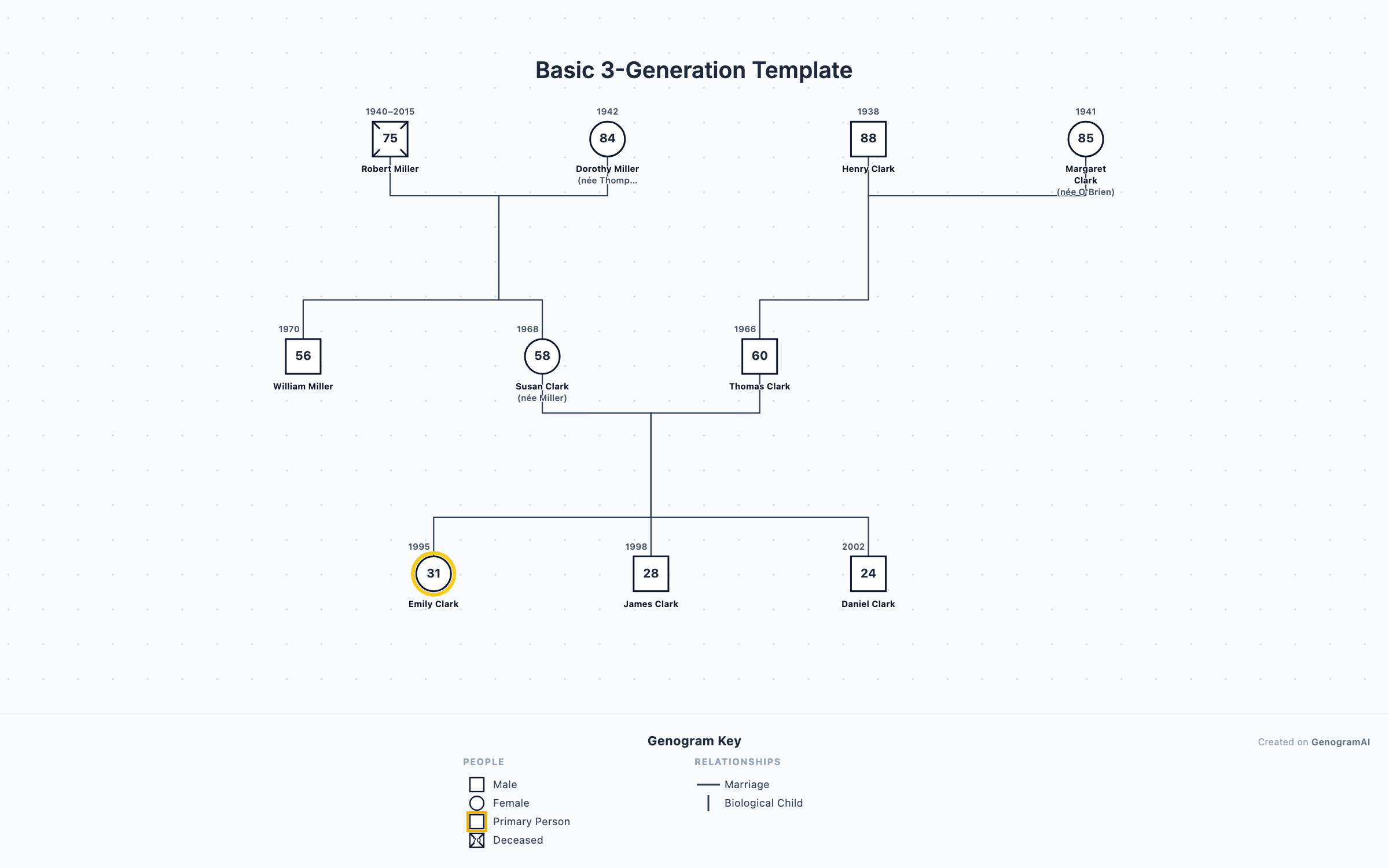
| Family Structure | Squares, circles and rows; marriage, divorce and child lines; adoption, step and twin symbols |
| Relationships | Emotional lines: close, distant, conflict, fused, cutoff |
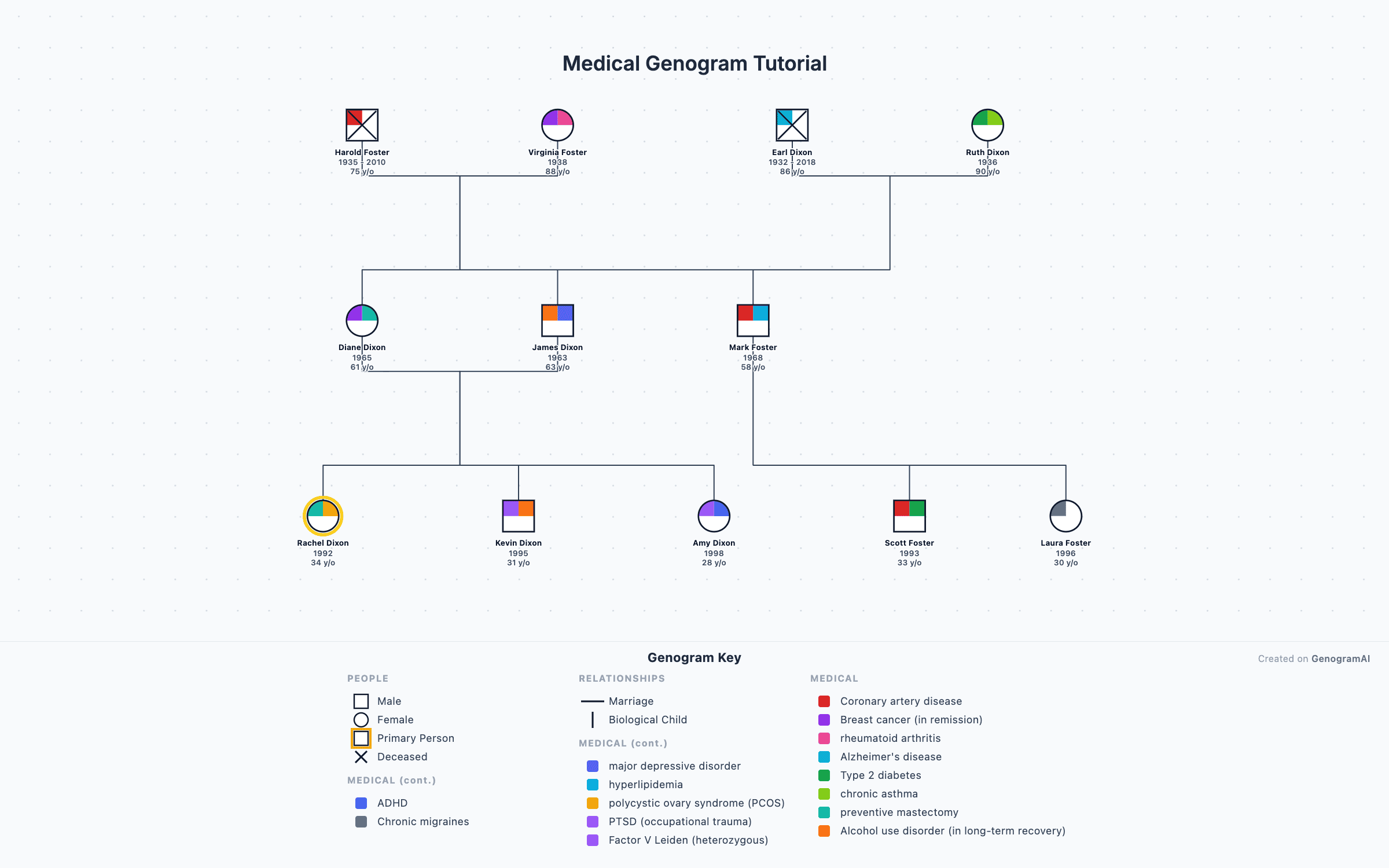
| Medical & Mental Health | Medical quadrants or shading; causes of death beside deceased symbols |
| Significant Events | Dates on the chart and a family chronology; X for deaths, migration markers |
| Patterns & Roles | Triangles, caretaking arrows, notes on roles |
| Culture & Context | Heritage, religion and migration markers; cultural genogram layer |
| Substance Use & Addiction | Substance-use shading (often the bottom half of the symbol); recovery noted |
| Financial Patterns | Occupation and education labels; financial genogram notes |
| Strengths & Resources | Notes on supports; often an eco-map alongside the genogram |
Suggested interview flow
- 1
Start with structure (5-10 min)
Begin with factual questions about who's in the family. These are low-threat and help you draw the basic genogram. "Let's start with your immediate family. Who's in your household?" On the chart: symbols, rows and marriage and child lines. - 2
Add demographics (5-10 min)
Ages, occupations, locations. Still factual but adds depth. "Tell me about your siblings: names, ages, where they live now?" On the chart: birth years, ages inside symbols, occupations. - 3
Explore relationships (10-15 min)
Move into relationship qualities: who's close, distant, conflictual. "How would you describe your relationship with your mother?" On the chart: emotional relationship lines. - 4
Health and history (10-15 min)
Medical conditions, mental health, substance use, deaths. Match depth to your clinical needs. "Are there health conditions that run in your family?" On the chart: medical shading, causes of death, key dates. - 5
Patterns and meaning (10+ min)
Explore multigenerational patterns, family rules, roles. This is where therapeutic insight often emerges. "What patterns do you see repeating?" On the chart: triangles, roles, annotations. - 6
Summarize and reflect (5 min)
Share observations and invite client reflection. "Looking at your family together, what stands out to you?"
Asking sensitive questions
| Framing technique | Example |
|---|---|
| Normalize | "Many families have experienced..." or "It's common for families to..." |
| Use tentative language | "I'm wondering if..." or "Some families have patterns around..." |
| Give permission to skip | "You don't have to answer this if it feels too personal..." |
| Third-person framing | "How would your mother describe...?" instead of direct questions |
Signs to slow down
- Client becomes quiet or withdrawn
- Body language shifts (crossed arms, looking away)
- Short or clipped answers
- Client changes the subject
- Visible emotional distress
- Statements like "I don't want to talk about that"
Adapting the questions
| Interviewing | How to adapt |
|---|---|
| Your own family (student assignment) | Answer the structure and medical questions yourself, then interview a parent or grandparent to fill gaps. Note where relatives disagree. |
| Parents or grandparents | Ask for stories rather than labels: "What was your father like?" works better than "Was he distant?" |
| Children | Use a drawing or figures, short concrete questions ("Who lives in your house?", "Who do you go to when you are sad?") and skip medical detail. |
| Social work intake | Prioritize household composition, safety, caregivers, kin who could help, and services involved; pair with an eco-map. |
Frequently asked questions
What genogram questions can I ask my parents or grandparents?
Keep it factual and story-based: where they grew up, their parents and siblings, when and where they married, who died and of what, what work they and their parents did, which moves the family made, and what illnesses run in the family. Then ask who they were closest to, and what they wish they had known about their own parents.
What questions should I ask for a genogram?
Start with structure (who is in the family, ages, marriages, deaths), then relationships (who is close, distant or in conflict), then health and significant events (illness, substance use, losses, moves), and finish with patterns, culture and strengths. This guide lists the questions for each area, in the order you would ask them.
How do I start a genogram interview?
Start with basic structure: "Let's start with your immediate family. Who's in your household?" Then work outward to parents, siblings, and grandparents. Begin with factual questions (names, ages, locations) before moving to more sensitive topics like relationships and health.
How detailed should genogram questions be?
The level of detail depends on your clinical purpose. A quick assessment might cover basic structure and major events. A comprehensive genogram for family therapy would explore relationship qualities, patterns, and multigenerational dynamics in depth. Match the depth to your goals.
What if clients don't know their family history?
Work with what they know. Missing information is itself informative—it may indicate cutoffs, secrets, or trauma. Ask "What do you know about...?" rather than assuming knowledge. Document unknowns clearly and explore what the gaps mean to the client.
How do I ask sensitive genogram questions?
Build rapport first with factual questions. Normalize sensitive topics: "Many families have..." Frame questions tentatively: "I'm wondering if..." Give permission to skip: "You don't have to answer if..." Watch for emotional responses and pace accordingly.
Should I ask the same questions to all family members?
Yes, when doing family genograms. Different family members often have different perspectives on relationships and events. These discrepancies are clinically valuable—they reveal where perceptions diverge and can open therapeutic conversations.
Further Reading
- McGoldrick, M., Gerson, R., & Petry, S. — Genograms: Assessment and Treatment (4th ed.). W.W. Norton & Company, 2020
- Bowen, M. — Family Therapy in Clinical Practice. Jason Aronson, 1978
- DeMaria, R., Weeks, G., & Twist, M. — Focused Genograms: Intergenerational Assessment of Individuals, Couples, and Families (2nd ed.). Routledge, 2017
- McGoldrick, M., Gerson, R., & Shellenberger, S. — Genograms: Assessment and Intervention (2nd ed.). W.W. Norton & Company, 1999