Clinical guide
Genograms in addiction treatment
Quick answer
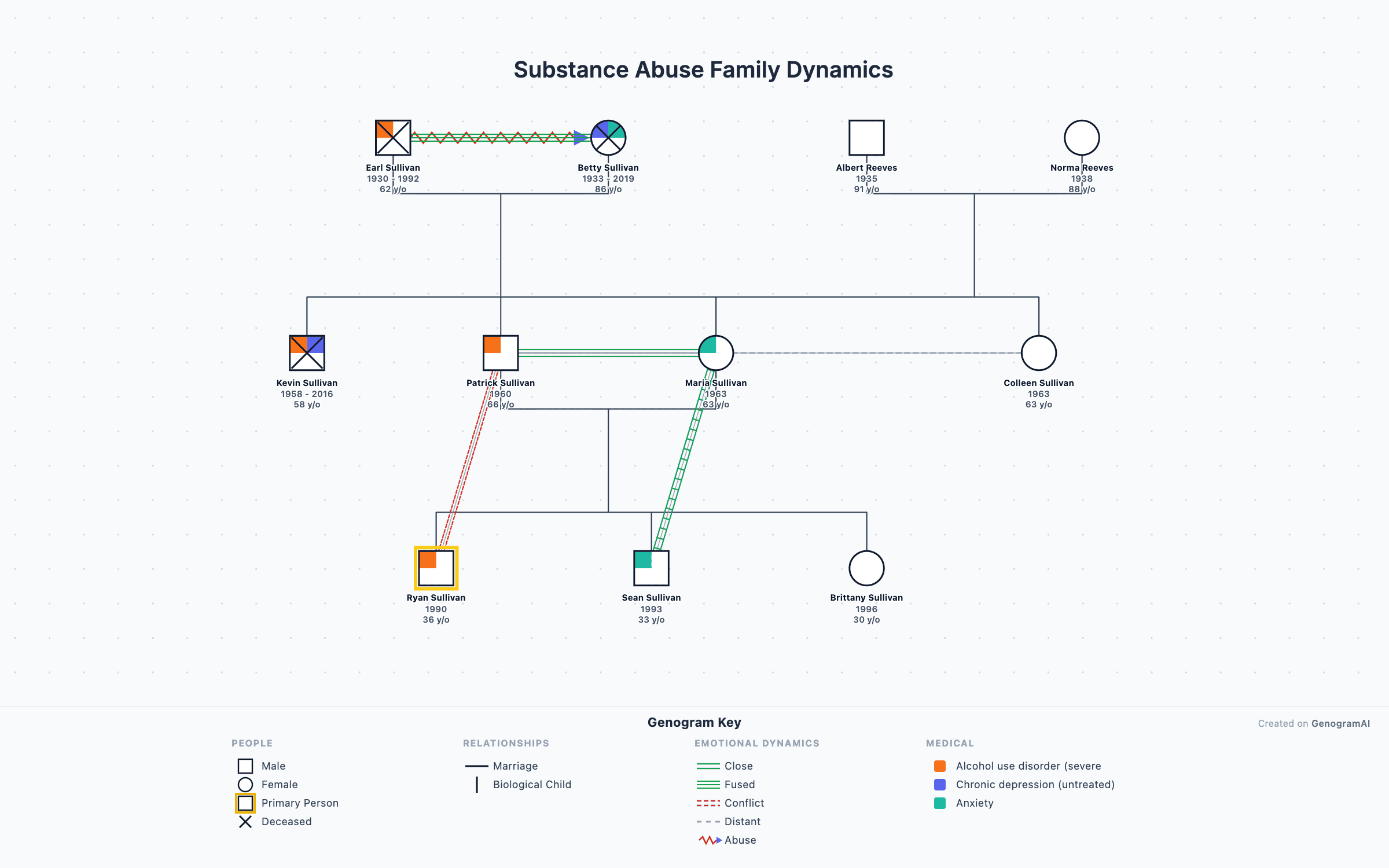
Understanding addiction through family patterns
Addiction rarely occurs in isolation. Research consistently shows that substance use disorders cluster in families, not just through genetics, but through learned behaviors, coping patterns, trauma transmission, and family system dynamics. The National Institute on Drug Abuse (NIDA) estimates that genes, including the effects environment has on gene expression, account for between 40 and 60 percent of a person's risk of addiction, with environment and development making up the rest. Genograms provide a powerful tool for making both sides of these patterns visible.
When clients see addiction mapped across their family, several things happen: shame often decreases ("I'm not the only one"), context emerges ("This is bigger than my willpower"), and resources become visible ("My uncle got sober; I can talk to him").
Clinical note
Addiction in families: key figures
| Measure | Figure | Source |
|---|---|---|
| Genetic share of risk | Genes, including environmental effects on gene expression, account for an estimated 40-60% of a person's risk of addiction; environment and development account for the rest. | NIDA, Drugs, Brains, and Behavior: The Science of Addiction |
| Children living with a parent with a SUD | About 8.7 million children aged 17 or younger (roughly 1 in 8) lived with at least one parent who had a past-year substance use disorder (2009-2014 data). | SAMHSA, Lipari & Van Horn, 2017 |
| Adverse childhood experiences | Adults reporting four or more categories of childhood adversity had a 4- to 12-fold higher risk of alcoholism and drug abuse than those reporting none. | Felitti et al., ACE Study, 1998 |
Why genograms matter in addiction treatment
Reduces Shame
Identifies Risk Factors
Reveals Family Dynamics
Highlights Recovery Resources
Breaks Denial
Informs Treatment Planning
Common patterns to identify
Multigenerational Substance Use
Addiction appearing across multiple generations, often with similar substances or cross-addiction patterns.
Examples
Grandfather → Father → Client all with alcohol use disorder
Pattern of prescription drug misuse in maternal line
Co-occurring Conditions
Mental health conditions that frequently appear alongside addiction in the family.
Examples
Depression + alcohol in multiple generations
Trauma history correlating with substance use onset
Enabling Relationships
Family members who protect the addicted person from consequences, perpetuating the cycle.
Examples
Spouse who calls in sick for partner
Parents who provide money despite drug use
Cutoffs and Estrangements
Family relationships severed due to addiction-related behavior.
Examples
Adult children who no longer speak to addicted parent
Siblings divided over how to handle family member's addiction
Role Patterns
Consistent roles family members take in relation to the addiction.
Examples
Eldest child as family hero/caretaker
Middle child as scapegoat
Quiet child who withdraws as the lost child
Youngest as mascot/comic relief
Recovery Resources
Family members who achieved recovery and can serve as models or supports.
Examples
Uncle with 20 years sobriety
Cousin active in recovery community
What are the family roles in addiction?
| Role | What it looks like | On the genogram |
|---|---|---|
| Dependent | The person with the substance use disorder; the family organizes around their use. | Shade with Alcohol or Substance Use; note onset age and treatment history. |
| Chief enabler | Usually a partner or parent who covers for the dependent, takes on their responsibilities and keeps the peace. | Caretaker |
| Family hero | Often the eldest child: high-achieving and responsible, making the family look fine from outside. | Focused On |
| Scapegoat | Acts out and gets into trouble, drawing attention away from the addiction. | Focused On — Negative |
| Lost child | Quiet and withdrawn, avoids conflict, needs little and is easily overlooked. | Distant |
| Mascot | Uses humor or clowning to relieve tension and distract from pain. | No standard line; add the role as a note or label. |
These roles come from clinical observation, not controlled research. Children often move between roles or hold two at once, and the roles appear in families affected by other stressors too. Use them as language for the client's experience rather than as a diagnosis.
Genogram symbols for alcoholism and substance abuse
| Symbol | Meaning | In GenogramAI |
|---|---|---|
| Lower half filled Alcohol or drug use disorder (McGoldrick-style) | Shading set to Classic: the bottom half is shaded for Alcohol or Substance Use, in the category colour. | |
| One quadrant filled Substance use when several conditions share the symbol | Shading set to Quadrants: each condition gets its own coloured corner. Substance Use is orange. | |
| Solid fill Active use | Status: Active. | |
| Striped fill In recovery (McGoldrick-style) | Status: Recovery. Write the sobriety date or years sober under the person. | |
| Faded fill Suspected / unconfirmed | Status: Suspected. | |
| X through the symbol Death, with substance-related cause noted | Mark the person deceased and write the cause (overdose, liver disease) and age at death. |
Additional information to record
- Specific substances: note in text (e.g., "Alcohol", "Opioids", "Meth")
- Age of onset: when substance use began
- Recovery date: sobriety date if applicable
- Treatment history: previous treatment attempts
- Cause of death: if substance-related (overdose, liver disease, etc.)
- Co-occurring conditions: mental health diagnoses
Key point
Substance abuse genogram examples
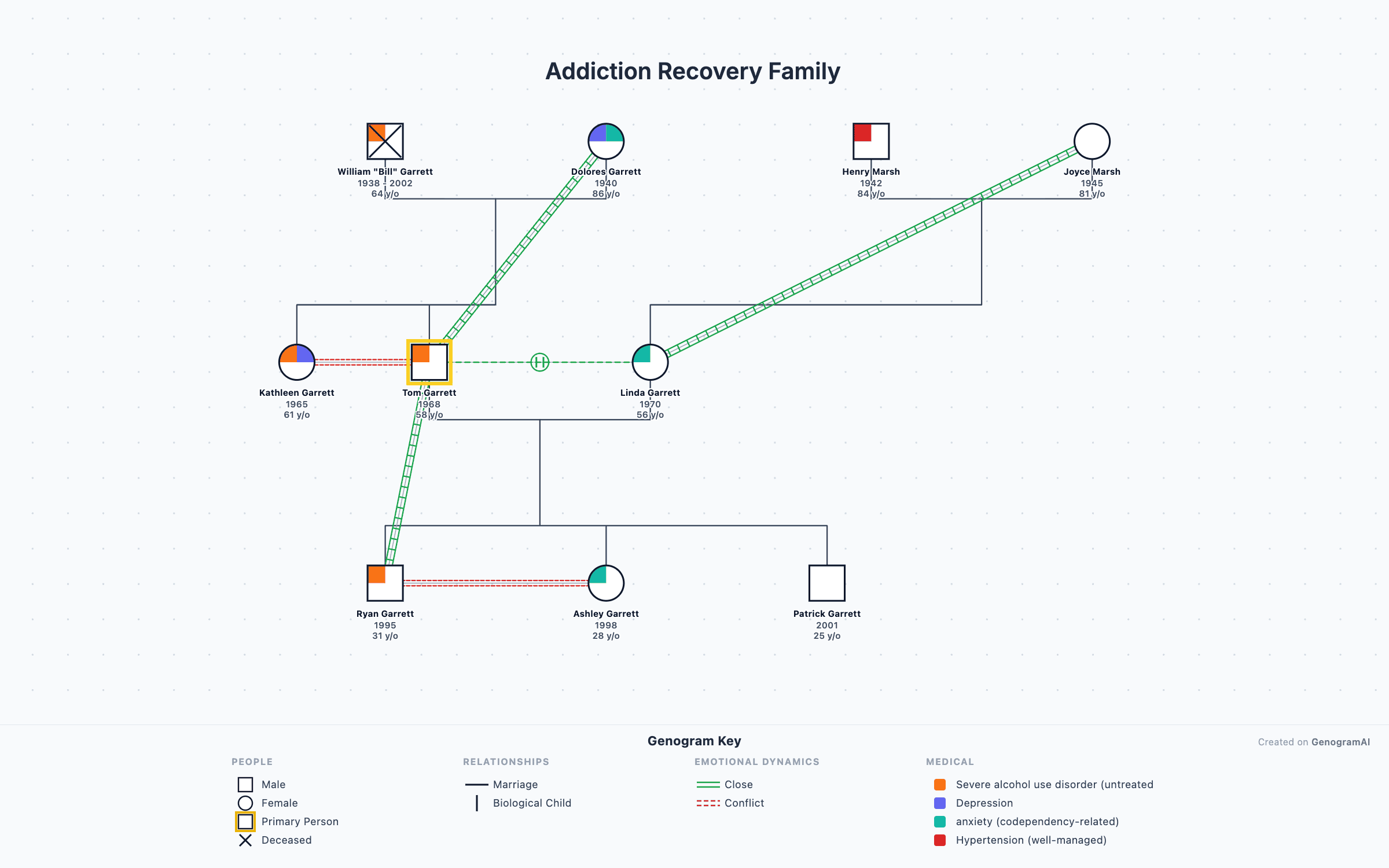
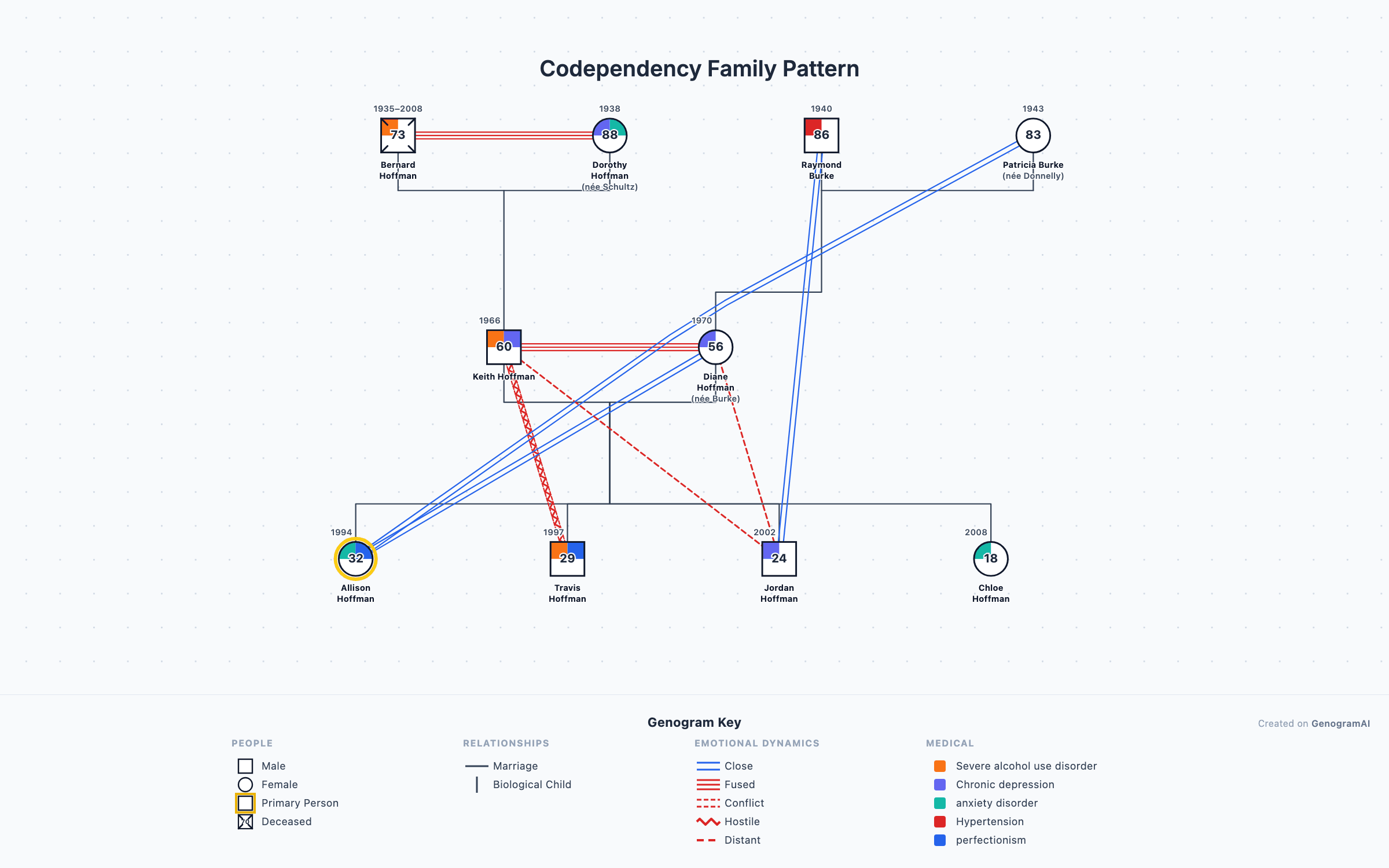
Read more: Substance abuse genogram examples · Substance abuse family dynamics example
Clinical applications
Initial assessment
Use genograms during intake to gather comprehensive family substance use history. This provides context for the current presentation and identifies risk factors.
Questions to explore
- Who else in your family has struggled with substances?
- What substances? When did their use start?
- How did the family respond to their use?
- Is anyone in your family in recovery?
- Were there consequences (health, legal, relational)?
- Who in your family do you feel comfortable talking to about your recovery?
Family therapy
Create the genogram collaboratively with family members present. Different perspectives often emerge, revealing discrepancies in how family members perceive the addiction and its impact.
Therapeutic uses
- Help family see their role in the system (enabling, rescuing, etc.)
- Identify healthy and unhealthy relationship patterns
- Explore how different members were affected
- Plan for changes in family dynamics during recovery
Relapse prevention planning
Use the genogram to identify family-related triggers and supports for the relapse prevention plan.
Family risk factors
- Family gatherings with alcohol
- Conflict with specific family members
- Enabling behaviors
- Anniversary dates (deaths, etc.)
Family protective factors
- Family members in recovery
- Supportive relationships
- Sober family activities
- Family members who set boundaries
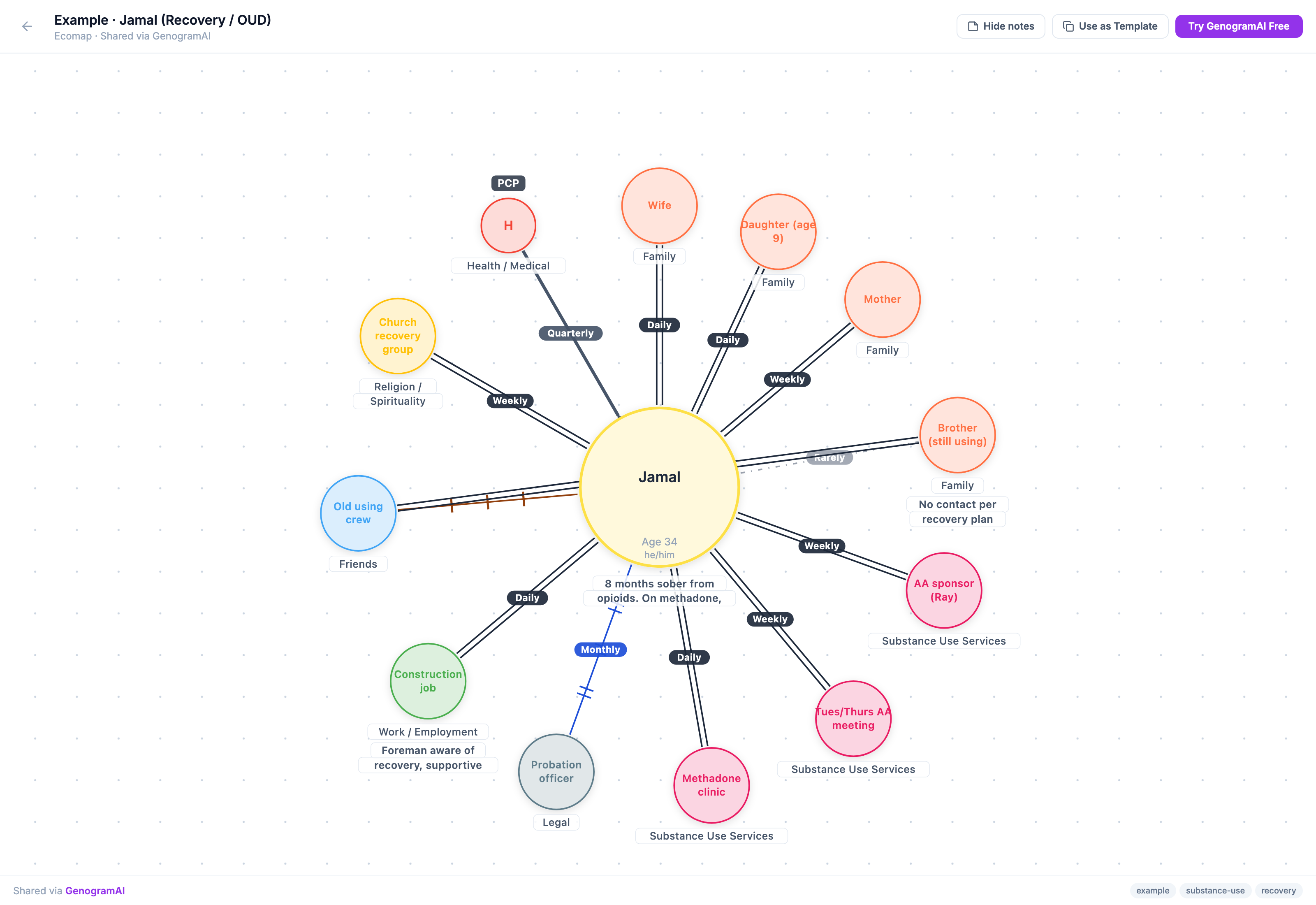
Pairing the genogram with an eco-map
Frequently asked questions
Why are genograms useful in addiction treatment?
Genograms help clients see that addiction often runs in families, reducing shame and isolation. They reveal multigenerational patterns of substance use, co-occurring mental health issues, enabling behaviors, and recovery. This visual map helps both clinician and client understand addiction in its family context.
What patterns should I look for in an addiction genogram?
Key patterns include: multiple generations with substance use disorders, co-occurring mental health conditions (depression, anxiety, trauma), enabling relationships, cutoffs due to addiction, recovery milestones, early deaths related to substances, and patterns of relationship dysfunction that correlate with substance use.
How do I mark addiction on a genogram?
In standard McGoldrick-style notation, alcohol or drug abuse is shown by shading the bottom half of the person's symbol. In GenogramAI, choose the Alcohol category for alcohol use disorder or Substance Use (orange) for other drugs, then set the status: Active (solid fill) for current use, Recovery (striped fill) for those in recovery, or Suspected (faded fill) for unconfirmed cases. Always include a legend; GenogramAI generates one automatically.
What are the family roles in addiction?
Sharon Wegscheider-Cruse described six roles in families affected by alcoholism: the dependent (the person with the addiction), the chief enabler, the family hero, the scapegoat, the lost child and the mascot. They come from clinical observation rather than controlled research, and children often move between roles, but they give clients useful language for what they lived through.
Does addiction run in families?
Yes. Substance use disorders cluster in families through both genes and environment. The National Institute on Drug Abuse (NIDA) estimates that genes, including the effects environment has on how genes are expressed, account for between 40 and 60 percent of a person's risk of addiction; the rest comes from environment and development, including parenting, trauma and exposure. A genogram shows both sides of that picture.
When should I introduce a genogram in addiction treatment?
Timing depends on the treatment setting and client readiness. In residential treatment, genograms are often part of family systems work after initial stabilization. In outpatient settings, they can be introduced when exploring family history. Always assess client readiness to discuss potentially painful family material.
Can genograms help with relapse prevention?
Yes. Genograms help identify family triggers (strained relationships, enabling dynamics), situations associated with past relapses, and family resources for recovery. Understanding family patterns helps clients anticipate challenges and build support systems that account for family dynamics.
Should I use a genogram or an eco-map for addiction recovery?
Use both. The genogram shows family history: who else used, who recovered, enabling and cutoffs across generations. An eco-map shows the client's current supports and risks: sponsor, meetings, treatment program, work, and people or places linked to use. Together they cover the family pattern and the recovery plan.
Further Reading
- McGoldrick, M., Gerson, R., & Petry, S. — Genograms: Assessment and Treatment (4th ed.). W.W. Norton & Company, 2020
- Lewis, J.A., Dana, R.Q., & Blevins, G.A. — Substance Abuse Counseling (4th ed.). Brooks/Cole, 2011
- Nichols, M.P. — Family Therapy: Concepts and Methods. Pearson, 2013
- Bowen, M. — Family Therapy in Clinical Practice. Jason Aronson, 1978
- Wegscheider-Cruse, S. — Another Chance: Hope and Health for the Alcoholic Family. Science and Behavior Books, 1981
- National Institute on Drug Abuse — Drugs, Brains, and Behavior: The Science of Addiction. NIDA
- Lipari, R.N., & Van Horn, S.L. — Children Living with Parents Who Have a Substance Use Disorder (The CBHSQ Report). SAMHSA, 2017