Bereavement guide
Genograms in grief counseling
Quick answer
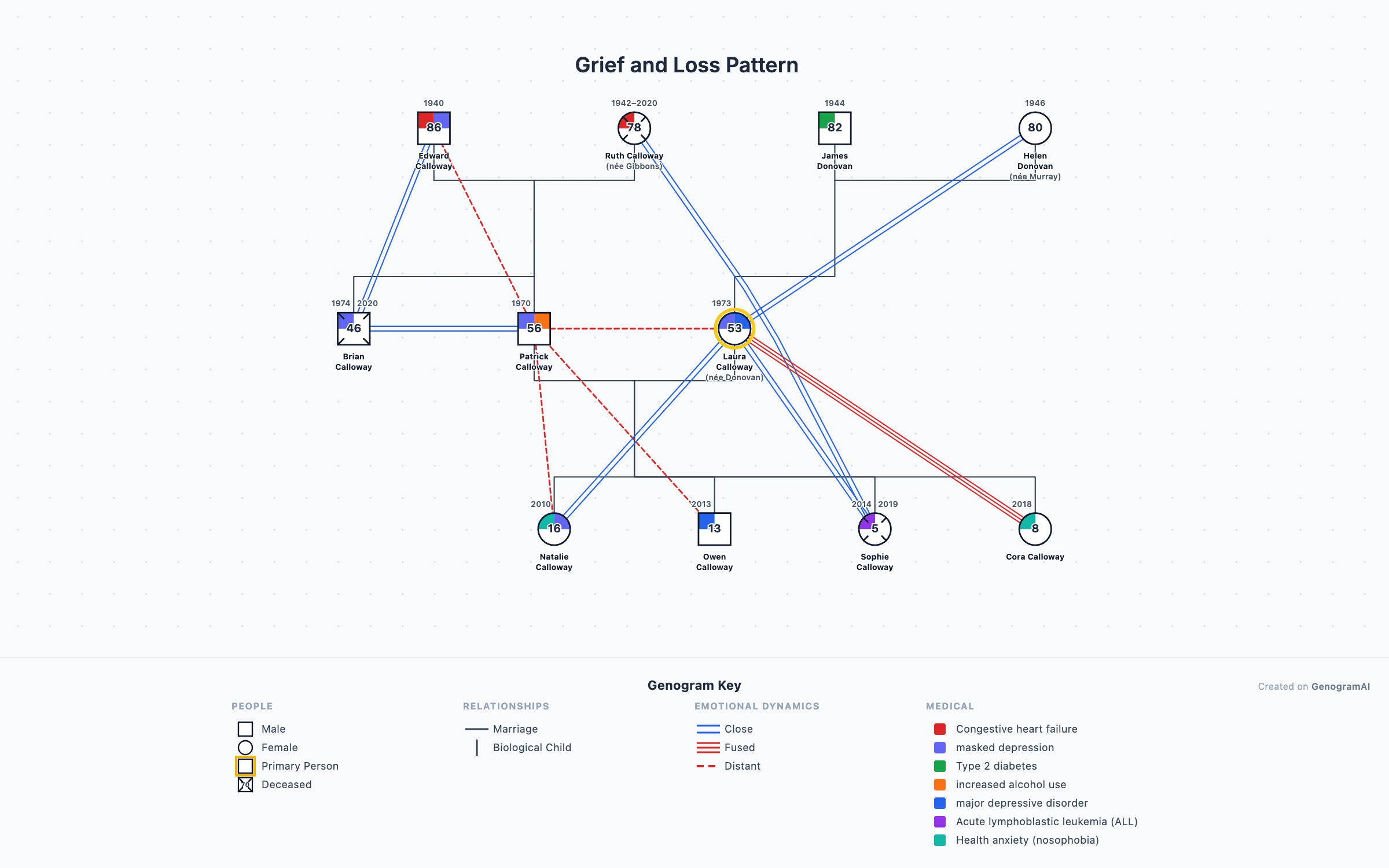
Understanding grief in family context
Grief is never just about one loss. Every death reverberates through a family system, intersecting with previous losses, family patterns of mourning, and the unique relationships each family member had with the deceased. Genograms help make these complex dynamics visible.
Monica McGoldrick, co-developer of the modern genogram, has written extensively about loss in families. She notes that families develop patterns around death and mourning that are transmitted across generations: patterns that can support or complicate the grief process.
Key resource
How do genograms support grief work?
Map loss history
Understand relationships
Reveal family rules
Identify support systems
Surface unresolved grief
Honor the deceased
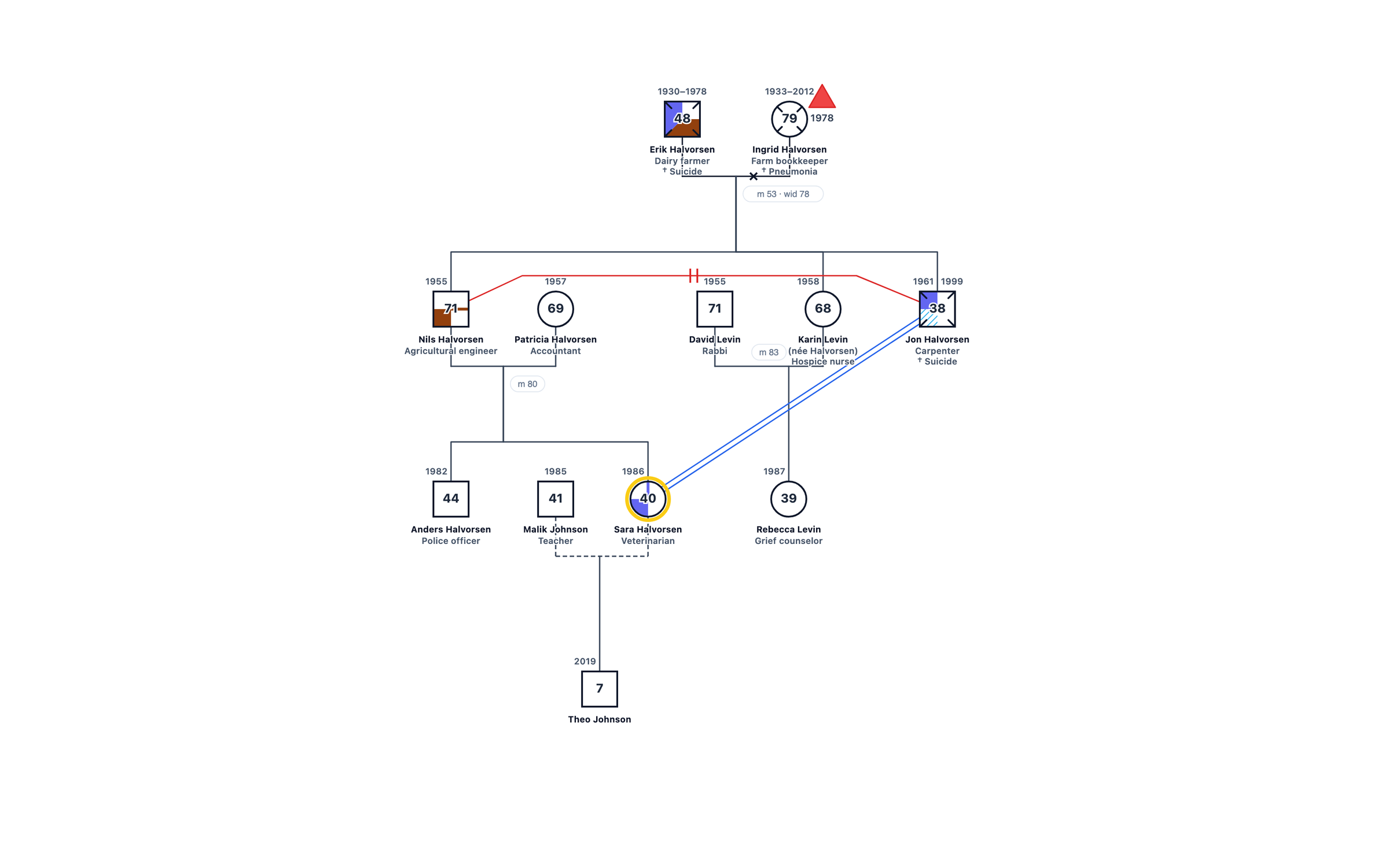
How do you mark a death on a genogram?
| Loss | How it is drawn | What to write beside it |
|---|---|---|
| Death | An X through the person's square or circle | Year of death, age at death, cause if relevant |
| Death by suicide | X through the symbol, cause recorded in notes | Date (for anniversary reactions) and who found out how |
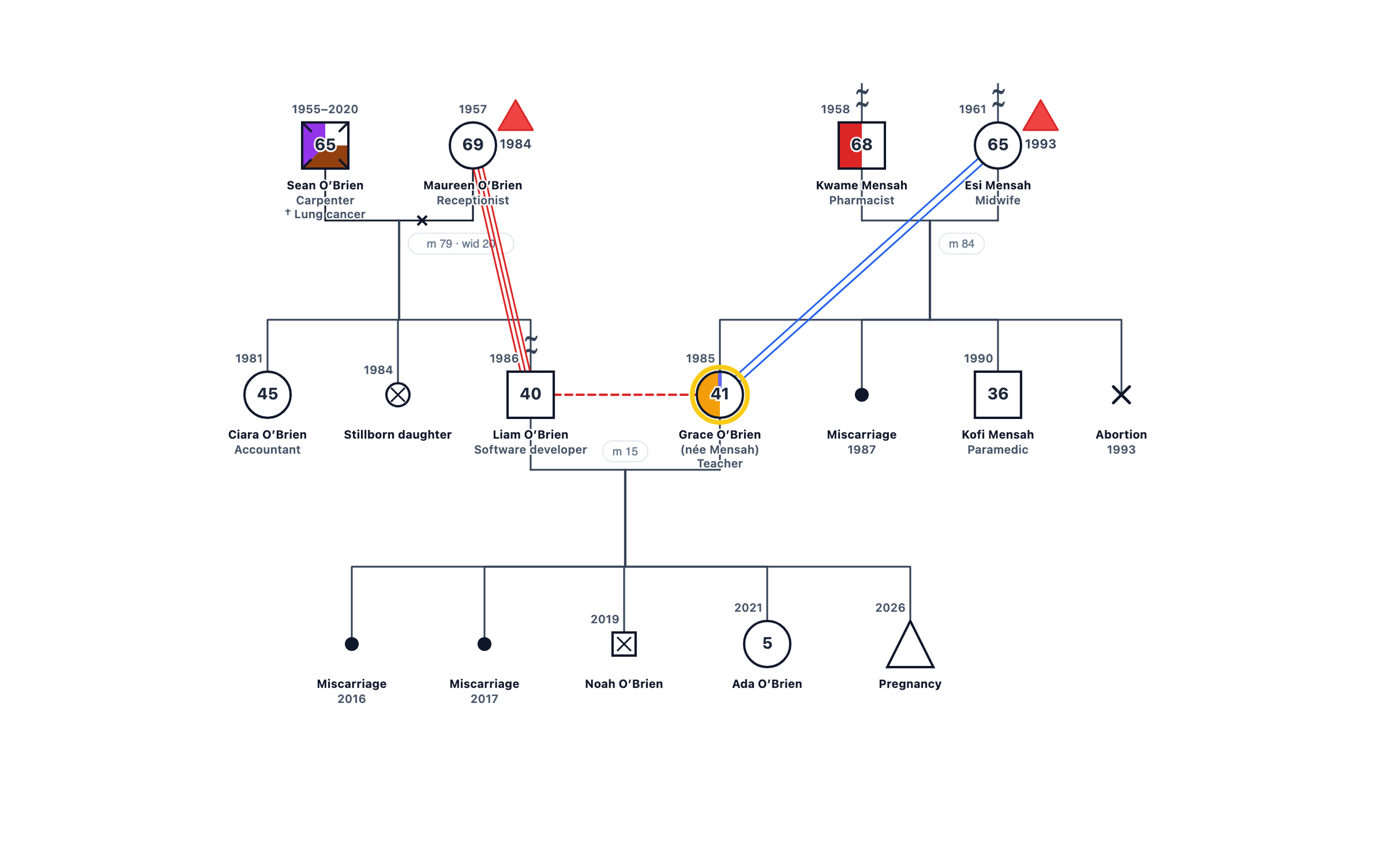
| Miscarriage | Small triangle with an X | Year and the parents' ages; often an unacknowledged loss |
| Stillbirth | Small gender symbol with an X | Year, name if one was given |
| Estrangement or cutoff | Cutoff line (broken by two short bars) | A living loss: when contact ended and why |
| Loss clustering | Several X marks with close dates | Losses within a year or two of each other |
Grief patterns to explore
Loss Clustering
Multiple significant losses occurring close together, overwhelming the family's capacity to grieve.
Clinical significance: Clients may carry unprocessed grief from earlier losses that surfaces with new ones.
Anniversary Reactions
Grief symptoms intensifying around death dates, birthdays, or other significant dates.
Clinical significance: Understanding family loss dates helps anticipate and prepare for difficult periods.
Mourning Styles
Family patterns of how grief is expressed (or suppressed)—stoic vs. expressive, private vs. public.
Clinical significance: Clients may struggle if their natural mourning style differs from family norms.
Unacknowledged Losses
Losses not recognized by the family or society: miscarriages, estranged relationships, pet deaths, dementia.
Clinical significance: Disenfranchised grief often goes unprocessed and complicates later mourning.
Role Reorganization
How family roles shift after a death—who becomes the caretaker, decision-maker, or emotional hub.
Clinical significance: Clients may be struggling with role changes as much as the loss itself.
Intergenerational Trauma
Traumatic losses (suicide, murder, war, disaster) that echo through generations.
Clinical significance: Current grief may be intertwined with historical family trauma.
What questions should you ask for a grief genogram?
About losses
- Who has died in your family?
- When did they die? What was the cause?
- How old were they? How old were you?
- Were there other losses around the same time?
- Are there losses the family doesn't talk about?
- Who else has the family lost (pets, miscarriages, relationships)?
About mourning
- How did your family handle grief?
- Was it okay to cry? To talk about the person who died?
- Who was most affected by past deaths?
- How do different family members grieve differently?
- What rituals does your family have around death?
- Who in your family has had the hardest time with loss?
About relationships
- What was your relationship like with [deceased]?
- Was there unfinished business between you?
- How did others in the family relate to [deceased]?
- Who else is most affected by this death?
- How have relationships in the family changed since the death?
About support
- Who in your family can you talk to about your grief?
- Who is struggling to be supportive?
- Are there family members you've lost touch with?
- Who has been through something similar?
- What has helped your family get through losses before?
Therapeutic applications
Normalizing grief responses
When clients see their grief in the context of family patterns, it often feels less pathological. "Of course this is hard. Look at how much loss your family has experienced" can be validating.
Try saying: "Looking at your family, I notice you lost your grandmother, your uncle, and your best friend all within two years. That's an enormous amount of loss. It makes sense that you're struggling."
Exploring family rules
Genograms can reveal implicit family rules about grief that may be constraining the client's mourning process.
Try saying: "I notice that in your family, it seems like the women carry the grief while the men stay strong and practical. Where did you learn that? Is that working for you now?"
Connecting past and present
Current grief often activates earlier losses. The genogram helps identify these connections.
Try saying: "Your mother died when you were 12, and now your daughter just turned 12. I wonder if some of what you're feeling about your father's death is also about that old loss."
Planning family interventions
Genograms inform decisions about who to include in family sessions and what dynamics to address.
Try saying: "It looks like you and your sister grieve very differently, and that's creating conflict. Would it help to bring her in so we can talk about that?"
Grief genograms: questions
Why use genograms in grief counseling?
Genograms help contextualize a client's grief within their family system. They reveal patterns of loss, mourning styles passed down through generations, unresolved grief that may complicate current mourning, and family resources for support. Understanding the family context helps tailor grief interventions.
What grief-related patterns appear in genograms?
Common patterns include: multiple losses in short time periods, unacknowledged or disenfranchised grief, family rules about expressing emotion, anniversary reactions, patterns of complicated grief across generations, and coping styles (stoic vs. expressive) that are transmitted through family culture.
How do I mark deaths on a genogram?
Deaths are marked with an X through the symbol. Include the date of death and cause of death (especially if relevant to the presenting concern). Age at death and relationship to the current client help reveal patterns like premature losses or deaths that coincide with the client's current age.
When should I introduce a genogram in grief work?
Timing depends on client readiness. Some clients find early genogram work helpful for understanding their grief in context. Others need time to process the immediate loss before exploring family patterns. Always follow the client's pace and ensure adequate support is in place.
Can genograms help with complicated or prolonged grief?
Yes. Genograms often reveal factors contributing to complicated grief: previous unresolved losses, family patterns of avoidance, enmeshed relationships with the deceased, lack of family support, or concurrent stressors. This understanding helps target interventions appropriately.
Further Reading
- Walsh, F., & McGoldrick, M. (Eds.) — Living Beyond Loss: Death in the Family (2nd ed.). W.W. Norton & Company, 2004
- McGoldrick, M., Gerson, R., & Petry, S. — Genograms: Assessment and Treatment (4th ed.). W.W. Norton & Company, 2020
- McGoldrick, M. — The Genogram Journey: Reconnecting with Your Family. W.W. Norton & Company, 2011
- Kübler-Ross, E. — On Death and Dying. Macmillan, 1969
- DeMaria, R., Weeks, G., & Twist, M. — Focused Genograms: Intergenerational Assessment of Individuals, Couples, and Families (2nd ed.). Routledge, 2017