For social work professionals
Genograms for social workers
Quick answer
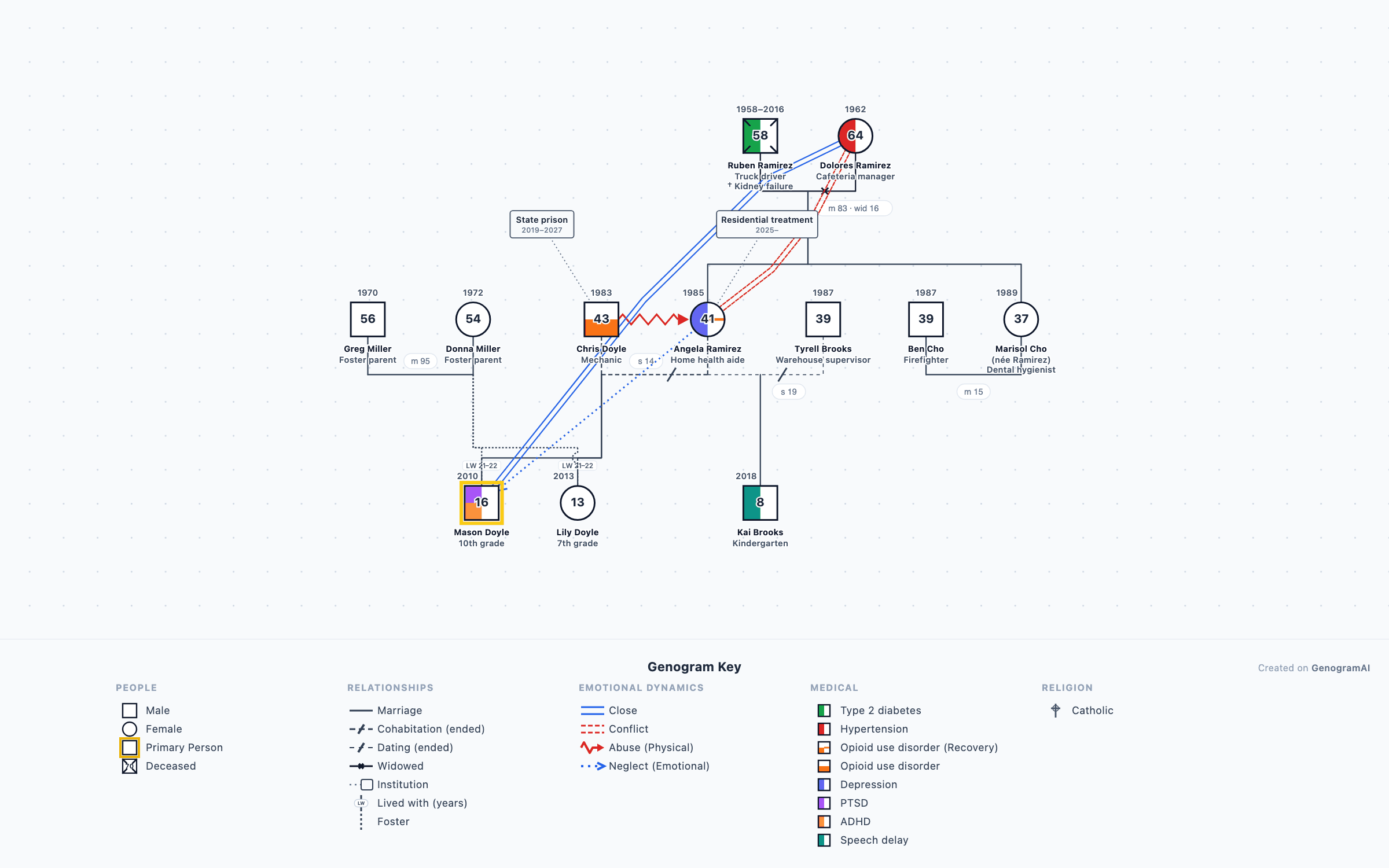
What is a genogram in social work?
A social work genogram is a standardized clinical diagram that maps a client's family system across three or more generations. Using McGoldrick-Gerson symbols, it captures family structure, emotional relationship patterns, medical history, and intergenerational cycles of behavior — all in a single visual that practitioners can read at a glance.
Family structure
Emotional patterns
Intergenerational data
Why genograms are essential in social work
See the bigger picture
Build rapport with clients
Professional documentation
Social work practice areas
Child & family services
- Document family structure for foster care placements
- Identify kinship care options and family resources
- Track intergenerational patterns of abuse or neglect
- Support reunification planning
Clinical social work
- Assess family history of mental health conditions
- Identify patterns of addiction across generations
- Map emotional relationships and family dynamics
- Plan family therapy interventions
Forensic social work
- Create visual exhibits for court proceedings
- Document custody and visitation arrangements
- Support parental fitness evaluations
- Aid in guardianship determinations
Gerontological social work
- Map caregiver networks and support systems
- Track family medical history for care planning
- Identify potential decision-makers and POA
- Document intergenerational family dynamics
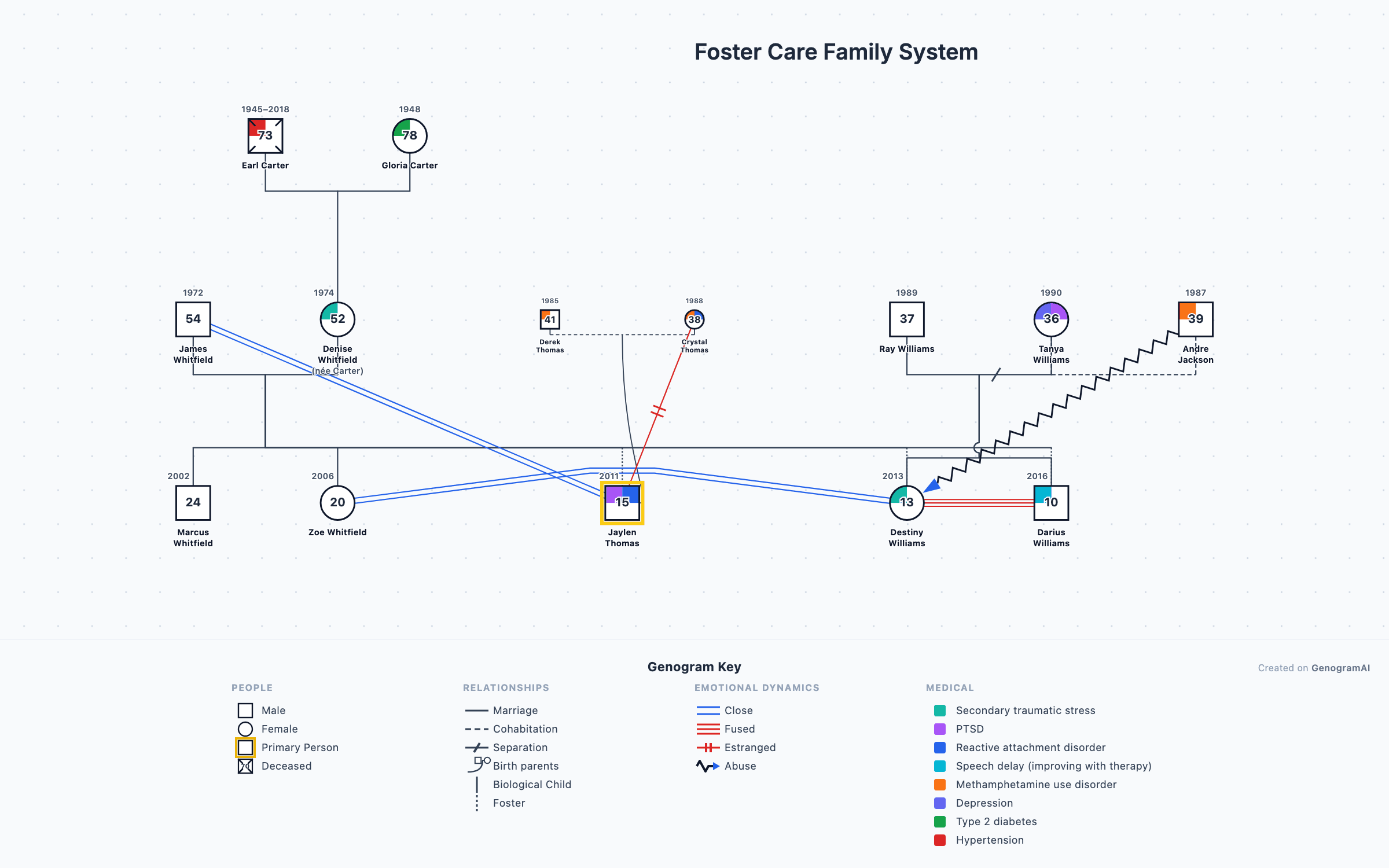
What to record on a social work genogram
| Information | How it appears on the genogram | Why it matters |
|---|---|---|
| Household composition | A line drawn around the members who live together | Shows who the child or client actually lives with |
| Marriages, separations, divorces | Partner lines with slashes for separation and divorce, plus dates | Context for custody, step-relationships and transitions |
| Foster, adopted and kinship children | Distinct child lines for biological, adopted and foster children | Placement history and kinship resources |
| Deaths and losses | An X through the person symbol, with year and cause | Unresolved grief and anniversary reactions |
| Substance use, mental health, medical conditions | Shaded quadrants inside the person symbol | Intergenerational risk factors |
| Abuse, violence, conflict, cutoffs | Emotional relationship lines between two people | Safety planning and relational patterns |
| Agency involvement, incarceration, key events | Short text annotations beside the person, with dates | Case history at a glance for the file or court |
Notation reference
Features social workers need
64 relationship types
Medical history tracking
Emotional overlays
AI-powered creation
Export for reports
Encrypted storage
| Free | Professional | Clinical | |
|---|---|---|---|
| Price | $0 | $12/month | $29/month |
| Genograms | 2 | Up to 25 projects | Unlimited |
| AI | 5 credits a month | Unlimited | Unlimited |
| Relationship types and medical quadrants | All 65, yes | All 65, yes | All 65, yes |
| Export | PNG | PNG, PDF, SVG, GEDCOM | PNG, PDF, SVG, GEDCOM |
| Zero-knowledge encryption, offline storage | — | — | Yes, plus Mac desktop app |
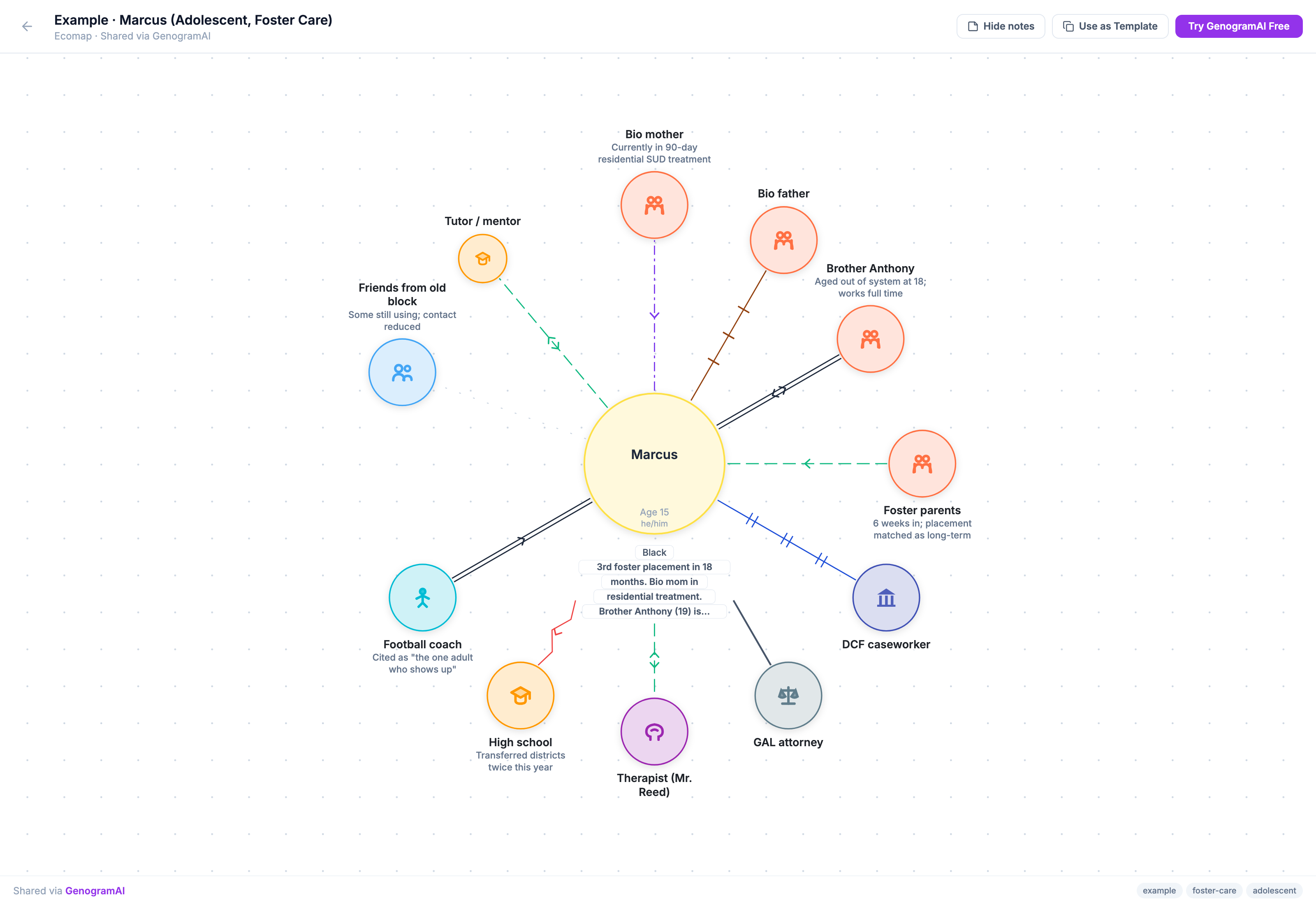
Genogram vs ecomap: which do you need?
| Genogram | Ecomap | |
|---|---|---|
| Maps | Family relationships across generations | Connections to external systems |
| Shows | Intergenerational patterns | Current support networks |
| Tracks | Medical and mental health history | Community resources |
| Documents | Emotional bonds within the family | Service provider relationships |
Save hours on documentation
Social workers report saving 30-60 minutes per genogram when using GenogramAI's AI-powered creation instead of drawing by hand or using complex desktop software.
Common questions from social workers
What is a genogram in social work?
In social work, a genogram is a standardized clinical diagram that maps a client's family system across three or more generations. Using McGoldrick-Gerson symbols, it captures family structure (marriages, divorces, children), emotional relationship patterns (conflict, estrangement, closeness), medical history, and intergenerational trauma. Social workers use genograms during intake assessments to identify risk factors, support systems, and patterns that may affect the client's current situation.
How is a social work genogram different from a family tree?
A family tree records biological lineage and names. A social work genogram goes much further: it documents emotional dynamics (conflict, cutoffs, enmeshment), tracks medical and mental health history across generations, marks significant life events, and uses standardized symbols that have clinical meaning. Genograms are tools for assessment and intervention; family trees are tools for genealogy.
What does a genogram show in social work practice?
A genogram in social work reveals: structural relationships (who is in the family and how members connect), emotional dynamics (which relationships are close, conflictual, or estranged), intergenerational patterns (repeated cycles of addiction, mental illness, domestic violence, or poverty), support networks, and risk factors relevant to a client's presenting problem. This bird's-eye view helps practitioners identify intervention points that would be invisible in a standard intake form.
Do MSW programs require students to learn genograms?
Yes. Genogram construction is a core competency in most MSW (Master of Social Work) and BSW programs. Students learn to create genograms in family systems, clinical assessment, and practice methods courses. The standard reference is McGoldrick, Gerson & Petry's 'Genograms: Assessment and Treatment' (4th ed., 2020). GenogramAI uses the same notation taught in accredited programs.
Can I use genograms created in GenogramAI for court documentation?
Yes. GenogramAI exports high-resolution PNG images on every plan, and PDF and SVG on paid plans, which suit court reports and legal documentation. The genograms use standard McGoldrick-Gerson notation that is recognized in professional settings.
Is client data secure and confidential?
Genogram data is encrypted in transit and at rest on every plan, and we do not sell or share user data. The Clinical plan adds AES-256-GCM zero-knowledge encryption and secure offline storage, so only you can read client charts; Clinical eco-maps stay on your device. You can export your genograms and delete them from our servers at any time.
How does the AI genogram creation work?
Simply describe the family in your own words - like you would in case notes. Our AI interprets the description and creates a properly formatted genogram with correct symbols and relationships. You can then edit and refine as needed.
What symbols and notation does GenogramAI use?
GenogramAI uses the standard McGoldrick-Gerson-Petry notation system taught in social work programs. This includes 18 partnership types, 39 emotional relationship types, and 7 child connection types - 64 relationship types total.
Can I collaborate with other social workers on a genogram?
Genograms are created and stored in your own account; there is no real-time co-editing. To share one with a colleague, publish a view-only link (every plan), or export it as a PNG (every plan) or as PDF, SVG or GEDCOM (paid plans). A colleague on a paid plan can import the GEDCOM file into their own GenogramAI account and keep working on it.
Does GenogramAI offer discounts for agencies?
Yes, we offer volume discounts for social service agencies and organizations. Contact us at [email protected] to discuss team pricing and enterprise features.
Start creating genograms today