Genogram example · Family structure
Co-Parenting Non-Romantic Family Genogram
Quick answer
At a glance
| This example | |
|---|---|
| Generations | 3 |
| Family members | 10 (5 male, 5 female) |
| Birth years | 1953 to 2022 |
| Deceased | 1 |
| Index person | Sophie Ross |
| Category | Family structure |
| Tags | Family Structure, Educational, Clinical |
About this genogram
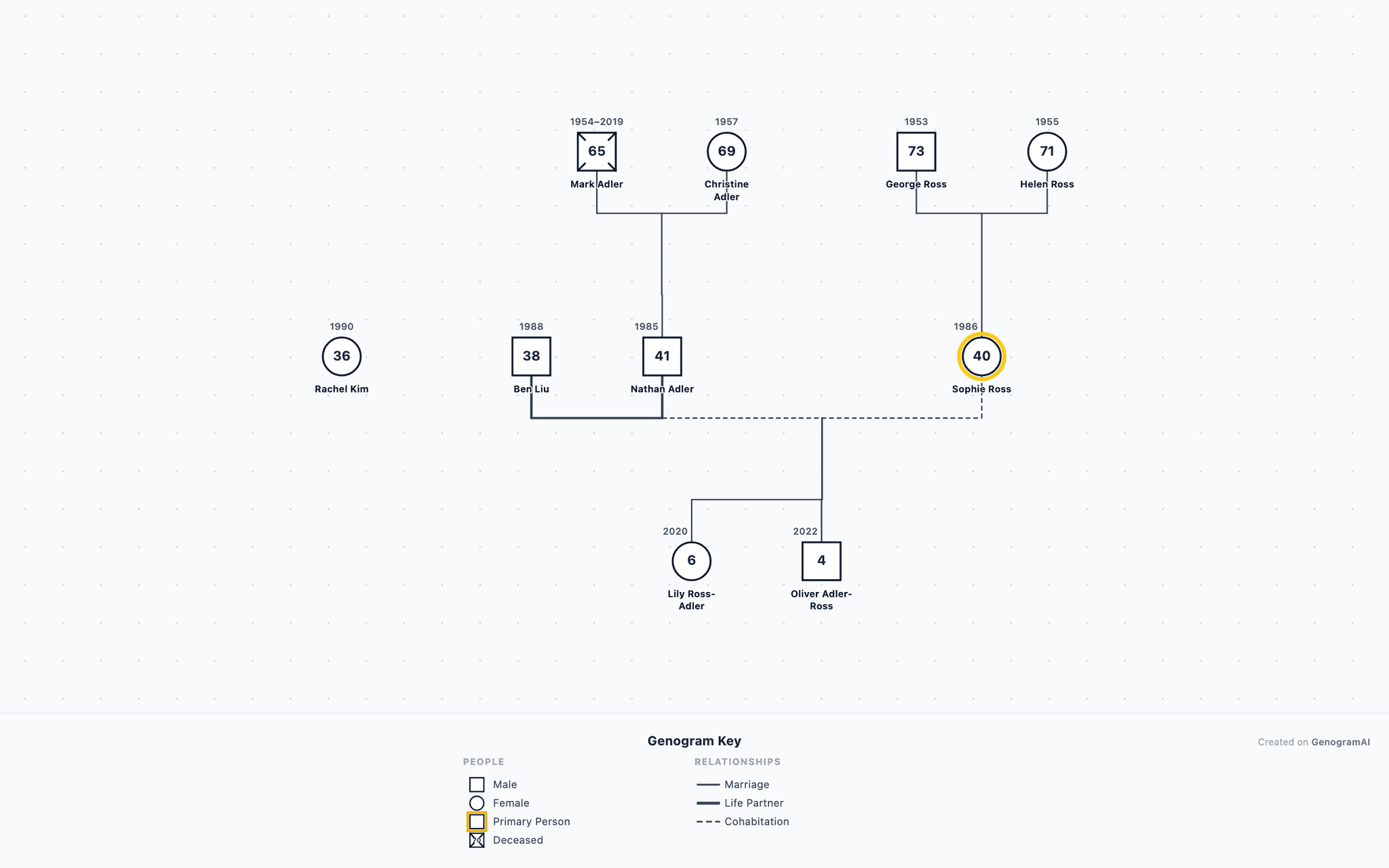
A co-parenting family genogram depicting non-romantic parenting arrangements including surrogacy, sperm donation, and intentional co-parenting between friends. This genogram illustrates the increasingly common phenomenon of people who choose to raise children together without being in a romantic relationship. The central family features two best friends — one gay man and one straight woman — who decided to co-parent together, sharing custody 50/50 across two households. The genogram also includes the surrogate who carried their second child and the known sperm donor involved in another family branch. This example is valuable for therapists navigating the legal, emotional, and relational complexities of donor-conceived and intentionally co-parented families.
Family analysis
Overview
This 3-generation genogram maps 10 family members with birth years spanning from 1953 to 2022, comprising 5 males and 5 females (1 deceased). The index patient is Sophie Ross (b. 1986), veterinarian.
Generation by generation
The family system encompasses 3 generations with distinct patterns at each level. The oldest generation includes Helen, George, Christine and 1 other. The middle generation includes Sophie, Nathan, Ben and 1 other. The youngest generation includes Lily, Oliver.
This genogram illustrates how family structure shapes individual development and relational patterns. Professionals working with families of this structure can use the genogram to normalize diverse family configurations and identify both strengths and areas for growth in the family system.
How do you read the Co-Parenting Non-Romantic Family Genogram?
- 1
Find each person and generation
Squares are males and circles are females, and each row is one generation, oldest at the top. This one has 5 males and 5 females across 3 generations. - 2
Check the status markers
Markers on a symbol add facts about that person: Deceased (X) and Index Patient (Arrow). 1 person is marked deceased. The index person, the focus of the assessment, is Sophie Ross. - 3
Follow the family lines
Horizontal lines join partners and vertical lines drop to their children, born left to right in birth order. This genogram uses Marriage and Parent-Child lines.
Genogram symbols used in this example
| Symbol | Type | What it means |
|---|---|---|
| Male (Square) | Person Symbols | A square represents a male family member in standard genogram notation. |
| Female (Circle) | Person Symbols | A circle represents a female family member in standard genogram notation. |
| Deceased (X) | Status Markers | An X drawn through the symbol indicates the person is deceased. |
| Index Patient (Arrow) | Status Markers | An arrow pointing to a person identifies them as the index patient — the individual who is the focus of the clinical assessment. |
| Marriage | Structural Relationships | A solid horizontal line connecting two individuals represents a marriage or committed partnership. |
| Parent-Child | Structural Relationships | A vertical line descending from a couple line to a child symbol represents a parent-child relationship. |
Build a genogram like this one
Example prompt
- 1
Start from the dashboard
Sign in to GenogramAI and choose Create with AI (paid plans), or open a blank genogram and use Ask AI (any plan). To start from this exact chart instead, use Open as template. - 2
Describe your family
Paste a description like the one above, with your own names, dates, relationships and health history. - 3
Check and adjust
Edit people and lines by hand, or ask the AI for one change at a time. - 4
Export
Download a PNG on the free plan. PDF and SVG export are on paid plans.
The free plan includes 2 genograms and 5 AI credits a month. See the AI genogram creator for what else it can do.
Related resources
- Browse our genogram templates to find structures similar to this example.
- See our 3-generation genogram guide for standard multigenerational mapping techniques.
- The deceased symbol (X through the shape) marks family members who have passed away.
- The marriage symbol connects partnered individuals in this genogram.
Frequently asked questions
What clinical patterns does the Co-Parenting Non-Romantic Family Genogram reveal?
The Co-Parenting Non-Romantic Family Genogram maps multigenerational transmission of psychological patterns, emotional dynamics, and relationship structures. Clinicians use it to identify recurring cycles of behavior, attachment styles, and communication patterns that may inform diagnosis and treatment planning in family therapy.
Who would benefit from studying the Co-Parenting Non-Romantic genogram?
The Co-Parenting Non-Romantic genogram is valuable for family therapists, social workers, counseling students, medical professionals, and anyone interested in understanding family dynamics and intergenerational patterns through visual family mapping.
What genogram symbols are used in the Co-Parenting Non-Romantic Family Genogram example?
This genogram uses Male (Square), Female (Circle), Deceased (X), Index Patient (Arrow), Marriage and Parent-Child. All of them follow standard genogram notation, so the chart reads the same way in any genogram program or textbook.
Can I build a genogram like the Co-Parenting Non-Romantic Family Genogram example?
Yes. Open GenogramAI, choose Create with AI on the dashboard (paid plans) or open a blank genogram and use Ask AI in the editor (any plan), and describe the family in plain words: who is in it, how they are related, key dates and the relationships or health conditions you want to show. The AI draws the symbols and lines, and you can then edit by hand or ask for one change at a time. A family of 10 people like this one takes a short paragraph to describe. The free plan includes 2 genograms and 5 AI credits a month, with PNG export.
About this example