Genogram notation
How to Show Triangles (Triangulation) in a Genogram
Quick answer
The notation
Drawing a triangle
Draw the emotional line between each pair: e.g., conflict between mother and father, fusion (over-closeness) between mother and son, distance between father and son. The three lines form the triangle visually and clinically.
Common triangles
Parent–parent–child (the classic), a couple and an in-law, a couple and an affair partner, siblings and a parent. Genograms with several triangles often show them interlocking.
Reading direction
Ask: when the two-person tension rises, who moves toward whom? The line types (conflict, closeness, cutoff) encode the answer.
Triangles (Triangulation): symbol and meaning
| Drawing | What you see | What it means |
|---|---|---|
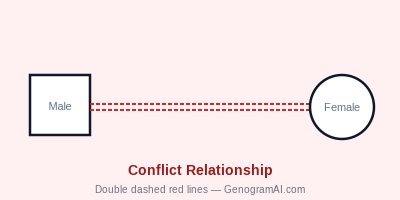 | Conflict line between two people | The original tension, e.g. between the parents |
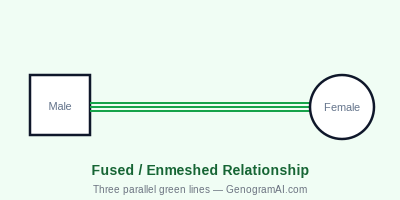 | Fused line (three parallel lines) | Over-closeness with the third person |
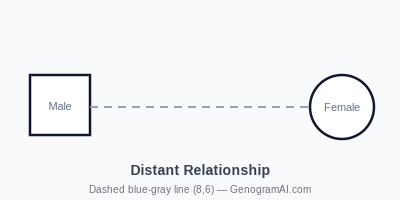 | Distant line (dashed) | The outsider of the triangle |
| — | All three pair lines read together | A triangle |
| — | A triangle shape used as a person symbol | A pregnancy, unrelated to triangulation |
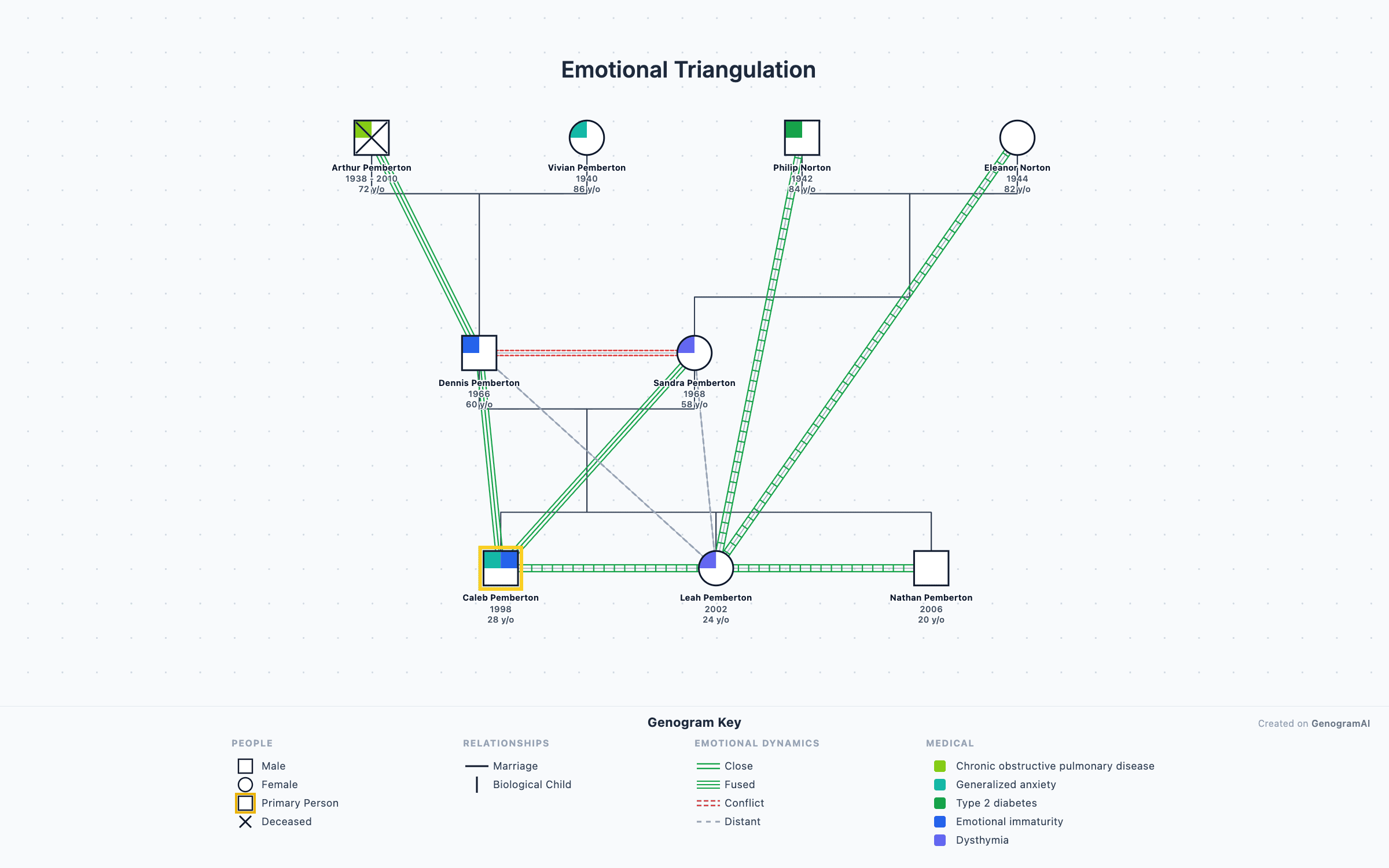
What does it look like on a real genogram?
How to draw it in GenogramAI
- 1
Use the emotional relationship tool to draw each pair’s line: conflict, fused, close, distant, cutoff — 39 emotional relationship types available
- 2
Multiple emotional lines between the same two people are supported when the relationship carries more than one quality
- 3
Ask the AI to analyze: "What triangles or alliances do you see?" works on your own genogram
Or just tell the AI
"Show conflict between Ana and Luis, and a fused relationship between Ana and their son Marco."
Frequently asked questions
Is there a triangle symbol in genograms?
Triangulation isn’t drawn as a literal triangle glyph — it’s the pattern that emerges when you draw the emotional lines between all three pairs. (A triangle shape as a person-symbol means a pregnancy, which is unrelated.)
What is an example of triangulation in a family?
A couple in conflict where the mother confides in the eldest daughter, who then distances from her father: conflict line between parents, fused line mother–daughter, distant line father–daughter.
Can AI detect triangles in my genogram?
GenogramAI’s assistant can analyze your diagram — ask it “what triangles or alliances do you see?” and it reads the emotional lines you’ve drawn.