Ecomaps
Ecomap vs genogram: when to use each in clinical practice
Quick answer
The one-sentence difference
A genogram maps the family system across time. An ecomap maps the environment in the present. Both are visual; both came out of social work theory; both pay off in proportion to how thoughtfully they’re assembled. But they’re built for different questions.
If a colleague asks, “What do I draw for this case?” the right answer depends on what they need to understand: the history of the family system, or the scaffolding around the client right now.
| Genogram | Ecomap | |
|---|---|---|
| Maps | The family system across time | The environment in the present |
| Typical scope | Three generations | The client and the systems around them now |
| Shows | Structure, deaths, illness, emotional relationships | Supports, stressors, services and the strength of each tie |
| Informs | Family-of-origin work, pattern surfacing, kinship decisions | Service coordination, support-network planning |
When should you use a genogram?
Pull out a genogram when the assessment hinges on intergenerational patterns: addiction across three generations, undiagnosed mental-health histories, repeating attachment dynamics, family-of-origin trauma transmission. The genogram surfaces the shape of the family system: who’s related to whom, who’s deceased, who carried which medical or emotional pattern. Standard genogram notation, as described by McGoldrick and colleagues, gives you a vocabulary for that.
Genograms are also the right tool for kinship-placement assessment in foster care, premarital counseling, and any clinical work where the historical family system is load-bearing.
When should you use an ecomap?
Reach for an ecomap when you need to see the current environment. Who’s in the support network? Where are the chronic stressors? What services touch this client, and how strong is each connection? An ecomap doesn’t go back through generations; it shows the live picture of the systems pulling on the person right now.
Case management, discharge planning, social-determinants-of-health documentation, community-health nursing, and recovery support all lean heavily on the ecomap. It’s the diagram you draw when the next action is intervention coordination, not family-of-origin work.
Three cases, three choices
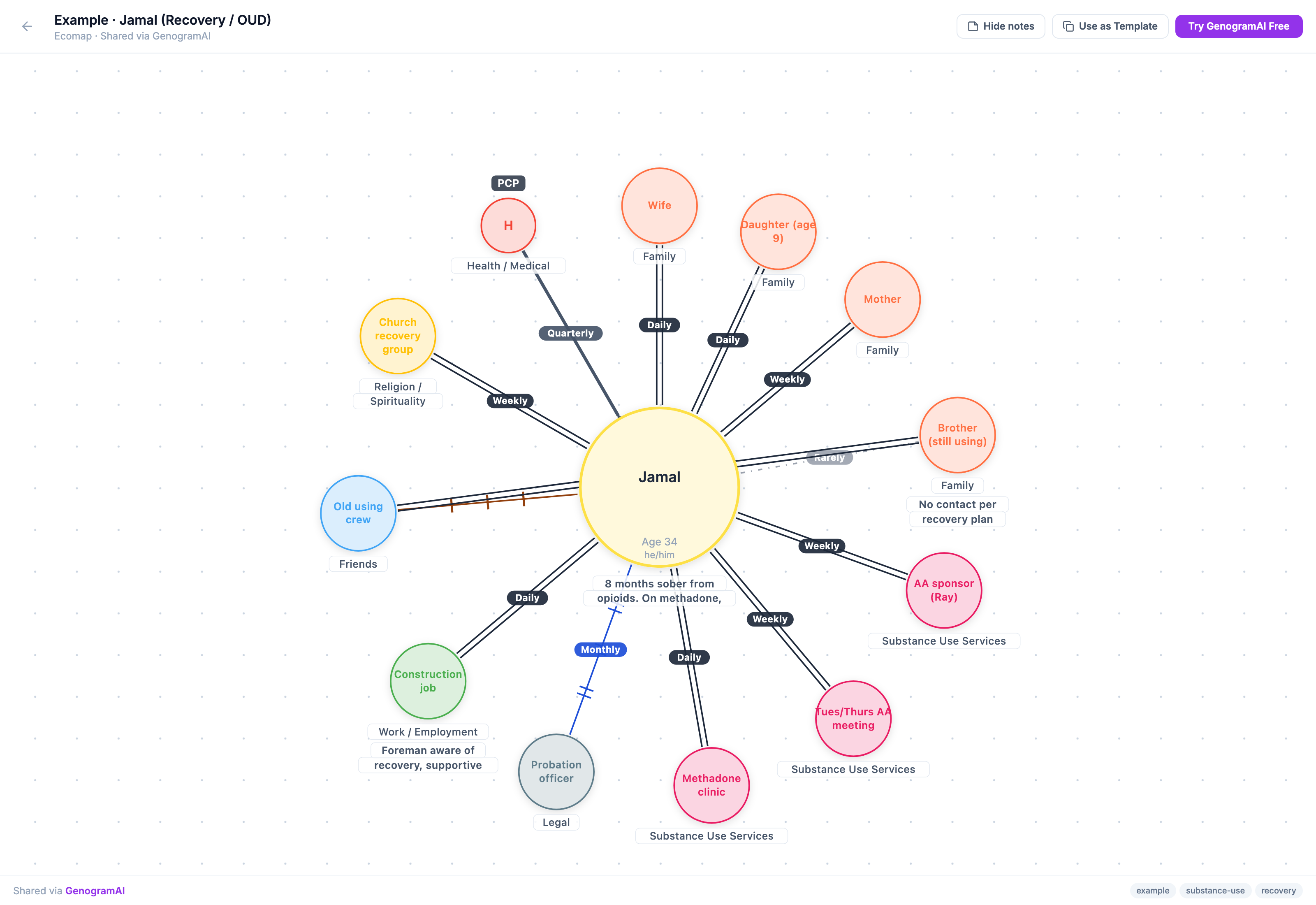
Case 1: James, 28, six months sober
James is in early recovery. His clinician wants to plan relapse prevention. What does the team need to see?
- Who’s sponsoring him? What groups is he in? How strong are those ties?
- What family relationships are pulling on him, supportively or stressfully?
- Are there using friends still in his life?
- Is his housing stable? His job?
These are all ecomap questions. An ecomap surfaces the recovery scaffolding and the stress points side by side. A genogram of James’s family-of-origin would be relevant later, especially if there’s intergenerational substance use, but for relapse-prevention planning this week, the ecomap is the right tool.
Case 2: Family Chen, three children, kinship-placement assessment
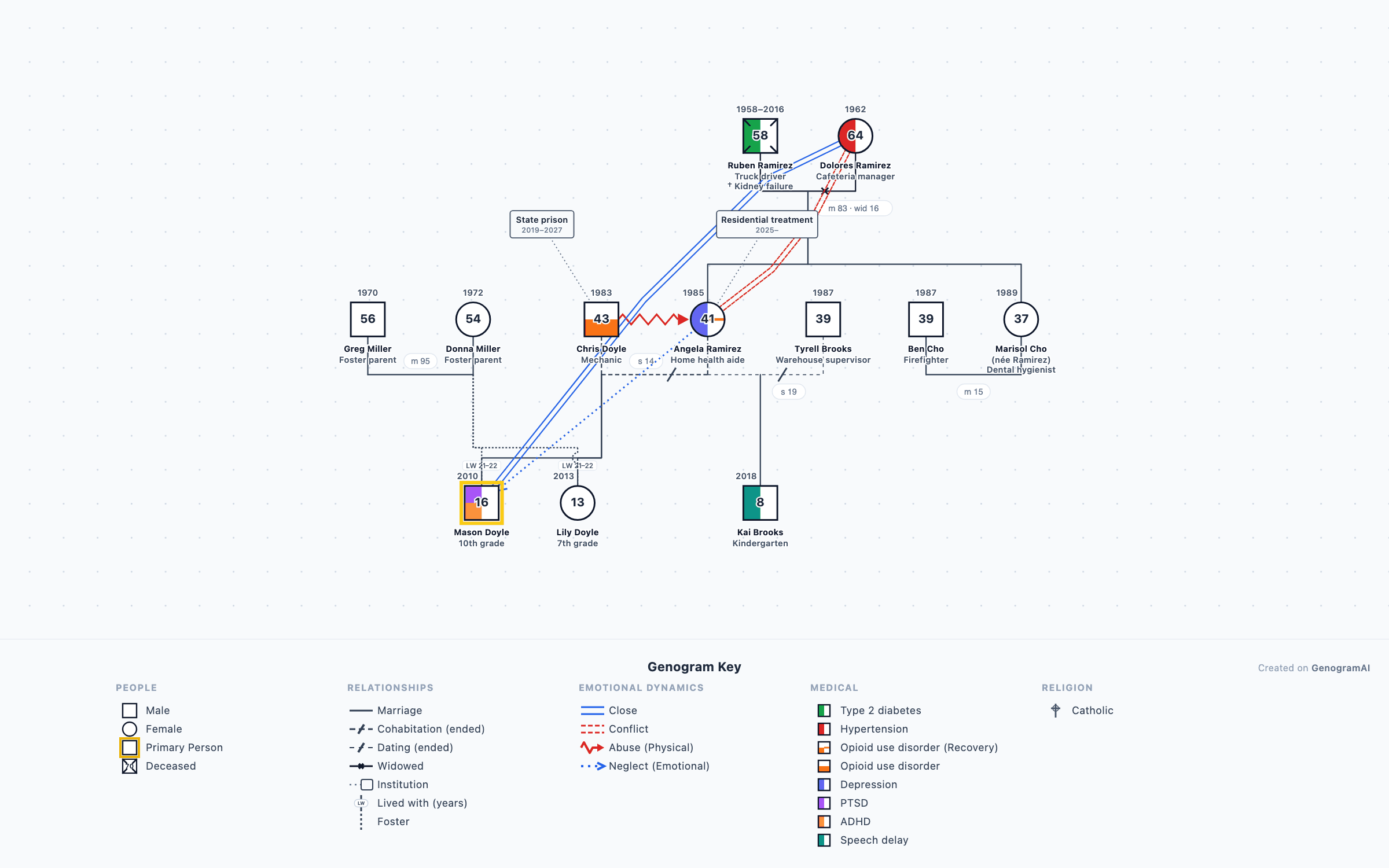
A foster-care worker is preparing for a permanency hearing. The placement team needs to know which relatives are realistic candidates for kinship placement of three siblings.
- Who are the children’s biological family members, and what are the relationships among them?
- Are there documented patterns (substance use, mental health, abuse) in any branches?
- Where do the children fit in the sibling order, and how are they currently bonded to extended family?
These are genogram questions. The genogram surfaces the family structure that makes kinship-placement decisions defensible. The team will likely add an ecomap later to map current services, but the kinship analysis itself is a genogram task.
Case 3: Maya, 15, school referral for declining grades and isolation
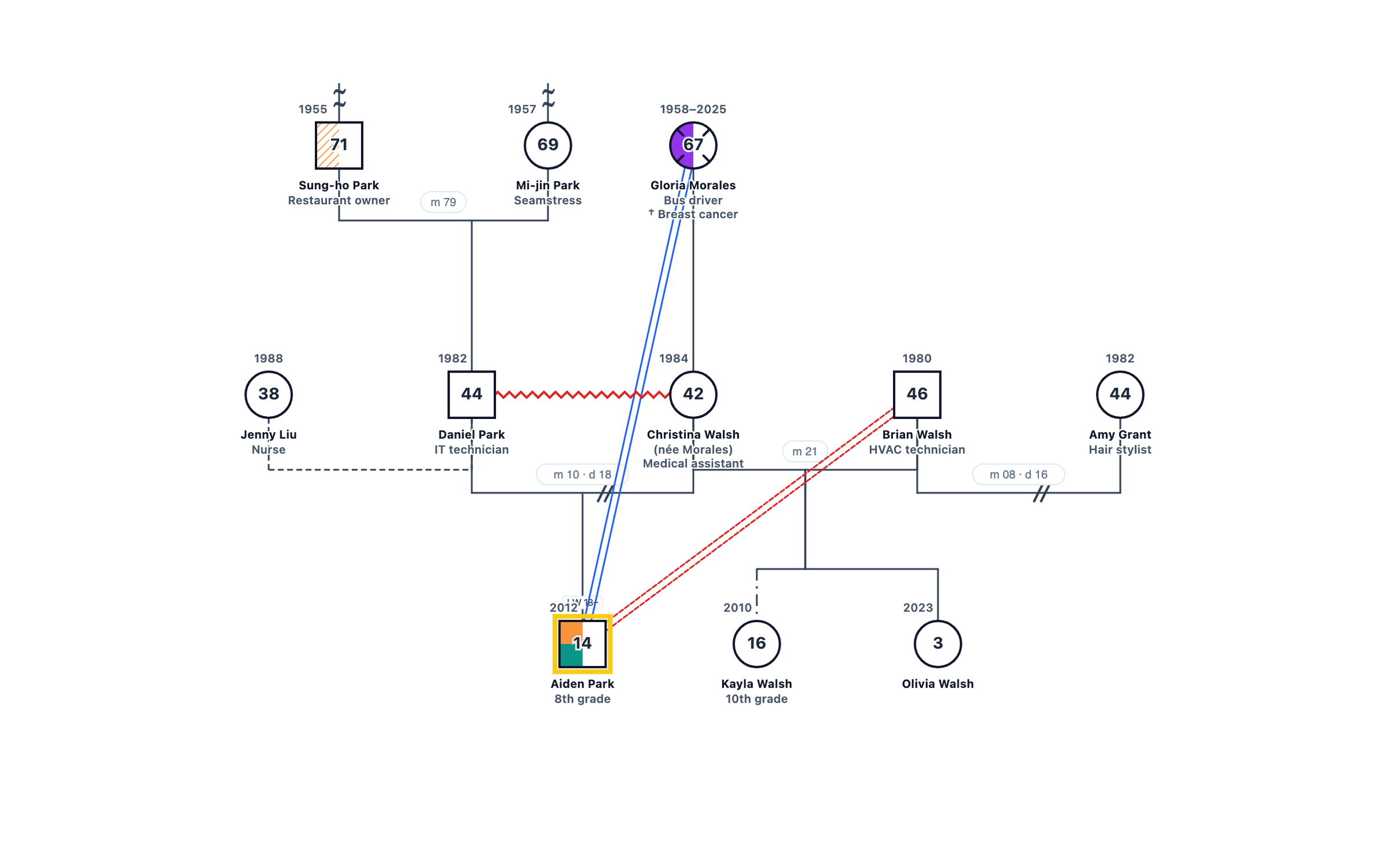
A school social worker has 45 minutes to gather context before the next IEP review. What goes on the page?
- What does Maya’s family-of-origin look like? Has anything shifted recently?
- Who’s in her support network now: teachers, peers, after-school program, family?
- What stressors are pressing on her today?
Both. A short genogram (immediate family, with any recent changes flagged) plus a focused ecomap (school + peers + supports + stressors). Many social workers do these as a two-page artifact in one session and attach both to the case file. Modern tools (including GenogramAI) make this fast enough that “just do both” stops being expensive.
The decision in one paragraph
Lead with the genogram when the clinical question is historical or relational. Lead with the ecomap when the question is contemporary or environmental. Use both when you need both, which is most cases of any depth. The fastest reliable test is to ask, “what’s the next action this diagram is supposed to inform?” Family-of-origin work or pattern surfacing → genogram. Service coordination or support-network planning → ecomap.
| If the question is… | Draw | Example |
|---|---|---|
| What patterns repeat across generations? | Genogram | Addiction or depression in three generations |
| Which relatives could take the children? | Genogram | Kinship-placement assessment (Case 2) |
| What hereditary risk does this family carry? | Genogram | Medical or genetic history |
| Who supports this client right now, and who drains them? | Ecomap | Relapse-prevention planning (Case 1) |
| Which services need coordinating before discharge? | Ecomap | Discharge planning |
| Both history and current context? | Both | School referral before an IEP review (Case 3) |
Tooling note
You can draw both diagrams in any whiteboard tool, but the time cost is real. GenogramAI supports both as peer document types: same canvas, same AI generator, same Clinical Mode privacy. Paste the case description into either tool and you have an editable canvas in seconds. Pick Genogram or Ecomap from the Start New tabs on the dashboard, then export each one for the case file: PNG on the free plan, PDF on the Professional and Clinical plans.
Further reading: the long-form side-by-side comparison, ecomaps in addiction recovery, or the AI ecomap generator.
Frequently asked questions
What is the difference between an ecomap and a genogram?
A genogram maps the family system across time, usually three generations, with standard symbols for structure, health and emotional relationships. An ecomap maps the environment in the present: the person or family at the centre and the people, services and institutions around them, with lines for the strength and stress of each connection.
When should I use a genogram instead of an ecomap?
Use a genogram when the clinical question is historical or relational: intergenerational patterns, family-of-origin work, kinship-placement assessment, premarital counseling, or hereditary health history.
When should I use an ecomap instead of a genogram?
Use an ecomap when the question is about current supports and stressors: case management, discharge planning, relapse prevention, social-determinants-of-health documentation, community-health nursing and service coordination.
Can I use both on the same case?
Yes, and most cases of any depth benefit from both. A common pattern is a short genogram of the immediate family plus a focused ecomap of current supports and stressors, both attached to the case file.
Try it