Gender Identity in the Family: Transgender and Nonbinary Members
Clinical genogram with a transgender teenager and a nonbinary sibling: gender identity symbols, orientation, cutoff, repair and support across generations.
Interactive Gender Identity in the Family: Transgender and Nonbinary Members
Click and drag to explore. Zoom with scroll.
Can't see the genogram? View in the GenogramAI Gallery
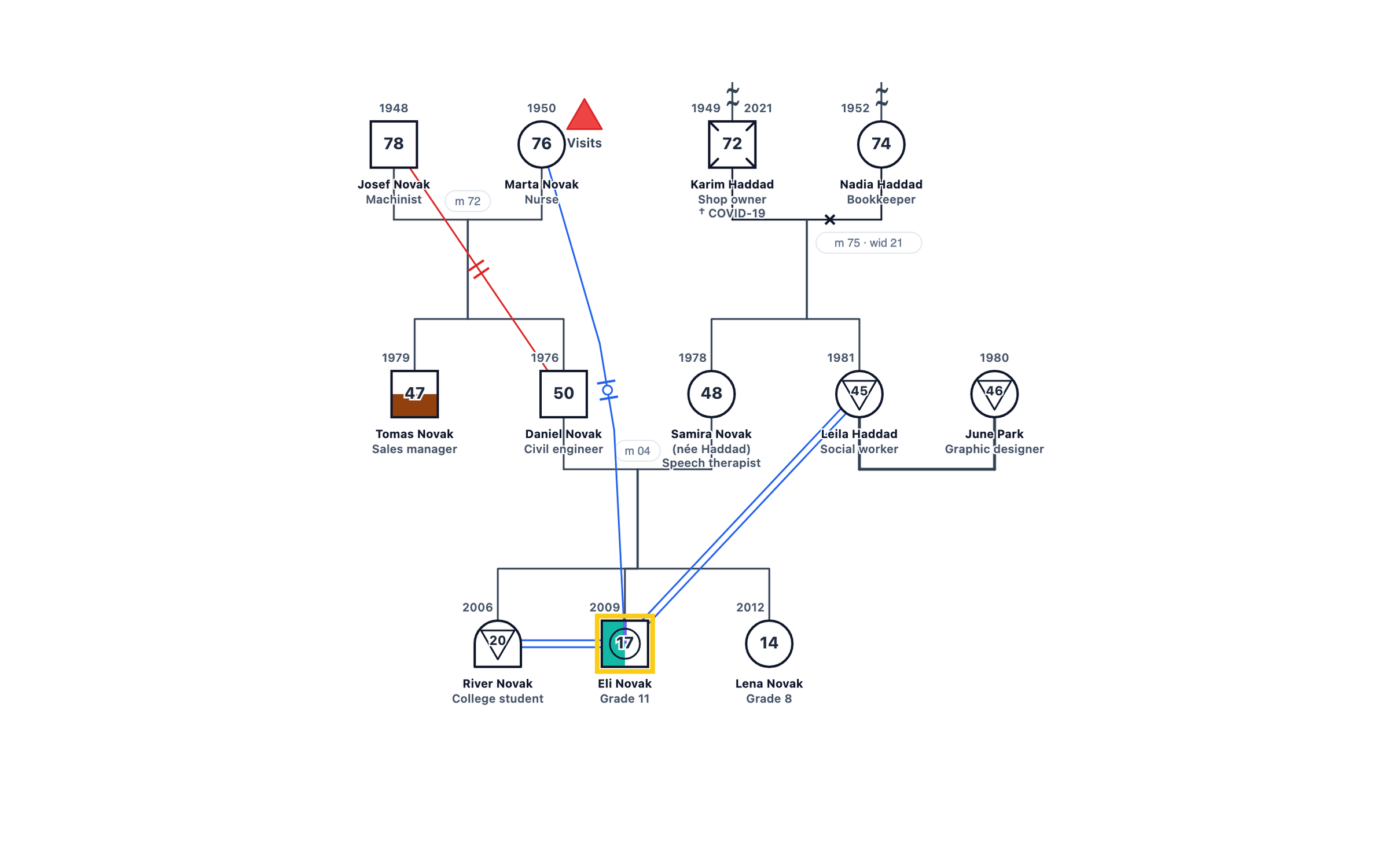
About This Genogram
A three-generation clinical genogram of a fictional family with a 17-year-old transgender son and a nonbinary older sibling. It records sexual orientation, a grandparent who cut off contact, a grandmother who quietly reconnected, a supportive lesbian aunt and the teenager’s anxiety, with a dated chronology of coming out.
How to Read This Genogram
Clinicians typically introduce this type of genogram during an intake assessment to build a three-generation picture of the family before treatment planning begins. The map helps the therapist apply Bowen Family Systems Theory by locating triangles, differentiation levels, and the emotional processes that link presenting symptoms to earlier family patterns. Squares represent male family members, circles represent female family members, horizontal lines connect couples, and vertical lines descend to their children. Dates near symbols mark births, marriages, separations, and deaths, giving the reader a timeline of key family transitions.
Multigenerational transmission patterns become visible when you trace the same relational or behavioral theme across two or more generations. A therapist reading this genogram looks for repetitions in relationship roles, anxiety management strategies, and symptom locations that span grandparents, parents, and the current generation. Identifying those threads allows the clinician to distinguish what belongs to the individual from what was absorbed from the family system, which is often the first step toward lasting change in family or individual therapy.
Key Patterns in This Genogram
Multigenerational Transmission
How conditions and behaviors are passed across generations through family dynamics.
Emotional Relationships
Patterns of enmeshment, cutoff, conflict, and closeness between family members.
Family System Dynamics
How the family operates as a system with roles, boundaries, and recurring patterns.
Clinical Analysis
The index person is Eli Novak, 17, a transgender boy referred for school refusal and anxiety in the spring after his paternal grandfather stopped contact with the family. Eli came out in 2023, two years after his older sibling River came out as nonbinary. His parents, Daniel and Samira, have been supportive; his younger sister Lena is 14.
Three generations of response are visible. Josef Novak, a devout Catholic, cut off his son Daniel’s household in 2023. His wife Marta did not follow: since 2024 she has met Eli for lunch every other week without telling Josef, a secret attached to her symbol. On the maternal side, Samira’s younger sister Leila, a social worker in a long-term relationship with June, is Eli’s closest adult outside his parents. The chart therefore shows both a cutoff and two sources of repair.
Clinically, the genogram helps separate Eli’s anxiety from his identity. The stress is relational: a grandfather’s rejection, a grandmother forced into secrecy and a father in conflict with both his own father and his brother Tomas. Work can focus on strengthening the existing supports (Leila, River, Marta) and on Daniel’s position between his father and his child.
Build a Similar Genogram
A practitioner documenting a family similar to this one would typically record three generations of household composition, significant life events such as births, deaths, marriages, and separations, any relevant medical or mental health history, and the quality of key relationships between members. That information comes from a combination of the client's verbal account, intake questionnaires, and, where available, collateral records. The completed diagram captures both the factual structure of the family and the practitioner's clinical observations about relational patterns, making it a reference that can be shared across disciplines or reviewed at future stages of treatment.
GenogramAI's AI genogram generator allows you to build a diagram like this one from a plain-language description of the family. You type or paste a narrative, such as the basic structure and any key relationships or health history you want to include, and the AI parses that text, places the correct symbols, draws the appropriate relationship lines, and arranges the layout automatically. The result is a fully editable diagram that you can refine, annotate, and export for clinical records or educational use. Try the AI genogram creator to generate your own genogram from a text description in seconds.
Genogram Symbols Used in This Example
The following standard genogram symbols appear in the Gender Identity in the Family: Transgender and Nonbinary Members. Each symbol follows McGoldrick and Gerson clinical notation conventions.
Person Symbols
- Male (Square)
- A square represents a male family member.
- Female (Circle)
- A circle represents a female family member.
- Transgender man
- A square with an inner marker records a person who is a transgender man, so gender identity is visible without relabelling the person.
- Nonbinary person
- A distinct nonbinary symbol records a person who identifies as neither man nor woman.
- Sexual orientation marker
- An inverted triangle inside the symbol records a gay or lesbian orientation; other orientations have their own markers.
- Index person (highlighted outline)
- The person at the centre of the assessment is drawn with a highlighted outline.
- Deceased (X)
- An X through the symbol marks a person who has died; birth and death years are written above it.
- Age inside the symbol
- The current age (or age at death) is written inside each symbol, with years above it.
Couples
- Marriage
- A solid line between partners; the marriage year is written on the line (m 90 = married 1990).
- Widowed
- A small x on the couple line marks the end of a marriage through death (wid 15).
- Committed partnership
- A couple line for a long-term committed partnership that is not a legal marriage.
- Immigration marker
- A double wavy mark on a person’s line records immigration; a single wavy mark records living across two cultures.
Emotional Relationships
- Cutoff
- A line broken by two short bars marks an emotional cutoff.
- Cutoff repaired
- A cutoff line with a reconnecting mark records contact that was broken and then restored.
- Close
- Two parallel blue lines mark an emotionally close relationship.
Other
- Family secret
- A red marker beside a person holds a secret that is revealed on click.
- Medical shading
- The left half of a symbol is shaded for a physical or mental illness and the bottom half for alcohol or drug use; each condition has its own colour, listed in the key. Hatching means suspected, a partial fill means in recovery.
Related Resources
- For support networks beyond blood relatives, see our chosen family genogram.
- The estranged relationship symbol marks Josef’s break with his son’s household.
- Read how clinicians use genograms in family therapy with LGBTQ+ clients and their families.
- If you are new to the tool, start with what a genogram is.
Frequently Asked Questions
How do you show a transgender person on a genogram?
How is a nonbinary person drawn?
What relationship patterns are common after a family member comes out?
Is this a real family?
Related Genogram Examples
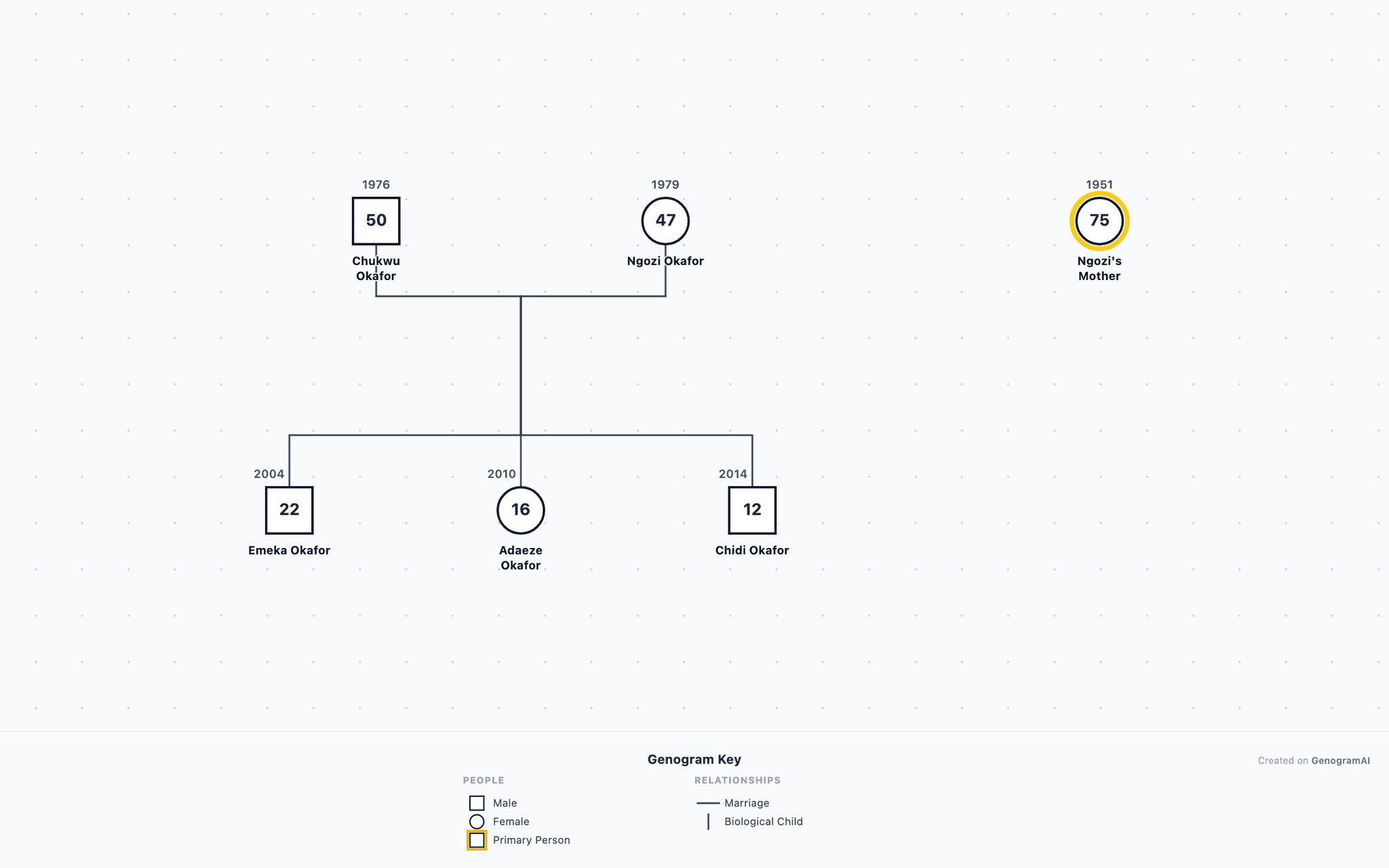
Okafor Family Genogram
Adaeze Okafor, 16, is brought to therapy by her parents, Chukwu (50) and Ngozi (47), for \"defiant behavior.
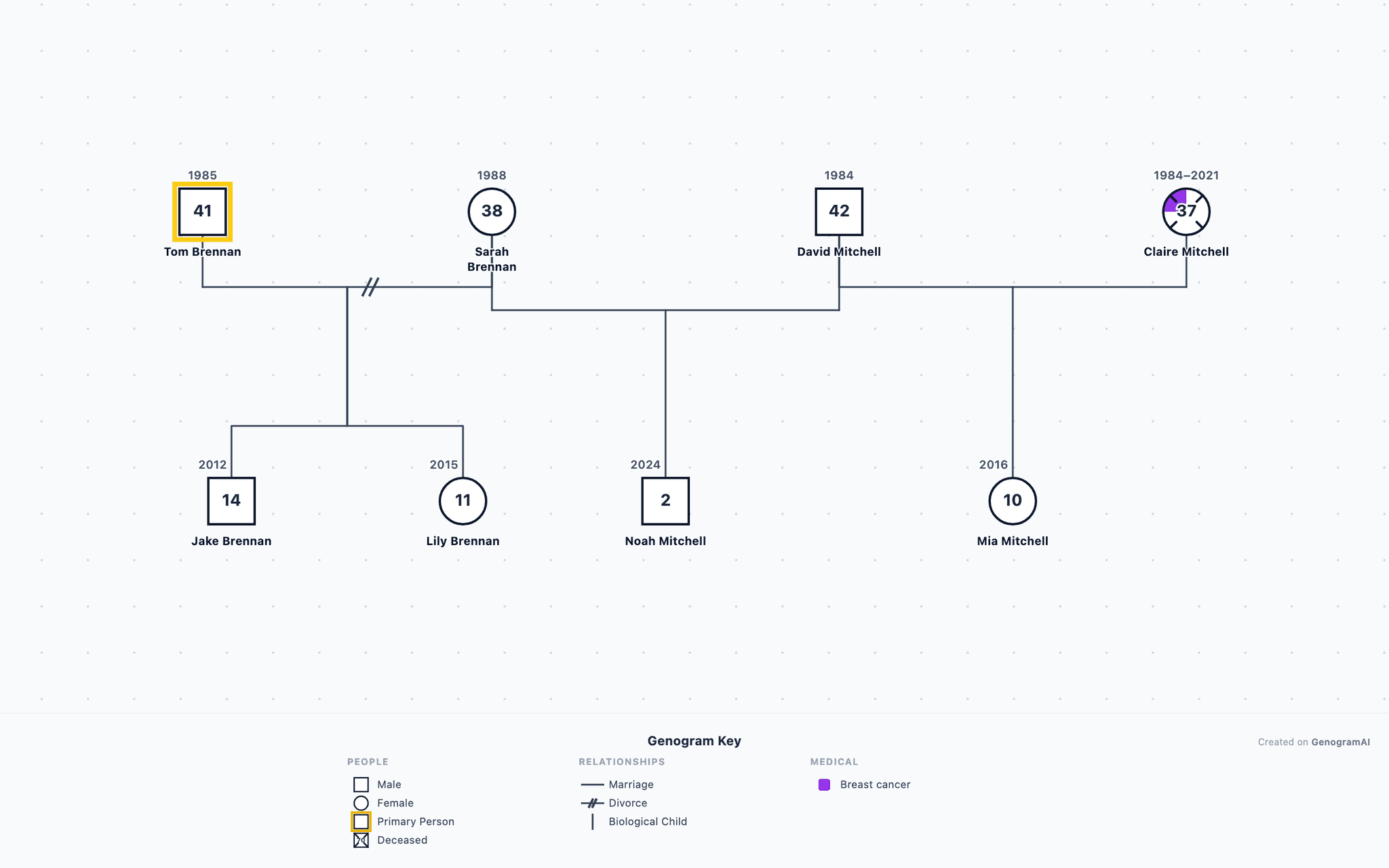
Brennan-Mitchell Family Genogram
Sarah Brennan (38) and David Mitchell (42) present for couple therapy, reporting constant conflict about parenting. They have been married for three years.
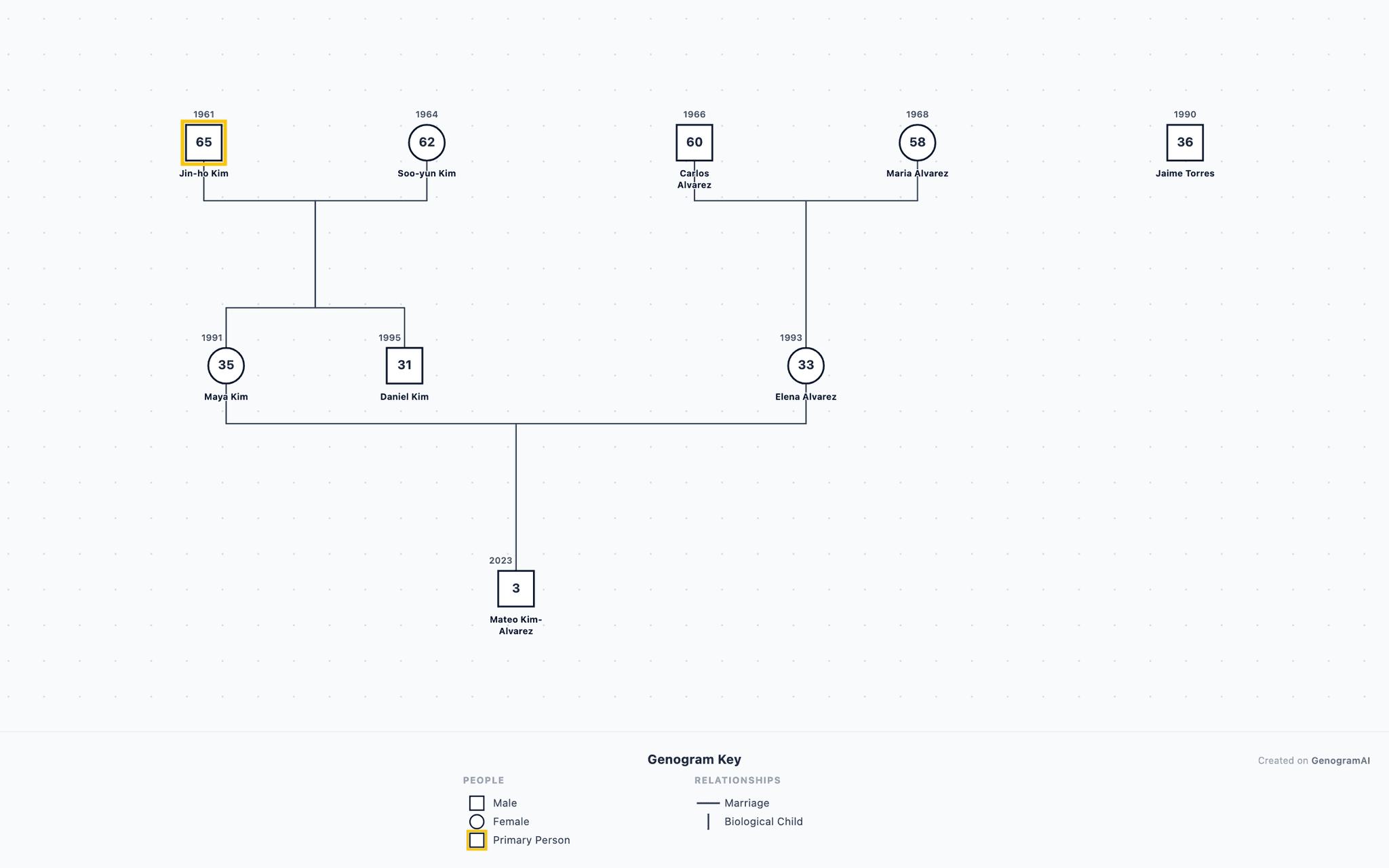
Kim-Alvarez Family Genogram
Maya Kim (35) and Elena Alvarez (33) present for family therapy.
Create Your Own Genogram
Use GenogramAI to build your own family genogram with AI assistance. Describe your family and let AI do the rest.
Educational disclaimer: This genogram example is an educational illustration of genogram notation and family systems concepts. Examples based on public figures use publicly available information. They are not clinical documents. All examples are intended for learning genogram symbols and patterns.