3-Generation Genogram Template
The standard genogram format — grandparents, parents, and children mapped in one clear diagram.
Template Preview
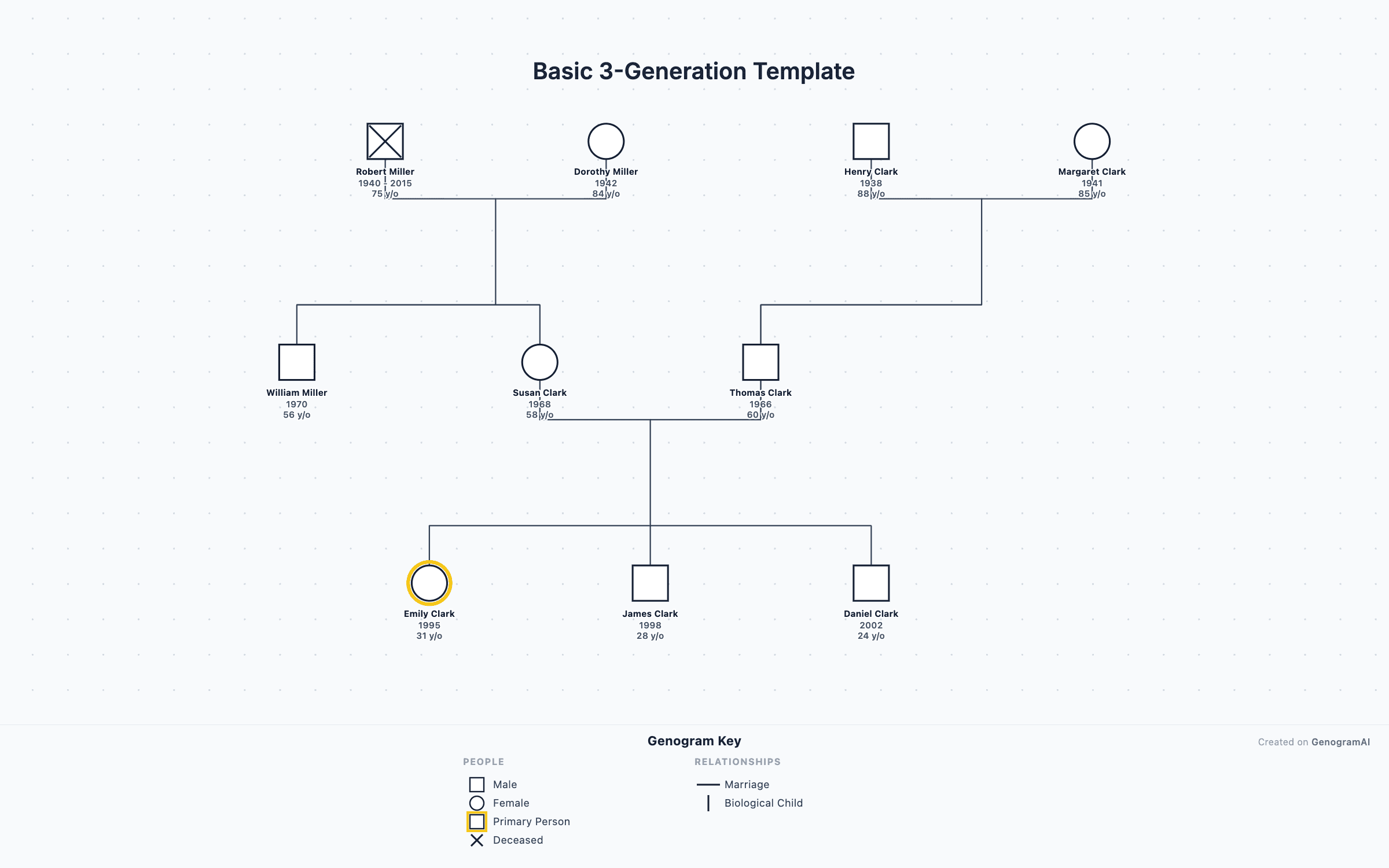
Example genogram created with GenogramAI — 3-Generation Genogram
Who Uses This Template
Students, therapists, social workers, nurses, and anyone creating a genogram for the first time.
Common Use Cases
- Clinical intake assessment across all mental health disciplines
- Graduate school genogram assignments (MSW, MFT, counseling, nursing)
- Family medicine 3-generation health history documentation
- Personal family history projects
- Teaching and training demonstrations
How to Use This Template
Start with the middle generation
Draw the parents (or presenting couple) in the center of the page. Place males as squares, females as circles. Connect them with a relationship line.
Add grandparents above
Place paternal grandparents (father's parents) on the upper left, maternal grandparents on the upper right. Connect each set of grandparents to their child.
Add children below
Draw children below the middle generation, connected by a horizontal sibship line dropping from the couple line. Order from left (oldest) to right (youngest).
What's Included
Skip the blank template
Describe your family in plain English — GenogramAI builds it for you instantly.
Frequently Asked Questions
What is a 3-generation genogram?
A 3-generation genogram is the standard genogram format that maps three generations of a family: the presenting person or couple (Generation II), their parents (Generation I), and their children if any (Generation III). McGoldrick and Gerson established 3 generations as the minimum for clinical genograms because patterns often require at least this span to become visible. Most graduate school genogram assignments, clinical intake protocols, and medical family history guidelines use the 3-generation format.
How do I draw a 3-generation genogram?
To draw a 3-generation genogram: (1) Draw the presenting couple in the center (squares for males, circles for females, connected by a horizontal line). (2) Add paternal grandparents upper-left and maternal grandparents upper-right, each connected to their child by a vertical line. (3) Add children below the couple, hanging from a horizontal sibship line. (4) Add relationship line types (solid = married, dashed = cohabiting, double slash = divorced) and any relevant annotations. GenogramAI generates this automatically from a text description.
How many people does a 3-generation genogram typically include?
A standard 3-generation genogram typically includes 10-20 people: 4 grandparents, 2 parents (plus their siblings and any step-parents), and the children of the presenting couple. Extended versions include aunts, uncles, and cousins. The size depends on family complexity — blended families, adoption, and large sibling groups can increase the count significantly.
Do I need software to make a 3-generation genogram?
No — genograms can be drawn by hand on paper, which many clinicians prefer for in-session use. However, digital tools like GenogramAI offer advantages: automatic symbol placement, cloud storage, easy editing when family composition changes, and professional export as PNG or PDF. For assignments requiring submission, a digital genogram typically looks more polished than a hand-drawn version.
Further Reading
- McGoldrick, M., Gerson, R., & Petry, S. — Genograms: Assessment and Treatment (4th ed.). W.W. Norton & Company, 2020
- Carter, B. & McGoldrick, M. — The Family Life Cycle: A Framework for Family Therapy. Gardner Press, 1980