Medical Genogram Template
Track hereditary conditions and genetic risk factors across three generations of family health history.
Template Preview
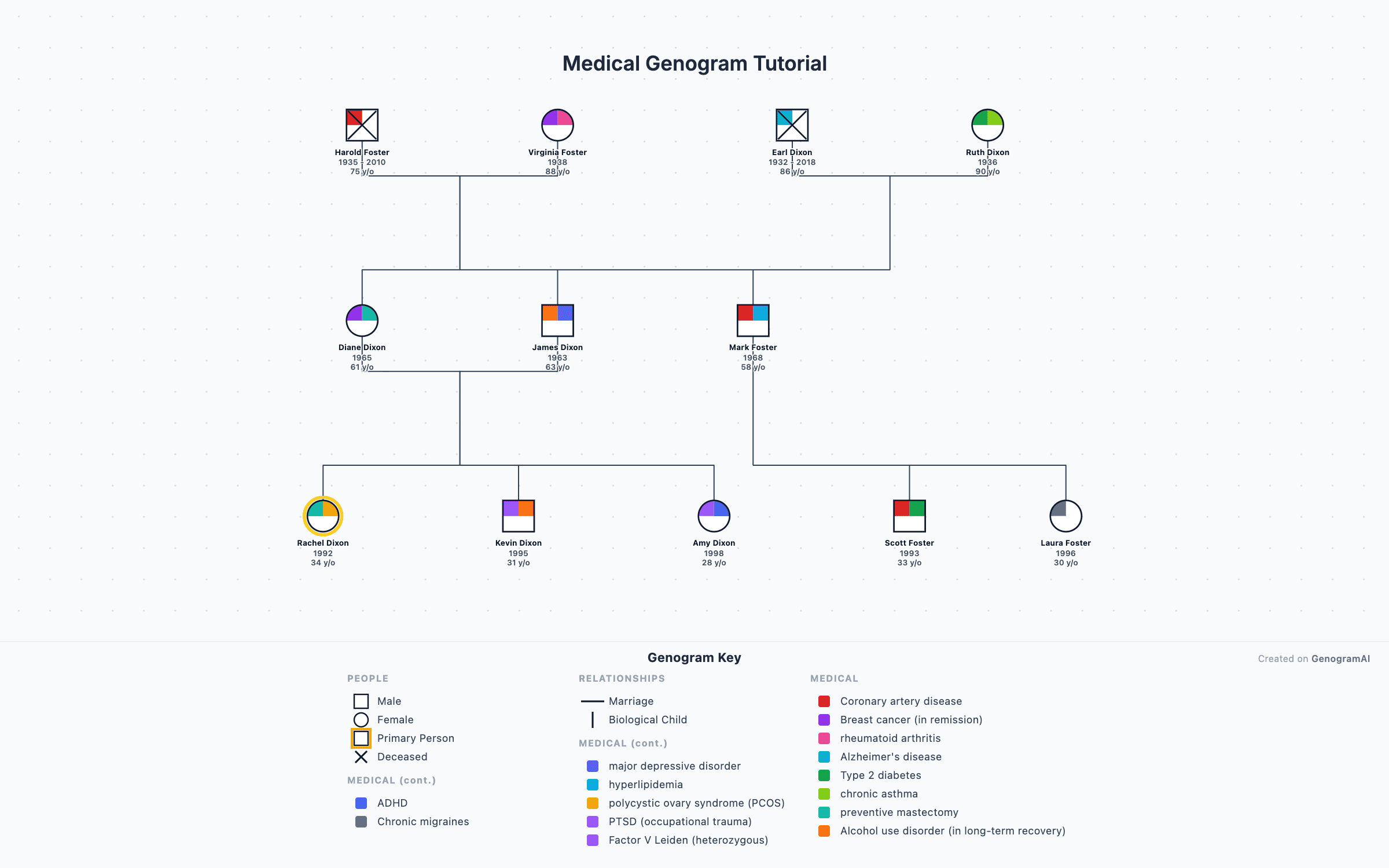
Example genogram created with GenogramAI — Medical Genogram
Who Uses This Template
Primary care physicians, genetic counselors, family medicine practitioners, and medical students.
Common Use Cases
- Family health history intake in primary care and preventive medicine
- BRCA and hereditary cancer risk assessment
- Cardiovascular disease and diabetes family pattern mapping
- Genetic counseling pre-appointment documentation
- Medical school and nursing school family history assignments
How to Use This Template
Map three biological generations
Record all first-degree relatives (parents, siblings, children) and second-degree relatives (grandparents, aunts, uncles). Note ages and age at death.
Document health conditions
Use medical quadrants to record diagnoses for each family member. Quadrants fill in the order you add the conditions — top-left, top-right, bottom-left, then bottom-right — and the colour key on the chart records which condition each one represents, so pick an order and keep it consistent across the family. Beyond four conditions the symbol switches from quadrants to pie slices.
Identify hereditary patterns
Shade affected individuals for specific conditions. Note age of onset, severity, and treatment. Circle clusters that suggest hereditary risk.
What's Included
Skip the blank template
Describe your family in plain English — GenogramAI builds it for you instantly.
Frequently Asked Questions
What is a medical genogram?
A medical genogram is a family health history diagram that maps inherited diseases, genetic conditions, and health patterns across three or more generations. It uses standard genogram symbols (squares for males, circles for females) with medical annotations — typically quadrant shading or coded labels — to show which relatives have which conditions, their age of onset, and cause of death. Medical genograms are used in primary care, genetic counseling, oncology, and cardiology.
What information goes in a medical genogram?
A medical genogram documents: age and date of birth for each relative, age and cause of death for deceased members, significant diagnoses (heart disease, cancer, diabetes, psychiatric conditions), age of diagnosis onset, surgical history, medications, and known genetic mutations (e.g., BRCA1/2, APOE). Ethnic background is also noted, as it affects genetic risk profiles for certain conditions.
How many generations should a medical genogram include?
A minimum of three generations is standard for medical genograms: the patient's generation, the parents' generation, and the grandparents' generation. For genetic counseling or hereditary cancer risk assessment, extending to four generations or including siblings of grandparents may be requested. The American College of Medical Genetics recommends a minimum 3-generation family history for all new patients.
Is a medical genogram the same as a pedigree chart?
They are closely related but differ in scope. A pedigree chart in genetics focuses specifically on the transmission of one trait or gene across generations, using standardized symbols for affected/unaffected status, carriers, and inheritance patterns. A medical genogram is broader — it captures multiple conditions, psychosocial factors, and relationship dynamics simultaneously. Clinicians use medical genograms; research geneticists typically use pedigree charts.
Further Reading
- McGoldrick, M., Gerson, R., & Petry, S. — Genograms: Assessment and Treatment (4th ed.). W.W. Norton & Company, 2020
- Berg, A.O. et al. — Family Health History in Clinical Practice. American Journal of Preventive Medicine, 2009
- Blazer, K.R. & Weitzel, J.N. — Genetics in Primary Care: A Faculty Development Initiative. Annals of Family Medicine, 2014