Nursing Genogram Template
Document family health patterns and social support systems for community and family nursing practice.
Template Preview
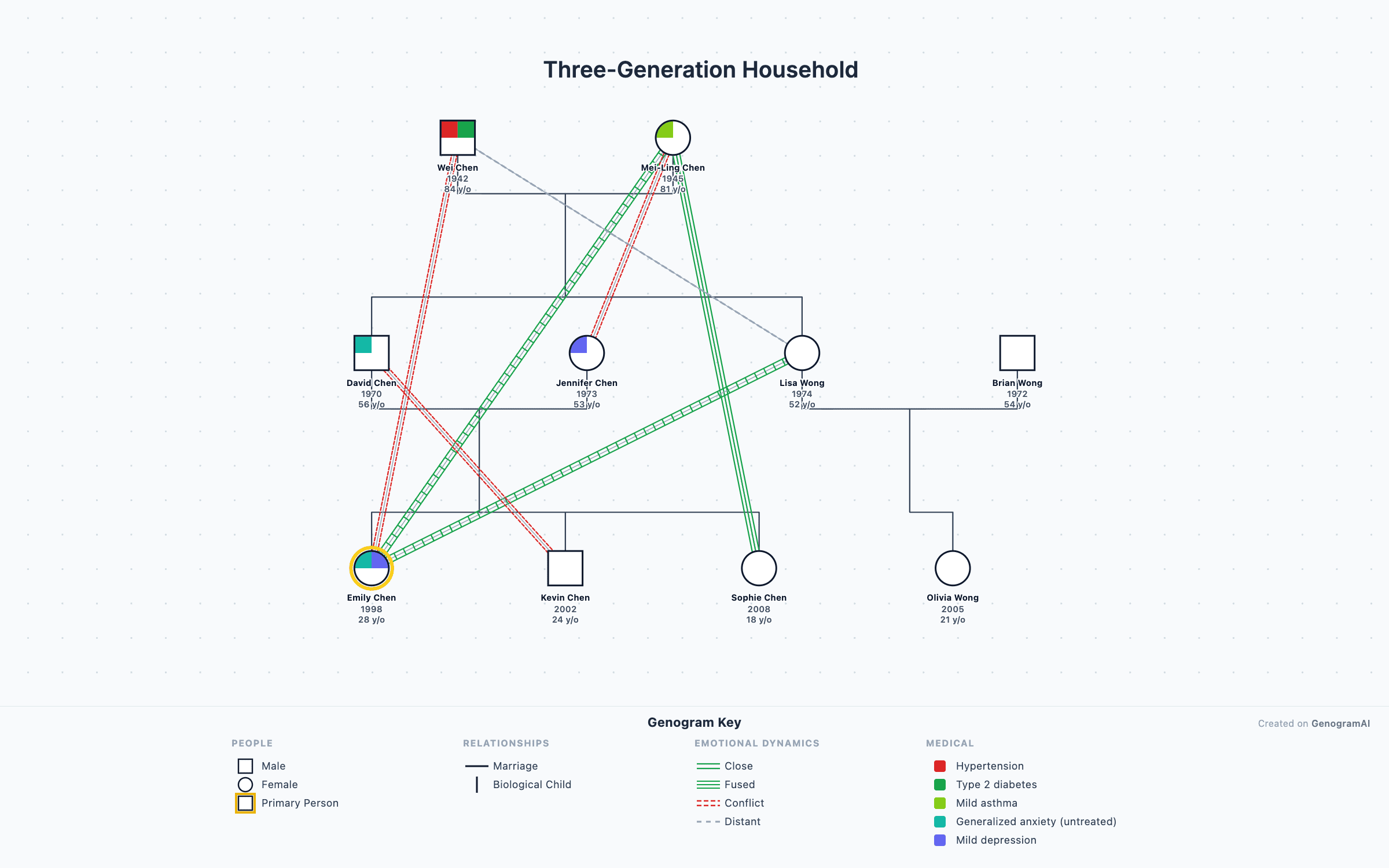
Example genogram created with GenogramAI — Nursing Genogram
Who Uses This Template
Community health nurses, family nurse practitioners, BSN and MSN nursing students, and nursing faculty.
Common Use Cases
- Community health nursing family assessments (NLN competency)
- Family nurse practitioner initial intake and health history
- Pediatric and maternal-child nursing family mapping
- Chronic disease management — identifying family support and risk
- Nursing school practicum and clinical assignment documentation
How to Use This Template
Map the household members
Begin with all current household members. Identify relationships: biological, adoptive, or chosen family. Note ages and primary diagnoses.
Add health history across generations
Extend to parents and grandparents. Document hereditary conditions, mental health diagnoses, and substance use patterns. Note age of onset and cause of death.
Integrate social support data
Pair with an ecomap to document external systems (healthcare providers, community services, employment, faith communities). Identify support gaps and strengths.
What's Included
Skip the blank template
Describe your family in plain English — GenogramAI builds it for you instantly.
Frequently Asked Questions
What is a genogram in nursing?
In nursing, a genogram is a family assessment tool that maps health history, hereditary conditions, and family relationships across three or more generations. Nursing students and practitioners use genograms as part of family-centered care assessments — particularly in community health nursing, family nursing, and maternal-child nursing. The National League for Nursing (NLN) includes genogram competency in its community health nursing curriculum.
What is the difference between a genogram and an ecomap in nursing?
A genogram maps the family system — biological relationships, health history, and intergenerational patterns. An ecomap maps the family's connections to external systems: healthcare providers, schools, employers, community organizations, and social services. In nursing practice, genograms and ecomaps are often used together: the genogram reveals internal family structure and risk, while the ecomap reveals external supports and stressors. Together, they provide a complete picture for care planning.
How do nursing students use genograms in clinical assignments?
Nursing students are commonly assigned to create a family genogram as part of community health or family nursing courses. The assignment typically requires interviewing a family (or using a fictional case study), mapping three generations, documenting health conditions, and writing a clinical analysis identifying health patterns and care implications. GenogramAI allows nursing students to create professional genograms from interview notes and export them as PNG or PDF for assignment submission.
Do nurse practitioners use genograms in practice?
Yes — family nurse practitioners (FNPs) and pediatric nurse practitioners (PNPs) use genograms during initial intake appointments to document family health history, identify hereditary risk factors, and understand the family context for treatment. Genograms are particularly valuable for managing chronic conditions (diabetes, hypertension, mental health) where family patterns directly affect patient risk and adherence.
Further Reading
- Wright, L.M. & Leahey, M. — Nurses and Families: A Guide to Family Assessment and Intervention (7th ed.). F.A. Davis Company, 2019
- McGoldrick, M., Gerson, R., & Petry, S. — Genograms: Assessment and Treatment (4th ed.). W.W. Norton & Company, 2020
- Anderson, E.T. & McFarlane, J. — Community as Partner: Theory and Practice in Nursing (8th ed.). Wolters Kluwer, 2018