Social Work Genogram Template
Document complex family structures for case assessments, child welfare, and intervention planning.
Template Preview
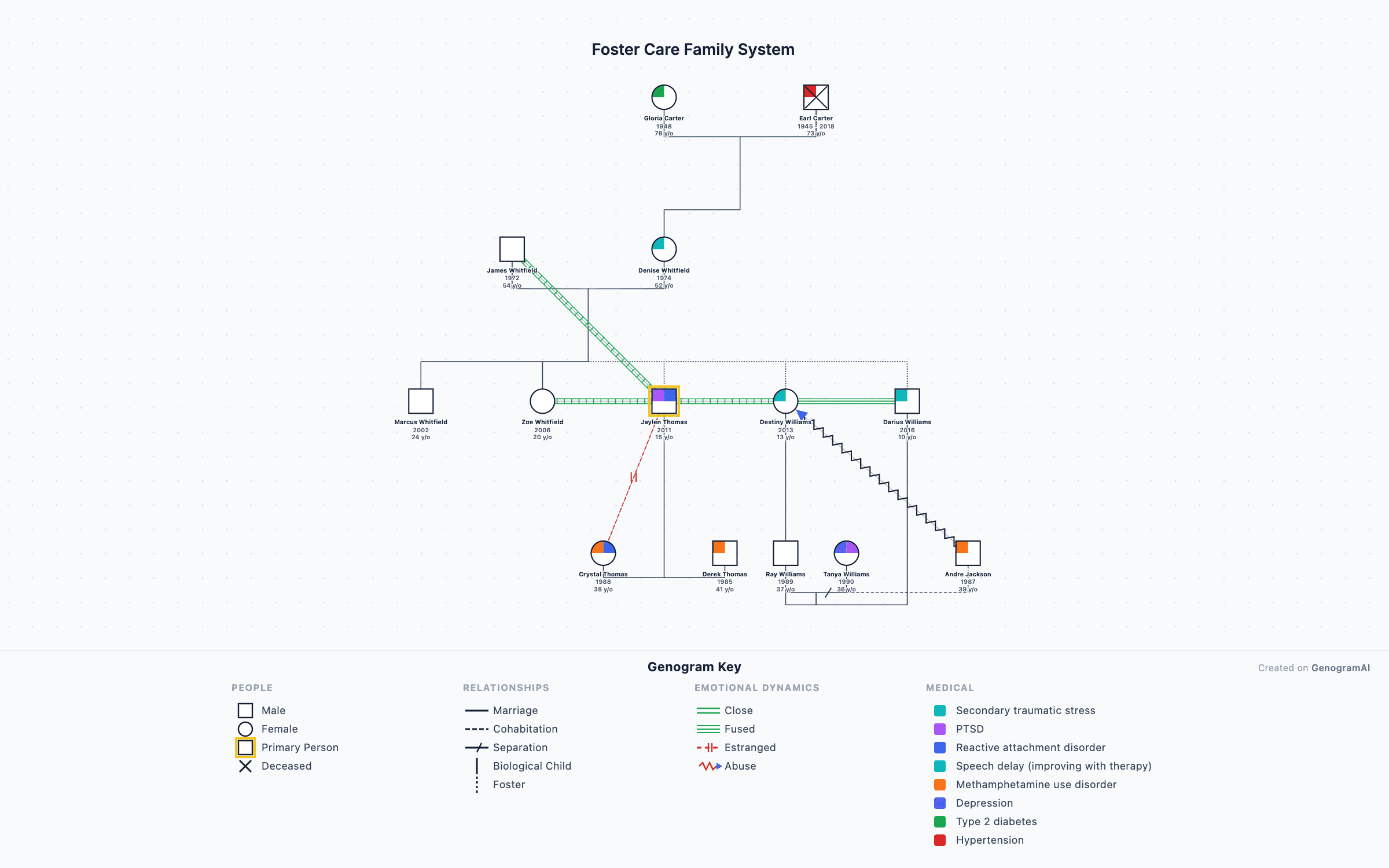
Example genogram created with GenogramAI — Social Work Genogram
Who Uses This Template
Licensed clinical social workers (LCSWs), child protective service workers, case managers, and BSW/MSW students.
Common Use Cases
- Child welfare assessments and family reunification planning
- Foster care and kinship placement documentation
- Adult protective services case mapping
- Community-based family support program assessments
- MSW practicum and field placement assignments
How to Use This Template
Identify the presenting family unit
Place the child or individual at the center. Map all household members and their legal relationships (biological, foster, adoptive, kinship).
Extend to key support systems
Add extended family members, especially those involved in care decisions. Note involvement of service systems (CPS, courts, schools, healthcare).
Document risk and protective factors
Annotate substance use history, domestic violence, mental health diagnoses, employment, and housing stability. Highlight strengths alongside risks.
What's Included
Skip the blank template
Describe your family in plain English — GenogramAI builds it for you instantly.
Frequently Asked Questions
What is a genogram in social work?
In social work, a genogram is a visual assessment tool that maps family structure, relationships, and patterns across at least three generations. Social workers use genograms to document complex family systems — including biological, foster, adoptive, and kinship relationships — and identify risk factors, protective factors, and intervention points. The NASW Code of Ethics supports using strengths-based assessment tools like genograms.
How is a social work genogram different from a therapy genogram?
Social work genograms emphasize structural relationships, legal arrangements (custody, guardianship, foster placement), and service system involvement. Therapy genograms focus more on emotional relationship quality and multigenerational patterns. Social work genograms also typically document concrete factors: housing, employment, substance use, and criminal history, whereas therapy genograms annotate attachment styles and emotional dynamics.
Do social workers need to know how to draw a genogram?
Yes — genogram creation is a core competency in BSW and MSW programs, covered in practice courses. Social workers use genograms in intake assessments, case planning, family meetings, and court documentation. Digital tools like GenogramAI accelerate genogram creation without sacrificing clinical accuracy, and export formats (PNG, PDF) are accepted in most case management systems.
What genogram symbols are used for adoption and foster care?
Standard social work genogram notation uses a dashed line to indicate adoptive relationships (contrasted with solid lines for biological), and a dotted line for foster placements. The symbol key should always be included with any genogram used in official documentation. GenogramAI includes all standard adoption, foster, and kinship placement symbols.
Further Reading
- McGoldrick, M., Gerson, R., & Petry, S. — Genograms: Assessment and Treatment (4th ed.). W.W. Norton & Company, 2020
- Hepworth, D.H., Rooney, R.H., Rooney, G.D., & Strom-Gottfried, K. — Direct Social Work Practice: Theory and Skills (11th ed.). Cengage Learning, 2022
- Saleebey, D. — The Strengths Perspective in Social Work Practice (6th ed.). Pearson, 2012