Grief Counseling Genogram Template
Map loss history, complicated grief, and intergenerational bereavement patterns across the family system.
Template Preview
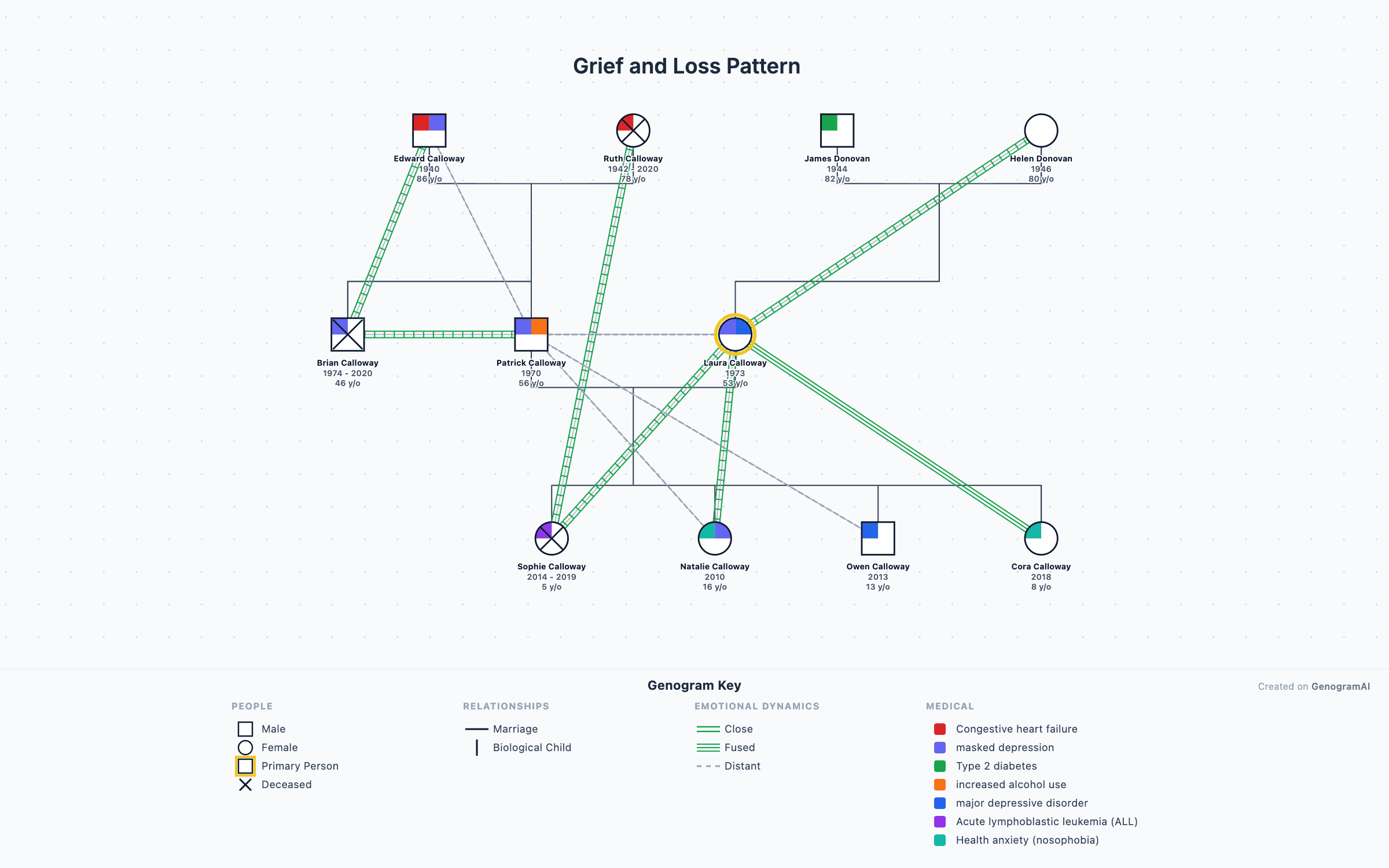
Example genogram created with GenogramAI — Grief Counseling Genogram
Who Uses This Template
Grief counselors, bereavement therapists, hospice social workers, chaplains, and graduate counseling students.
Common Use Cases
- Mapping loss history in complicated grief assessment
- Identifying anniversary reactions and transgenerational grief
- Hospice family assessment and bereavement follow-up planning
- Traumatic loss — suicide, homicide, sudden death documentation
- Children's grief counseling — understanding family loss context
How to Use This Template
Map all significant losses
Document all deceased family members with age at death, cause of death, and date. Note miscarriages, stillbirths, and early childhood losses which are often invisible but clinically significant.
Annotate grief responses
Mark family members who experienced prolonged or complicated grief. Note anniversary dates, unresolved mourning, and family taboos around discussing specific deaths.
Identify relational shifts after loss
Explore how the family system reorganized after major deaths — who took on new roles, what relationships became closer or more distant, and what meaning was made of the loss.
What's Included
Skip the blank template
Describe your family in plain English — GenogramAI builds it for you instantly.
Frequently Asked Questions
How is a genogram used in grief counseling?
In grief counseling, genograms map all significant losses across at least three generations — including deaths, miscarriages, and disenfranchised losses. This reveals patterns of complicated grief (e.g., multiple losses in the same generation), anniversary reactions (grief that activates around anniversaries of deaths), and transgenerational transmission of unresolved mourning. McGoldrick's work on loss and the family life cycle established the genogram as a central tool in grief-informed family therapy.
What is transgenerational grief?
Transgenerational grief refers to grief patterns, attitudes about death, and unresolved mourning that are transmitted from one generation to the next — often without explicit discussion. A grandparent's unprocessed grief over a sibling's death during wartime may shape how the family communicates about loss for generations. Genograms make these invisible transmissions visible, which is often the first step toward resolution.
Should genograms include miscarriages and stillbirths?
Yes — perinatal losses including miscarriages, stillbirths, and infant deaths are clinically important and are often omitted from family histories. These losses can have significant impacts on family dynamics, attachment patterns, and subsequent parenting. Standard genogram notation uses a small X within a circle or square to indicate miscarriage, and a smaller symbol for stillbirth. GenogramAI includes these notation options.
How do I create a grief genogram with a client?
Creating a grief genogram with a client in session is itself a therapeutic intervention. Begin by explaining the purpose — to map their family's relationship with loss. Work collaboratively, asking about each relative: "How old were they when they died? What was it like for your family?" Allow silences and emotional responses — these are data. The completed genogram often becomes a touchstone throughout grief work, returned to as new connections emerge.
Further Reading
- Walsh, F. & McGoldrick, M. — Living Beyond Loss: Death in the Family (2nd ed.). W.W. Norton & Company, 2004
- McGoldrick, M., Gerson, R., & Petry, S. — Genograms: Assessment and Treatment (4th ed.). W.W. Norton & Company, 2020
- Kübler-Ross, E. & Kessler, D. — On Grief and Grieving. Scribner, 2005