Addiction Counseling Genogram Template
Map multigenerational substance use patterns, enabling dynamics, and recovery resources.
Template Preview
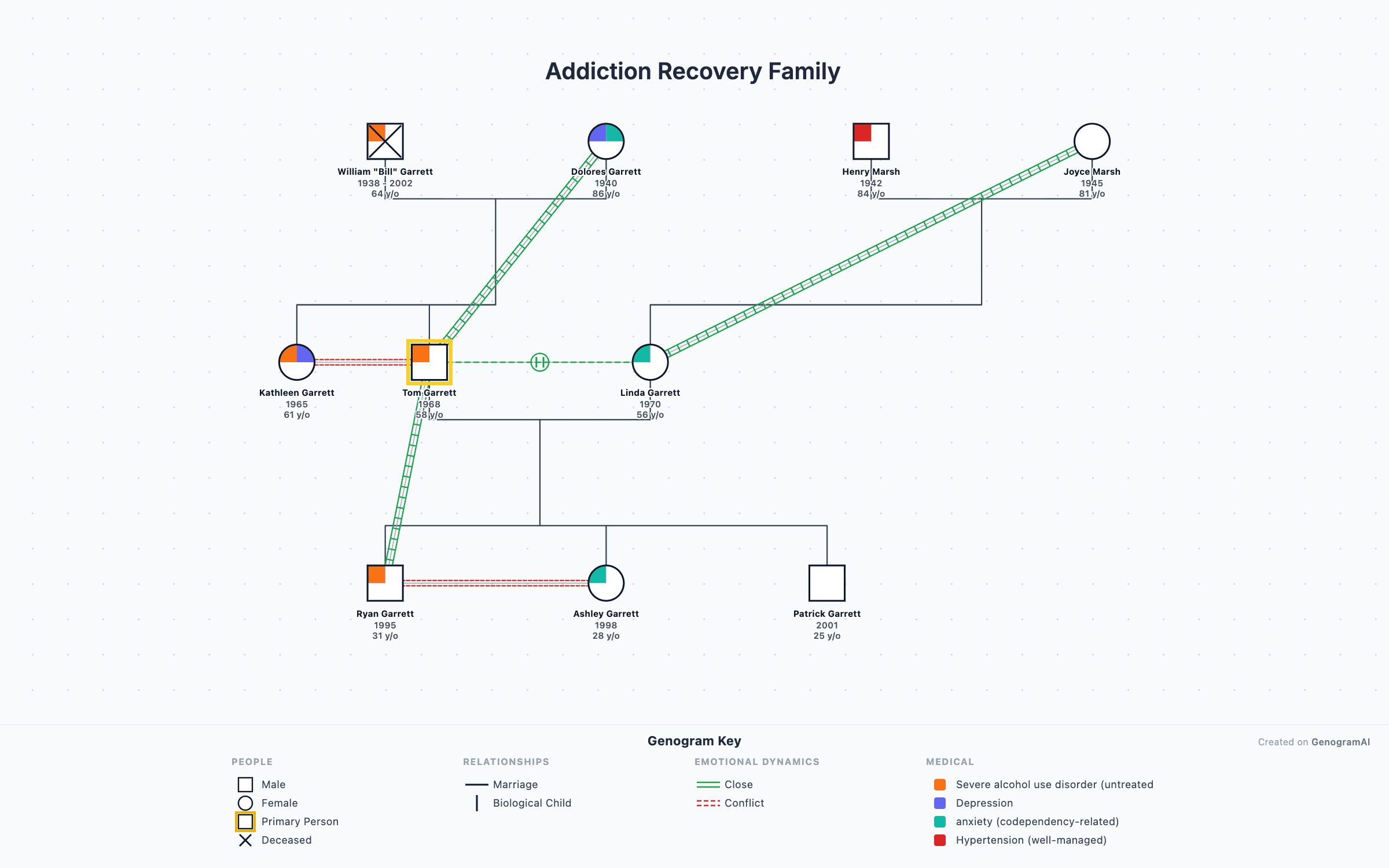
Example genogram created with GenogramAI — Addiction Counseling Genogram
Who Uses This Template
Substance use counselors (CADCs, LCADCs), addiction psychiatrists, recovery coaches, and chemical dependency counseling students.
Common Use Cases
- Identifying multigenerational addiction transmission patterns
- Mapping enabling and codependent family dynamics
- Assessing co-occurring mental health disorders in family context
- Family therapy in residential treatment programs
- CADC/LCADC clinical documentation and supervision
How to Use This Template
Map substance use across generations
Document all family members with known substance use history. Note substance type, duration, severity (use/abuse/dependence), and current status (active, recovery, deceased).
Identify relational patterns
Mark enabling relationships, codependency, emotional cutoffs, and recovery supports. Note which family members are in 12-step programs or other recovery communities.
Annotate co-occurring conditions
Record mental health diagnoses, trauma history, legal involvement, and employment instability alongside substance use. These patterns often cluster across generations.
What's Included
Skip the blank template
Describe your family in plain English — GenogramAI builds it for you instantly.
Frequently Asked Questions
Why is a genogram useful in addiction counseling?
Genograms reveal multigenerational addiction patterns that clients may not have consciously recognized. Research shows addiction has both genetic and environmental transmission components — seeing three generations of substance use mapped visually often creates powerful insight moments in therapy. Genograms also help counselors identify enabling relationships, codependency, family recovery resources, and co-occurring mental health patterns that inform treatment planning.
What does an addiction genogram include?
An addiction genogram documents: substance types used by each family member (alcohol, opioids, stimulants, etc.), severity and duration of use, current status (active use, in recovery, or deceased from substance-related causes), co-occurring mental health diagnoses, trauma history, relational dynamics (enabling, codependency, cutoff), and protective factors (family members in recovery, 12-step involvement, supportive relationships).
How do genograms help clients in addiction treatment?
Genograms create visual "aha moments" — when a client sees that alcohol use appears in their grandfather, father, two uncles, and older sibling, the pattern becomes undeniable. This counters minimization and increases motivation for change. In family therapy components of residential treatment, genograms help all family members see their roles in the family system. Research by Brown & Lewis (1999) and Steinglass (1987) supports family systems approaches in addiction treatment.
Is a genogram used in 12-step programs?
Genograms are not a standard part of 12-step programs (AA, NA), but they are commonly used by addiction counselors and family therapists who work with 12-step participants. In inpatient and outpatient treatment settings, genograms are often part of the clinical assessment conducted alongside 12-step work. They complement the 4th step (moral inventory) by externalizing family patterns.
Further Reading
- Steinglass, P., Bennett, L.A., Wolin, S.J., & Reiss, D. — The Alcoholic Family. Basic Books, 1987
- McGoldrick, M., Gerson, R., & Petry, S. — Genograms: Assessment and Treatment (4th ed.). W.W. Norton & Company, 2020
- Liddle, H.A. & Dakof, G.A. — Substance Abuse Treatment and Family Therapy. SAMHSA Treatment Improvement Protocol (TIP) 39, 2004